
This Way Up: Spiritual Means to Psychological Ends
The Torah Through Eastern Eyes: A Five Element Midrash
A Five Element Commentary on the Hidden Design of Creation
Throughout Jewish history, the Torah has invited interpretation through the lenses of other cultures. The Aramaic commentary of Onkelos, a Greek convert to Judaism, became an authoritative translation and interpretation of the Torah, demonstrating how foreign eyes—steeped in other traditions—can bring forward fresh perspectives.
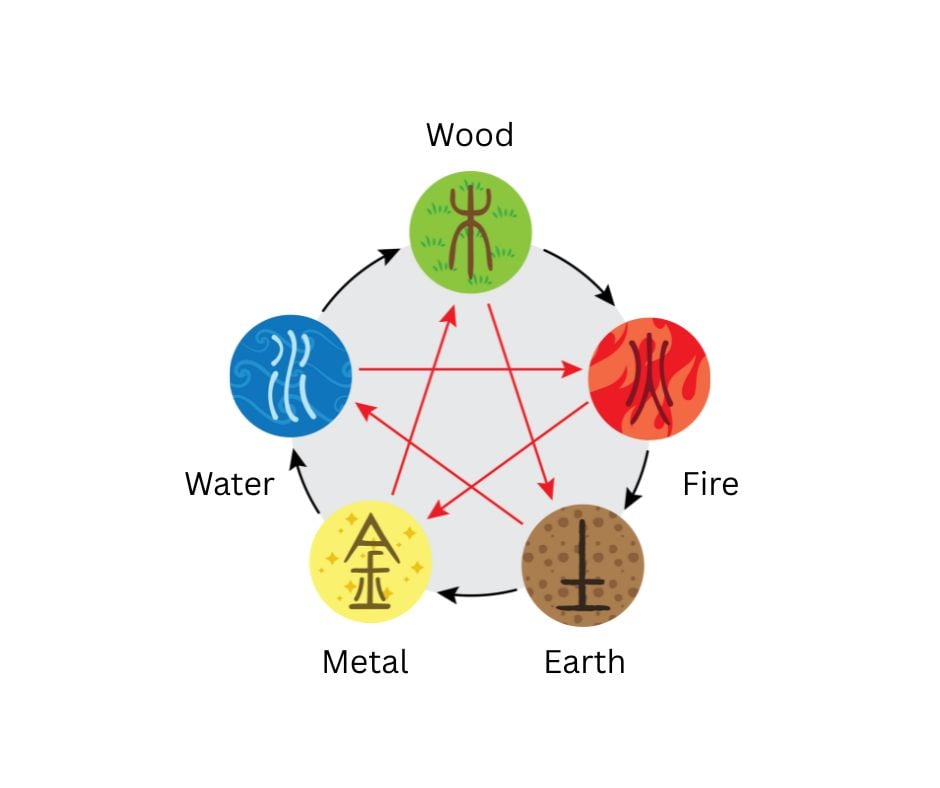
What if the same interpretive generosity were extended eastward? What if, instead of a Greco-Roman lens, we held the Torah up to the mirror of Chinese Five Element Theory—an ancient system that describes the world as governed by five dynamic phases: Water, Wood, Fire, Earth, and Metal?
What insights would a Taoist sage bring to our sacred stories? What harmonies might we uncover if we let these two ancient streams flow together?
Elemental Glimpses Behind the Curtain of Torah
Five Element Theory teaches us that each element both creates and controls others in a dynamic, never-ending cycle of transformation. These laws are not metaphors—they are patterns embedded in nature, in the body, in society, and, we might now suggest, in the Torah itself.
1. Moses Strikes the Rock: Metal Precedes Water
When Moses strikes the rock and water pours forth (Numbers 20), we are witnessing more than a miracle. A Chinese master might say this moment reveals an elemental law of the universe: Metal generates Water. In the Five Element generating cycle, Metal (which governs contraction, minerals, and structure) condenses and gives rise to Water (which governs flow, mystery, and life force).
What seems like a physical act becomes a cosmic unveiling. The rock is not just a rock—it is metal made manifest, and when Moses strikes it, the world’s hidden architecture briefly comes into view. We are shown the inner lawfulness of nature, where hardness gives birth to fluidity, and restraint begets renewal.
2. The Burning Bush: Wood Begets Fire
When Moses encounters the burning bush (Exodus 3), he sees a paradox: a flame that burns but does not consume. From a Five Element perspective, the scene is no longer just symbolic—it becomes elemental.
Wood generates Fire. The bush (Wood) produces Fire, but the Fire doesn’t destroy the Wood. Instead, it reveals a higher law: the energy of transformation (Fire) that arises from growth (Wood) without destruction. The bush that burns but is not consumed is an image of spiritual fire—an awakened state that illuminates but neither destroys nor depletes the self. Awakened consciousness is sustained by rootedness.
3. The Tabernacle: Controlled Wood, Encased in Metal
The Mishkan, or Tabernacle, is built from acacia wood, but its beams are plated with gold and silver—both metals. Why this combination?
According to the controlling cycle of the Five Elements, Metal controls Wood. Wood represents growth, initiative, and expansive force—but when unchecked, Wood can become impulsive, angry, and scattered. Metal represents refinement, clarity, and restraint.
The Tabernacle’s structure reflects this cosmic balance. The human functional impulse (Wood), when it is channeled towards the task of building a sacred home for G-d, must be held, contained, and even controlled by discipline and precision (Metal). Gold and silver encase the creative urge, preventing spiritual fire from becoming egoic chaos. What looks like design becomes a spiritual teaching: the holy vessel is one that is necessarily shaped by boundaries.
Beginnings in Water: A Shared Cosmology
In both Torah and Five Element Theory, Water marks the origin of the cycle.
In the Torah, the first element to appear isn’t light—it’s water: “the spirit of G-d hovered over the face of the waters” (Genesis 1:2). Creation emerges not from fire or earth, but from the deep, the unknown, the fluid—what the Chinese would call Water.
Many new beginnings in Genesis occur by a well. Isaac meets Rebecca at a well. Jacob meets Rachel at a well. Moses meets Zipporah at a well. Important relationships so often have their beginning at the edge of water—the threshold between the known and the mysterious. And Water, is, after all, the first of the five elements in the Chinese model!
And yet, the Torah never tells us how water was created. Like in Five Element Theory, Water is the mystery before beginnings. The cycle begins in Wood, but Water is always the unseen source.
Thus, the Tree of Knowledge and the Tree of Life—central features in the Garden—are, effectively, Wood arising from the mystery of Water. This sequence fits precisely into the generating cycle wherein each of the following elements generates the one that follows: Water → Wood → Fire → Earth → Metal → Water, and so on.
Toward a Five Element Commentary of Torah
A Five Element reading of Torah doesn’t replace Jewish interpretation—it complements it. It offers a second voice in the sacred dialogue, a kind of “Eastern Onkelos,” whose insights reveal that the Torah doesn’t only speak Hebrew.
-
The Exodus becomes a Wood story—rebellion against limitation, the bursting forth from Mitzrayim (Egypt).
-
Shavuot becomes a Fire moment—revelation, clarity, intensity.
-
Yom Kippur aligns with Metal—introspection, judgment, precision.
-
Sukkot is Earth—harvest, grounding, integration.
-
And the rainy season returns us to Water—the dissolution and renewal of self.
Conclusion: A Meeting of Worlds
Jewish tradition thrives on multiplicity—on the interplay between levels of meaning that include the literal but encompass the symbolic or even the mysterious; between Sephardic and Ashkenazic, mystic and rationalist. What if we now invited the Five Elements to sit at our table of commentators?
What would a Chinese sage say?
In both traditions, wisdom arises from harmony. The more languages we allow Torah to speak, the more we realize that revelation is not a one-time event. It is an ongoing dialogue between the human and the eternal—between East and West, water and fire, Heaven and Earth.
Related Topics
Related Posts