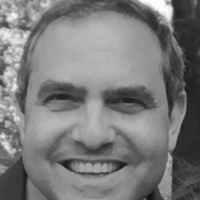
The Transatlantic Historian: Prof. Matthew Mark Silver (1961–2025)

Matthew Mark Silver (1961-2025)
Delivered at the 38th Annual Midwest Jewish Studies Association Conference, October 25, 2026
Thank you for being here to remember Professor Matthew Mark Silver: historian, teacher, colleague, and friend.
A memorial lecture invites us to consider more than a biographical sketch or a list of publications. It asks what a person taught us to notice, and how their way of seeing can continue to shape our own. The corpus of Silver’s scholarship illuminates the deep connections among American Jewish life, Zionism, Israel, and the Galilee. His work asks us to look across borders without assuming that borders tell the whole story. It prompts us to consider how ideas travel with people, how institutions are made through human effort, and how history unfolds not only through celebrated leaders and decisive events, but through migration, argument, care, persuasion, and daily choices.
Silver was born in the United States in 1961 and he grew up in Connecticut. After completing his undergraduate degree at Cornell University, he made aliyah to Israel in the mid-1980s. Launching his graduate work at the Hebrew University of Jerusalem, he completed his doctorate under the historian Dr. Eli Lederhendler. He taught modern Jewish history for decades at Max Stern Yezreel Valley College and the University of Haifa. A bilingual scholar, he wrote and worked in Hebrew and English, carrying ideas across linguistic as well as geographic boundaries. At the University of Haifa, he was a founding faculty member of the Ruderman Program, and he later served as a visiting scholar at several American universities.
These details suggest the intellectual position from which he worked. Silver studied American Jewish history from within Israeli academic life, and Israel and Zionism with a deep understanding of the American Jewish experience. He knew that historical narratives change as they cross languages and institutions, and that an event can look different from different shores—not because one perspective must be false, but because each is shaped by its own memories, expectations, and needs.
That recognition runs through his work. Silver does not treat American Jewish history, Zionism, and Israeli history as separate subjects that happen to meet. He studies them as histories linked from the beginning: through migration, correspondence, institutions, travel, fundraising, religious commitments, political debate, and the movement of people and ideas. The relationship between America and Israel, in his work, is not simply a story of one place influencing another. It is a story of encounter: people arrive with convictions and ambitions, meet unfamiliar circumstances, and change in ways they may not have expected.
This vision is already present in his first major book, First Contact: Origins of the American-Israeli Connection, published in 2006. Growing out of his doctoral research, the book examines American Jewish migrants who went to British Mandatory Palestine. These halutzim carried more than luggage. They brought political ideals, professional experience, practical skills, and expectations about how communities should be organized. They entered the Yishuv—the pre-state Jewish community—and sought to take part in a project that was national, communal, and intensely practical.
The word “contact” matters. Contact is not the same as harmony. It brings people together, but it can also reveal differences. The Americans shared a Jewish identity with the people among whom they settled, yet did not necessarily share their habits, assumptions, or priorities. Liberal and democratic ideals met the urgent needs and political realities of the Yishuv. Professional expertise could be welcomed, questioned, or adapted; hopes for belonging could collide with local structures. Silver does not reduce these tensions to a simple story of success or disappointment. He treats them as the substance of history.
Among the episodes he explores is the 39th Battalion of the Jewish Legion, which recruited young American Jews—many recent immigrants from Eastern Europe—to serve under British command during the First World War. Its story includes illness, loss, and conflict with British officers. Silver’s account reminds us that enlistment is not an abstraction. It is a decision made by people whose lives have already been shaped by ideas and this-worldly affairs and commitments, and whose hopes for collective belonging are tested by transformation, disease, and war.
In another chapter, Silver focuses on Judah Magnes, the Reform rabbi and Hebrew University president who advocated peaceful Arab-Jewish negotiations and a binational state. Magnes’s positions did not secure lasting influence among American Zionists. His story asks us to remember that political history is not only the history of ideas that prevail. It is also the history of ideas that become marginal, and of people who continue to argue for possibilities the prevailing sensibility rejects. In Silver’s account, Magnes exemplifies the difficult work of a communal leader responding to political pressure and urgent circumstances, one life and one decision at a time.
Together, these and other case studies show why First Contact provides such an important foundation for Silver’s career. The American migrants are connected to the Yishuv by Jewish identity, but subcultural differences can yield a variety of manifest attitudes and behaviors—from isolation, discouragement, and retreat to adaptation, networking, and innovation. The American-Israeli relationship begins not with settled assumptions, but with uncertain encounters: people trying to participate, negotiating belonging, and deciding what to accept, adapt, or resist.
Silver’s next major work turned from migration and institutional history to literature and public memory. In Our Exodus: Leon Uris and the Americanization of Israel’s Founding Story (2010), he examines the influence of Uris’s bestselling 1958 novel Exodus and Otto Preminger’s 1960 film, starring Paul Newman and Eva Marie Saint. The book asks how a novel and movie shape the way Americans imagine Israel, and how a story travels beyond the page and screen into public consciousness.
That question reaches beyond literary and film criticism. Popular fiction can become a historical intermediary: it can make distant people feel close while shaping the terms in which their lives are understood. Silver treats Exodus as a cultural force, exploring how the novel and film bring Israel’s founding story into the American mainstream. Fiction does not replace history; it participates in the shaping of public memory, offering readers a bridge between political realities and lives they might otherwise encounter only as headlines or abstractions.
Silver’s 2013 biography, Louis Marshall and the Rise of Jewish Ethnicity in America, which was a finalist for the National Jewish Book Award, explores the life of the towering New York lawyer of Central European ancestry at the center of Jewish organizational and political affairs in the early twentieth century. Its subject is not only one extraordinary career, but the formation of a recognizable American Jewish identity in a society that often asks immigrants and minority groups to explain how and where they belong.
Silver organizes Marshall’s life into four phases: patrician reformer, organizational architect, wartime leader, and, for the 1920s, “Marshall Law.” The framework helps us follow the evolution of Marshall’s responsibilities and influence, while also raising questions about how any historical structure shapes what we see. Critics of biography as a form note that the phases can seem too tidy: a person’s life and character rarely conform to the boundaries historians draw. Yet the framework invites productive questions. How does a lawyer become an institutional leader? How does a public figure bring together groups with competing interests? How does advocacy become a tool for building a broader communal voice?
Silver’s account of Marshall’s role in the American Jewish Committee (AJC) offers a compelling answer. The organization’s early development depended on bringing disparate Jewish groups and competing leaders into a shared body. Silver portrays Marshall as the person who supplied a coherent vision and labored to make cooperation possible. The AJC did not emerge and grow simply because American Jewry needed such an organization. Someone—in this case Marshall—had to persuade, negotiate, draft, listen, revise, and persist; he was the indispensable force that launched what would become a pivotal American Jewish institution.
The same lesson appears in Silver’s treatment of Marshall’s campaign to abrogate the 1832 commercial treaty between the United States and Imperial Russia. The treaty promised equal treatment to American citizens residing in Russia; Marshall argued that Russia’s discriminatory policies toward Jews violated that commitment. He used his legal expertise and public influence to press the U.S. government to cancel the treaty and to mobilize a broader American Jewish community. Silver shows him translating the persecution of Jews in Russia into a question of treaty obligations and American responsibility—and turning a specific grievance into a cause that attracted political support beyond the Jewish community.
One of the biography’s most compelling sections concerns Marshall’s response to Henry Ford’s antisemitic campaigns in the Dearborn Independent. Silver places Marshall’s actions within a late-1920s climate shaped by the circulation of The Protocols of the Elders of Zion and the newspaper’s attacks on Jews. He also describes the fragmented responses of American Jewish leaders, which made collective action difficult.
Marshall’s strategy, as Silver reconstructs it, involved coordinated efforts: sponsoring a journalistic exposé of the Protocols, partnering with socialist activist John Spargo to criticize Ford publicly, and arranging a forceful statement supported by a wide coalition of Jewish organizations. Silver shows that responding to antisemitism took more than silence or outrage. It required strategy, coordination, and an understanding of public opinion, community divisions, potential allies, and the risks of a public campaign.
This attention to context is central to Silver’s method. To understand Marshall’s choices, Silver asks us to understand the world in which he made them: the political atmosphere, the language of prejudice, and the competing judgments within the Jewish community. Context can make a decision newly intelligible. A strategy that looks hesitant from a distance, as Silver demonstrates, was in fact a deliberate response to a complicated field of risks.
Silver continued his study of movement and connection in his 2014 Hebrew-language book, Beshlikhut hamaarav: Mabat akher al hahistoryah hayehudit hamodernit, translated as In Service of the West: A New Look at Modern Jewish History. Offering a highly original alternative interpretation of modern Jewish history, the book examines Jewish migration from Eastern Europe to both the United States and Mandatory Palestine. These migrations are often narrated separately, as if they belonged to different historical stories. Silver’s comparative method brings them into view together.
That comparison shows us that migration does more than transport people. It reveals the pressures, hopes, and inherited practices that shape their choices. Community politics, local culture, geography, and a sense of possibility all influence how people imagine a future. By studying migration to the United States alongside migration to Palestine, Silver illustrates how modern Jewish identity took shape through more than one route. The paths diverged, but they emerged from overlapping debates about modernity, belonging, safety, and collective life. As previewed by the book’s title, Silver contends that these massive demographic, cultural, and political movements ultimately interacted with and operated “in service of” Western geopolitical and cultural frameworks.
Silver’s conceptual and methodological strategy reached full expression in his 2020 book, Zionism and the Melting Pot: Preachers, Pioneers, and Modern Jewish Politics. Here he shifts attention from prominent leaders and influential ideologies to the people who built communities through practical, often uncelebrated work. He follows the lives and activities of preachers, fundraisers, emissaries, organizers, and migrants: people who facilitated emigration, created mutual-aid networks, generated and disbursed resources, and maintained connections across distance.
The book focuses on Ottoman Palestine, tsarist Russia, and the United States from the 1870s to the eve of the First World War, a period of mass migration, rising political antisemitism, and public debate about modernization. Its central insight is that efforts later understood as political did not necessarily begin as parts of a single, coherent program. They grew from inherited customs, religious obligations, and communal networks. Practical acts of support could and did acquire new political meanings over time.
This is a nuanced account of how modern Jewish politics developed in the decades that spanned the nineteenth and twentieth centuries. Silver does not suggest that ideas are unimportant, but he asks us to pay close attention to the ground in which ideas took root. Political identities formed not only through abstract belief, but through what people did together, especially under pressure. Zionism and American Jewish integration were not simply rival doctrines; they developed alongside one another through practical efforts to respond to shared crises and to build and sustain communal life.
Silver’s methodology matches the complexity of his subject. He moves among political and diplomatic history, literary criticism, biography, and institutional history. In Silver’s capable hands, lesser-known preachers, emissaries, and organizers appear alongside familiar figures such as Theodor Herzl and Emma Lazarus. A political leader may articulate a program, but local organizers make its consequences tangible. Lazarus’s iconic poem “The New Colossus” may give voice to an ideal, but communal activists and relationships carry that ideal into practice.
Together with his work on migration and political history, Silver developed a deep relationship with the Galilee, where he lived and worked for more than twenty years. That relationship resulted in two wide-ranging books: The History of Galilee, 47 BCE to 1260 CE: From Josephus and Jesus to the Crusades and The History of Galilee, 1538–1949: Mysticism, Modernization, and War. Together, these masterful studies trace centuries of religious, cultural, and political change.
The Galilee, in Silver’s view, was and is not simply a setting in which other histories happen. It has its own history—layered, continuous, and shaped by the people who live there. Historical writing can treat a region as a backdrop, a stage on which national events unfold. Silver’s work resists that reduction. His histories of the Galilee—and it is worth noting that he was already thinking about a third volume focusing on the second half of the twentieth century—make the region a living landscape with its own institutions, communities, memories, and transformations.
In many respects, Silver’s work on the Galilee reflected his larger vision and was a natural extension of a larger project. Whether he was writing about American Jews, Jewish migration, modern Jewish politics, Louis Marshall, or the Galilee, he worked against the assumption that local and global history are separate, disembodied subjects. His scholarship, down to a 2025 volume titled The Last Historian in Galilee: Three Essays on Money, Truth, and Power for Jews and Christians, connects explorations of identity, culture, and politics; public arguments and private concerns; grassroots organization and national leadership; regional experience and transnational movement; and the entangled histories of the Jewish people and the Land of Israel.
To remember Silver, then, is to remember not only what he wrote, but the kind of attention he practiced. His life as a scholar, teacher, and American-Israeli reflected his commitment to connection. He was a meticulous researcher, and that meticulousness served a larger aim: making complicated relationships visible. His bilingual work crossed the boundary between Hebrew and English scholarship; it included his private commitment to a bilingual Arab-Jewish school in the Lower Galilee. His teaching linked research to new generations of students. His institutional work, including his role as an architect of the University of Haifa’s Ruderman Program, helped create a place for American Jewish history within Israeli academic life.
A scholar’s legacy is sustained not only through books, but through classrooms, programs, conversations, and relationships that pass questions on to new generations. It is not a closed argument but rather an invitation to continue thinking. Silver’s work leaves us with urgent and complicated questions: How do people turn shared identity into collective action? How do migrants negotiate belonging in a community they have chosen? How do popular stories shape public memory? How do local practices become political movements? How do institutions make cooperation possible across deep differences? And how do we write histories that attend both to the famous and to the forgotten?
These questions do not have one final answer. Their value lies in the candor, care, and honesty with which they are asked and pursued.
And perhaps that is the deepest tribute we can offer to Professor Matthew Mark Silver. We can continue to look carefully at the connections his work brings into view, to resist turning complex histories into easy binaries, and to attend to people whose labor receives strikingly little attention. We can ask how communities were built, who was included, and what responsibilities followed from belonging. History, he would surely remind us, is not only something we inherit. It is something people make together—in institutions and arguments, journeys and acts of care, and choices that link one generation to the next. It is how people, ideas, and communities come into contact—and how, through that contact, they meet and change one another.
This memorial lecture was delivered at “20th-Century American Zionism and Culture: In Memory of Matthew Mark Silver,” a session of the Midwest Jewish Studies Association meeting, Sunday, October 25, 2026. Other panelists were Jessica Cooperman (University of Connecticut), Alan Levenson (University of Oklahoma), and Sean Martin (Western Reserve Historical Society).
Related Topics