
The Turkish Trap in Gaza
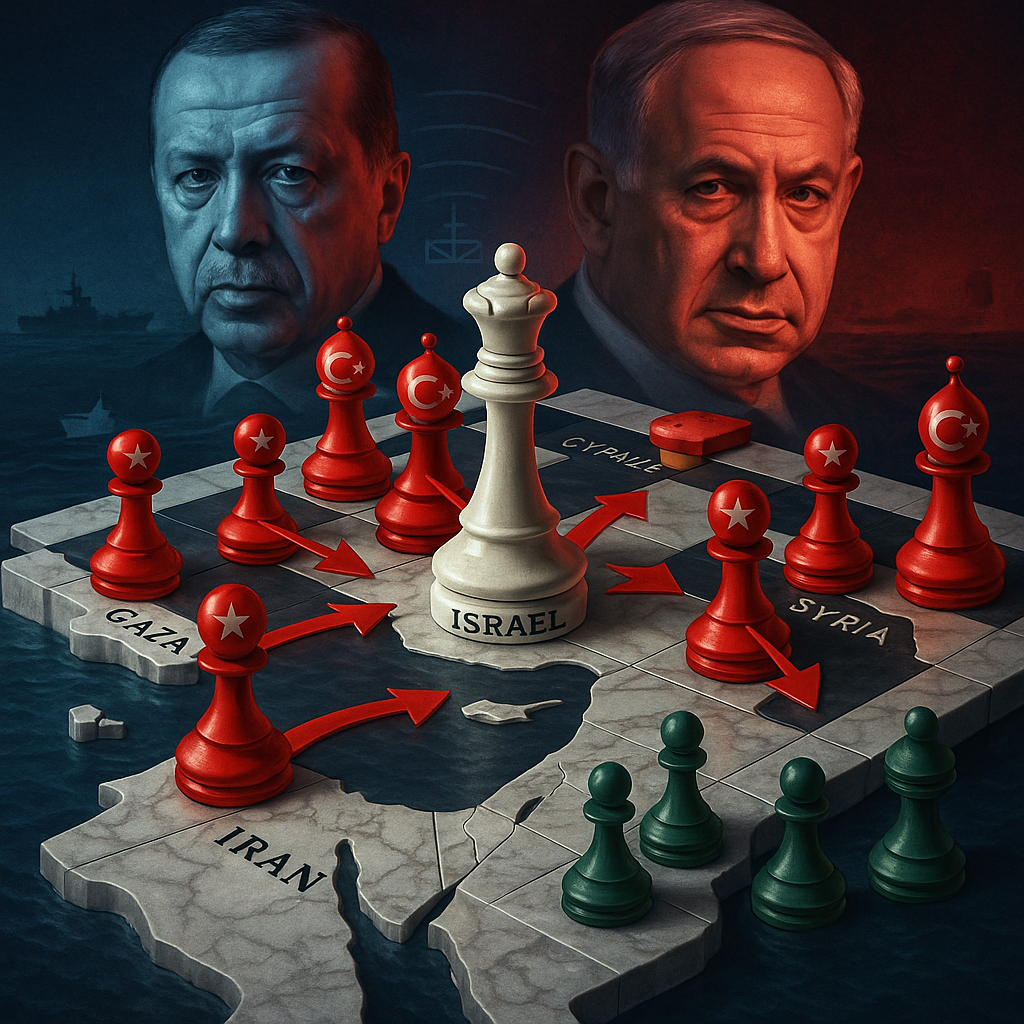
Has Israel just committed one of its greatest strategic blunders by agreeing to Trump’s peace plan, a deal that has allowed Erdogan’s Turkey an active presence in Gaza? Only days after the signatures, Turkish bulldozers, flags flying, were photographed in the Strip. After two years of intense fighting on multiple fronts, is this the endgame Israelis had been waiting for, a vociferous, hostile Erdogan expanding his military and political footprint on Israel’s northern border in Syria while now planting a foothold in Gaza?
Turkey is far more powerful than Iran in many respects: a NATO state with a well-trained, well-funded, battle-hardened military, an expanding navy, and a maturing domestic arms industry. It enjoys diplomatic mobility across regions and acts as a major trade conduit in the global economy. Put bluntly, compared to Turkey, Iran looks like a schoolyard rehearsal.
Erdogan dresses the part of a modern post-Ottoman statesman, but the rollback of Atatürk’s secular reforms over the past two decades has been profound. Turkey today behaves as an increasingly Islamist, autocratic actor. Political opponents and journalists are jailed at whim, the presidential model instituted by Erdogan has degraded representative government in Ankara, alliances with the Muslim Brotherhood and Iran are deepening, investments are funneled toward Islamist causes and proxies, and most worrying for Israel, Ankara has set its sights on the Jewish state as a principal regional antagonist. Erdogan has hosted Hamas leaders and permitted operational offices tied to the Al-Qassam Brigades to function openly in Turkey. Since October 7, 2023, his rhetoric, amplified by state-influenced Turkish media, has escalated to levels where armed hostility can no longer be dismissed as mere bluster.
Research outlets such as MEMRI have documented rhetoric that goes far beyond diplomatic posturing and instead appears designed to prepare the Turkish public for conflict. The examples are plentiful. On July 30, 2024, amid Israeli strikes in Lebanon, Erdogan warned, “Who can guarantee that those who today have their eye on Lebanon will not tomorrow extend their filthy hands elsewhere?” On October 1st, he claimed Israeli policies directly threatened Turkey: “Israel’s aggression also includes Turkey.” By June 18, 2025, he invoked Ottoman history: “We are following very closely Israel’s terror attacks on Iran… The victorious army of the Ottoman State had a principle: ‘If you desire peace, be prepared for war.’” Two days later he called for global action to “end Israel’s madness.” Turkish officials have accused Israel of genocide in Gaza, labeled a raid on a flotilla “piracy,” and on August 8, Turkish Communications Minister Burhanettin Duran declared, “The conscience of the world is strong enough to stop and defeat Israel.”
Meanwhile, Istanbul-sponsored charters and clerical statements, like the June 27 declaration signed by hundreds of Muslim clerics and organizations, have provided a religious veneer of legitimacy to Hamas’s conduct surrounding October 7.
This is the actor Netanyahu has now allowed into Gaza. The question is stark: is the remedy worse than the disease?
The temptation for mischief is undeniable for hostile forces in Istanbul. The possibilities are not difficult to imagine: leveraging Turkey’s new presence in Gaza to reorganize and train a local proxy force under Ankara’s thumb, as it did in northern Syria; building intelligence networks along Israel’s southern flank; and using its new proximity to Egypt to bring the two largest navies in the eastern Mediterranean into closer operational contact, thereby compressing Israel’s maneuverability along its maritime borders. This presence also gives Erdogan an endless supply of pretexts to move from incendiary rhetoric to kinetic engagement with Israel whenever it suits his timing or domestic needs.
Viewed in full measure — 1,200 massacred, the kidnapped and their families, the sacred sacrifice of 917 IDF soldiers, and billions spent over two years of Israel’s longest war — to now see Turkish flags flying in Gaza is nothing short of a catastrophic strategic failure. Whoever pressured or persuaded the Prime Minister into this arrangement bears responsibility, but ultimately the buck stops with him for opening this Pandora’s box. Allowing a clearly hostile Turkey, aligned with Hamas and its Islamist patrons, to embed itself on Israel’s southern border trades one ring of fire for another, and an even more dangerous one. Even the most amateur observer can see the thousand doors of mischief this opens for Erdogan and his jihadi allies.
Erdogan has sought influence inside Israel for years through gray-zone tactics: the Mavi Marmara, funding Islamist activity in Jerusalem, and building political and civil society footholds under the guise of humanitarian work. He has used the language of reconstruction and peace to pave a road into Israel’s south. Recall what one Turkish-sponsored militia leader, Ahmet Yiğit Yıldırım of the Ülkü Ocakları (“Idealist Hearths” or “Grey Wolves”), declared after seizing Damascus at the end of 2024: “We all saw the reflection in Syria of our leader’s words, ‘We may come suddenly one night.’ … After Damascus is stabilized and assured, inshallah, we will all see that the conquest of Jerusalem is near.”
And still, the escalation of words is taking strategic shape. Only last month, Erdogan’s likely successor, Turkish Foreign Minister Hakan Fidan, issued a thinly veiled threat regarding Israel’s alliance with Greece and Cyprus. In an interview with Turkish state television, he said: “There are attempts to encircle Turkey by certain states. We are watching this very closely.” He then added, “The government is developing diplomatic strategies to address this situation. If they fail, the case will be referred to the armed forces and security forces. Then we will see more.”
This week we saw what “diplomatic strategy” looks like, the election in Turkish-controlled East Cyprus of an Erdogan loyalist, followed by calls for the annexation of East Cyprus into Turkey. The bouncing ball isn’t hard to follow.
It is often said that Israel excels at tactics but falters at strategy. Netanyahu has kept the nation in the dark about his post-war vision for Gaza. What is emerging under the Trump peace plan looks less like resolution and more like a nightmare, replacing Iranian influence with Turkish, not removing the jihadi threat but mutating it under a new patron. The damage is done. The urgent question now is how quickly, and with how little further harm, Israel can reverse course and prevent Turkey from becoming a permanent fixture on its southern border.