Too Much Time to Dwell. Time to Create.
I need a project. Badly.
Before Rosh Hashanah, I had one. I was preparing to lead the Mussaf services. It gave me something to work towards, something to practise and, if I’m honest, something to worry about other than my illness. It mattered enormously to me. Then Rosh Hashanah came and went, and suddenly there was a gap.
I have a terminal neurological illness called Progressive Supranuclear Palsy (PSP). It has forced me to retire from a career I loved, severely restricted my physical independence and left me with something that sounds like a luxury until you actually experience it: too much time. Not necessarily time in which I can do very much, but time in which my mind can wander wherever it chooses. Insomnia does not help. At three in the morning, when everyone else is asleep, there is a remarkable amount of time available to think about everything that has gone wrong, everything you can no longer do and everything that might go wrong next.
I have come to realise that too much time without a purpose can be a dangerous thing. I write a great deal about my illness, my faith, Judaism, Israel and antisemitism. Those subjects matter deeply to me and I will continue writing about them. Yet I have increasingly felt the need for somewhere happier to take my mind. I needed a project that was not primarily about illness, decline, politics or mortality. I needed something that looked forwards rather than backwards.
That thought took me back to a part of my life that I miss enormously: business.
For nearly thirty years, I worked in consulting, helping organisations solve problems, navigate change, manage conflict and work together more effectively. I loved the intellectual challenge and the creativity involved, but above all I loved the feeling that I was helping people achieve something. Recently, I have found myself having conversations with friends facing difficult professional and personal decisions. Nothing formal. No invoices, no contracts and certainly no PowerPoint presentations. Just conversations. Yet I came away from those discussions energised. They reminded me that while illness may have ended my career, it did not erase the experience I accumulated over decades.
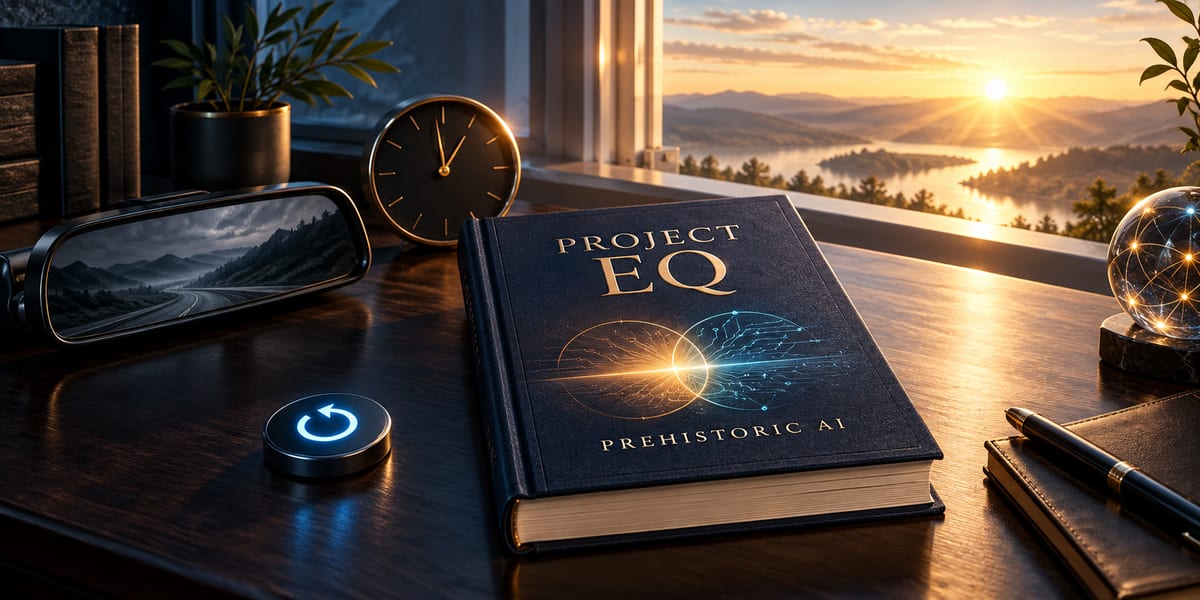
So I have made a decision. I am going to write another business book.
As if the world does not already contain enough business books promising leadership, transformation and extraordinary success before breakfast.
This one, however, is inspired by a question that fascinates me. I started my career before Google, smartphones and artificial intelligence transformed the workplace. Back then, much of consulting depended on understanding people. We learned how to read a room, build trust, navigate difficult conversations and bring conflicting personalities together. Today I use AI extensively and am continually amazed by what it can do. Yet the more powerful AI becomes, the more convinced I am that emotional intelligence will become more valuable, not less.
Machines are becoming increasingly capable of processing information, generating content and answering questions. What they cannot do is genuinely care about another human being. They cannot build trust, inspire confidence, navigate complex emotions or exercise moral judgement. As AI makes technical expertise more accessible, the uniquely human qualities of empathy, wisdom, leadership and relationships may become the qualities that matter most. My working title is Project EQ: Prehistoric AI, a slightly tongue-in-cheek attempt to explore what those of us who learned business before algorithms still have to contribute.
Perhaps it will be a good book. Perhaps it will be terrible. Perhaps nobody will read it. That is not really the point. I am not writing it to make money, restart my career or prove anything to anybody. I am writing it because I need something positive to create. I need a reason to look ahead rather than dwell on what has been lost.
The older I get, and the more limitations my illness imposes, the more convinced I become that we underestimate the importance of creation itself. Not creation in the sense of fame, recognition or commercial success, but simply bringing something into existence that was not there before. A book, a garden, a painting, a meal, a song, an act of kindness or a solution to somebody else’s problem. Human beings seem to flourish when they are making rather than merely consuming, contributing rather than merely observing.
That idea strikes me as profoundly Jewish. We have just begun reading the Torah again with Bereshit, and the very first thing we learn about God is that He creates. The Torah opens not with a commandment, a moral lesson or a legal code, but with six days of creation. Out of chaos comes order, structure, purpose and meaning. Human beings are then created b’tzelem Elokim, in the image of God. Perhaps one way we honour that image is through our own acts of creation. We cannot create worlds, but we can create knowledge, beauty, community, opportunities and hope.
Judaism reinforces this idea through the rhythm of the week itself. For six days we create and build; on the seventh we stop. Shabbat is not simply a day off because we are exhausted. It is a deliberate pause from creative activity. In truth, I have found Shabbat harder since retirement because I am no longer stepping back from a busy working week. Yet that challenge has made me appreciate something important. The satisfaction of rest is often connected to the experience of having created something first. Shabbat is meaningful not only because we stop, but because there is something from which we are stopping.
Of course, not everyone can work. Illness, disability, age and circumstance can strip away enormous amounts of our capacity. I certainly cannot work in the way I once did. Nor should we confuse productivity with human worth. Sometimes simply getting through a difficult day is an achievement in itself. But creativity is not limited to employment. It is available to almost all of us in some form. It is the decision to use whatever abilities remain to bring something positive into the world.
For those who have retired, become ill or simply found themselves with too much unstructured time, that distinction can be extraordinarily important. There is a world of difference between having time to fill and having something to look forward to.
I have noticed that difference in myself. For the first time in quite a while, I find myself eager to finish writing one article so I can start working on something else. That feeling surprised me. It feels suspiciously like enthusiasm. Perhaps even optimism.
I do not know how much time I have left. I do not know whether this project will take months, years or remain permanently unfinished. But I know I would rather spend some of that time creating something than worrying endlessly about what comes next. I cannot control how much time I have left, but I can still choose what to do with some of it.
And if God began the Torah by creating, perhaps that is not such a bad place for me to begin again.
Now, if you’ll excuse me, I have a book to write.