Owner of the world's largest Herzl collection
Treasure Trove: Achooza, the Great Estate of New York (Yes, Jews Bought Land!)
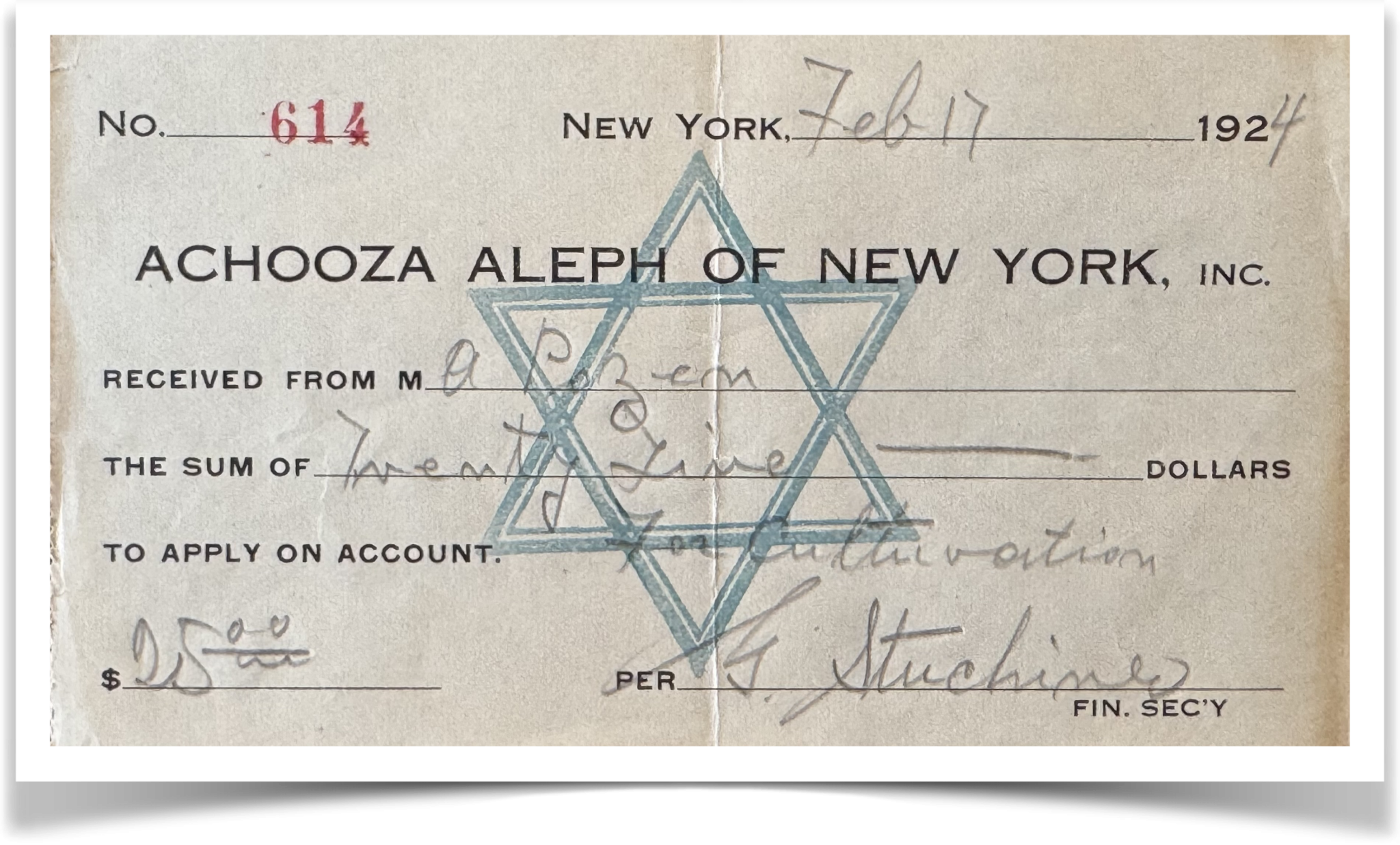
From the Herzl and Zionism Collection of David Matlow, Toronto (www.herzlcollection.com). Photograph by David Matlow.
In a synagogue presentation I did about Herzl a number of years ago, I mentioned the various organizations that purchased land in the Land of Israel in anticipation of the future Jewish state. Someone in the audience with a puzzled expression then said: “Bought land? I thought the Jews just came and took it.” Wow, I thought. This basic fact is not known to some in our own community. “Yes,” I replied, “the Jews bought land.”
Within the 1948 borders of the State of Israel, 8,6% was land purchased by Jews and 70% was effectively “crown land” of the British Mandatory authority that reverted to Israeli control when the British left. About half the land owned by Jews was purchased by the Jewish National Fund. There were also other groups and organizations that purchased land, including those in the Achooza movement.
An Achooza (literally, holding or estate) land purchasing company was a program in which a group of approximately 50 investors got together, agreed to invest in a newly formed company payable in instalments over five or so years, use the capital to enable an agent to purchase land in Palestine, and arrange for a crop to be planted on that land (usually almonds or olives) and homes to be built. After five or six years, when the crop became harvestable, the investors would move to the land they had purchased. Under this system, the investors would avoid the difficulties of pioneer farming and be able to accumulate more capital while their plantations matured.
Starting in 1908, Achooza companies were established in many cities in North America including St. Louis, Chicago, Cleveland, Cincinnati, Los Angeles, Pittsburgh, Brooklyn, Montreal and Winnipeg. This is a receipt for a contribution made to the Achooza that was established in New York City in 1912.
Achooza Aleph of New York, Inc. had acquired 30,000 dunams (7400 acres) of land by 1930. Its holdings included the land that is now Gan Yavne and Ra’anana.
Gan Yavne was established in 1931 near the historic city of Yavne, which was where Rabbi Yochanan Ben Zakkai built his Yeshiva following the destruction of the Holy Temple by the Romans in 70 CE. It was here that Jewish observance pivoted from animal sacrifice to prayer, which enabled Judaism to survive the loss of Jerusalem.
Ra’anana was established in 1922 when four Achooza members, three labourers and one security guard, arrived on two wagons from Tel Aviv. In its early days, the town was called Ahuza A-New York and was sometimes referred to as Little America as most of its residents spoke English. The city (now home to 85,000 people) remembers its roots as its main street is Ahuza Street.
The word ra’anana means fresh and verdant, the kind of place where life flourishes, where there is abundance, new growth and fresh ideas. This is precisely the kind of place that New York Achooza Aleph’s investors/aspiring farmers had in mind when they first made their decision to become members of the Achooza over a century ago.
_______
Treasure Trove is a program of The Herzl Project. Another program is The #Herzl100. 100 Herzl artefacts will be posted over 100 days on Instagram, FaceBook and TikTok. Search #Herzl100 on any of these platforms to see the first 18 artefacts, with 82 still to go!
For more treasures from the Herzl and Zionism Collection of David Matlow, which has appeared weekly in the Treasure Trove column in the Canadian Jewish News (www.thecjn.ca) since February 2021, see https://herzlcollection.com/treasure-trove
Related Topics
Related Posts