
Trump’s Ukraine ‘Peace Plan’ Shows He Has No Red Lines
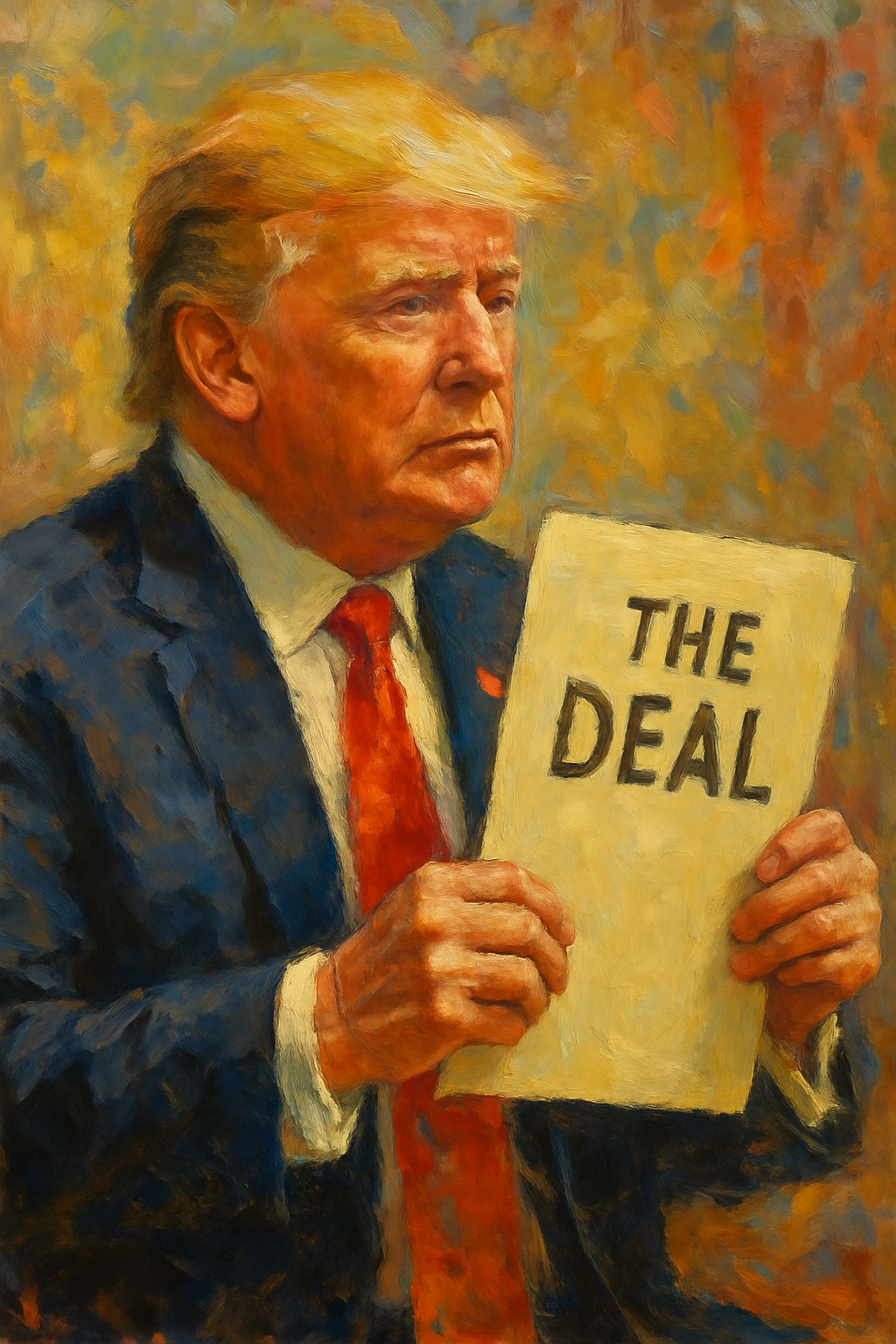
Trump’s Ukraine ‘Peace Plan’ Shows He Has No Red Lines
When even his own threats are negotiable, small democracies become bargaining chips
Donald Trump keeps promising that he can end the war in Ukraine in “24 hours.” We now have a better idea what that looks like, thanks to the leaked 28-point draft and the newer 20-point US–Ukraine talks: a “peace” built on Ukrainian concessions, Russian rewards — and no real red lines anywhere in sight.
Worse, the Ukraine draft exposes something deeper about Trump’s worldview: not only are borders negotiable, but so are his own threats. In the run-up to any grand bargain, Trump makes maximal, headline-grabbing threats of devastating sanctions, overwhelming force, or sweeping economic punishment. But once the cameras are rolling and the deal-making begins, those “bold” measures quietly vanish. The threats were never principles. They were just opening bids.
For Ukrainians and Israelis alike, that should be chilling.
Rewarding aggression, rebranded as peace
The 28-point Ukraine plan, obtained by US media and confirmed by multiple officials, would require Kyiv to:
- Accept Russian control over Crimea, Donetsk, and Luhansk as de facto permanent.
- Cap its armed forces at a level well below today’s strength.
- Abandon its bid to join NATO.
In exchange, Russia would see sanctions eased and be welcomed back into the Western economic fold, while a vague new “security architecture” is promised to deter any future Russian attack.
Reporting has since shown that key elements of this plan were drawn from a Russian-authored document handed to the Trump administration — a remarkable fact that should give any democracy pause.
The updated 20-point framework now under discussion walks back some of the most blatantly pro-Russian features. It allows the possibility of NATO membership and introduces ideas such as a special economic zone in the east and joint management of the Zaporizhzhia nuclear plant. But it still wrestles with Moscow’s demand for Ukrainian withdrawal from its own internationally recognized territory.
President Volodymyr Zelensky insists that any territorial concession would require a national referendum — in other words, consent from the very people whose homes are on the table. The Trump team, by contrast, appears far more focused on getting some document signed than on defending the principle that borders may not be changed by force.
Threats that melt away once the deal is on the table
This is not a one-off. It fits a pattern we’ve seen throughout Trump’s foreign policy.
With North Korea, Trump famously threatened “fire and fury like the world has never seen” and publicly traded insults with Kim Jong Un. Conflict felt dangerously plausible. Then, abruptly, the posture flipped: summits, photo-ops at the DMZ, warm talk about “falling in love” — and no actual denuclearization deal. Analysts of those talks have described the cycle as bluster and threats followed by a headlong rush to a big, optics-heavy bargain that leaves the core problem unsolved.
We see the same rhythm in Trump’s trade fights. Sweeping tariff threats against Mexico, Canada, and China — sometimes imposed, sometimes just dangled — became leverage to get to the table. But once new trade arrangements were inked, the apocalypse rhetoric disappeared. The “emergency” powers used to justify tariffs became bargaining chips, not lasting commitments to defend a principle.
In each case, bold threats were loudly advertised in advance — and quietly abandoned or watered down once the negotiations themselves became the main event. The pattern is clear: the deal eclipses the red line.
Now apply that to Ukraine. Before talks, we hear about punishing sanctions and “the best deal for everyone.” In the leaked draft, what survives is not maximal pressure on Moscow, but significant concessions to it and a pathway to sanctions relief. The tough talk doesn’t make it into the fine print.
From the “Gaza Riviera” to a fragile ceasefire
For Israel and Gaza, Trump’s record is just as revealing.
In February, standing beside Prime Minister Benjamin Netanyahu, he unveiled an astonishing idea: the United States would “take over” the Gaza Strip, expel its Palestinian population, and redevelop it as the “Riviera of the Middle East.” Palestinians would be relocated to “beautiful” locations elsewhere; Gaza would become a kind of international playground under US control.
The backlash from Arab states and much of the international community was immediate. Within weeks, Trump was saying he would merely “recommend” such a plan, not enforce it, and later insisted that “nobody is expelling any Palestinians” — a striking retreat from his original maximalist vision.)
Again, we see the same arc: dramatic, norm-breaking proposal up front; then, once reality intrudes, a rapid pivot to softer language and vague reassurances, without ever acknowledging that the original “plan” was dangerous on its face. The threat — in this case, of mass displacement — becomes disposable once it ceases to serve the deal.
Today, the Gaza file looks very different. After a UN Security Council resolution backed by the United States, there is a fragile ceasefire, an International Stabilization Force (ISF) on paper, and a Trump-branded Gaza “Board of Peace” that will manage reconstruction funds and redevelopment plans.
Much of this sounds reasonable; Israelis rightly want quiet on their southern border and an end to Hamas rule. But here, too, the whole architecture rests on a supposed red line: Hamas must disarm, surrender its rockets and tunnels, and accept a demilitarized Gaza policed by international forces.
What happens if Hamas simply refuses? What if, as is entirely predictable, it offers half-measures, hiding weapons or “storing” them out of sight while insisting that disarmament is complete?
Based on his record, it is hard to imagine Trump walking away from the deal at that point. Far more likely is the kind of fudge we’ve seen elsewhere: redefining compliance downward, pressuring Israel and the international community to accept ambiguous arrangements, postponing the hard questions for “Phase Two” or “after the elections.” The deal survives; the red line does not.
When the immovable object wins
Putin has been explicit that he views much of Ukraine as historically Russian land. Hamas is explicit that it views all of Israel as occupied territory and sees armed “resistance” as non-negotiable. In both cases, we are dealing with actors for whom crossing red lines is not a bug; it is the strategy.
Trump’s instinct, when confronted with such immovable objects, is not to sustain pressure or build a united front around clear principles. It is to bend the situation until he can announce a breakthrough.
In Ukraine, that means pressuring Zelensky — not Putin — to accept territorial amputations and neutrality, while nudging European leaders toward the belief that appeasement is pragmatism “for the sake of peace.”
In Gaza, it means sketching bold schemes (from taking over the Strip to handing it to a patchwork of international trustees) that all ultimately require Hamas to do what it has never shown any intention of doing: voluntarily abandon its weapons. When that doesn’t happen, the temptation will be enormous to accept partial, unverifiable “disarmament” rather than admit failure.
This is not statesmanship. It is showmanship — and small democracies are cast as props.
Why Israelis and Ukrainians can’t outsource their red lines
For Ukrainians, accepting Trump’s version of “peace” would enshrine a lethal precedent: that a nuclear-armed neighbor can seize territory by force, hold it long enough, and then have its gains blessed at an American-brokered conference. That message would echo far beyond Eastern Europe.
For Israelis, the stakes are just as high. A Gaza arrangement that leaves Hamas armed — or allows it to rearm under the nose of an under-mandated ISF — is not peace. It is a pause. And a US president who treats his own threats and red lines as negotiable instruments is unlikely to defend Israel’s non-negotiables when they collide with his desire to declare “the greatest deal ever.”
None of this means rejecting diplomacy. Israelis and Ukrainians both know the unbearable cost of endless war. Genuine peace, however, demands a stubborn defense of certain lines:
- Borders cannot be revised by artillery and then ratified by signatures.
- Terror organizations cannot be legitimized while retaining their arsenals.
- Security guarantees must be backed by enforceable commitments, not just press releases and investment prospectuses.
Trump’s Ukraine peace plan, and his behavior on Gaza, make one thing painfully clear: he does not believe in such lines. Threats are made to be traded away; principles are there to be “flexible”; the only constant is the hunger for a deal he can put his name on.
For small democracies facing ruthless adversaries, that is not the ally you choose to entrust with your future.