Documenting Hidden Jewish Histories and Legacies
Two Years After October 7, Isaiah 56:7 Still Startles, and Promises
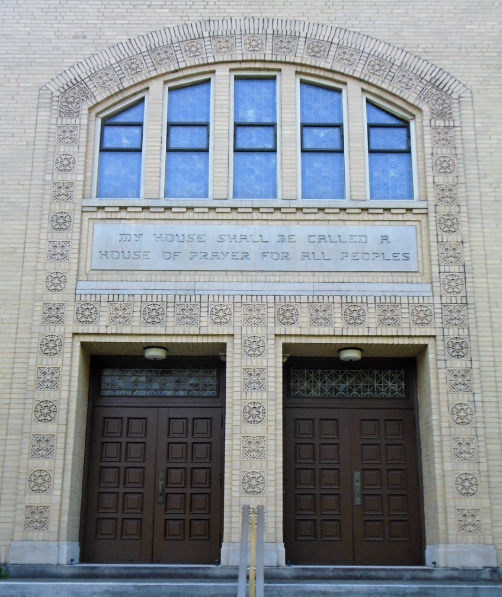
Facade of Temple Beth Israel in Altoona, Pennsylvania, with Isaiah 56:7 inscribed above the entrance. (Photo by William E. Fischer, Jr., Society of Architectural Historians, SAH Archipedia)
Two years after the attacks of October 7, 2023, the world feels smaller, harder, and more suspicious. The anniversary invites mourning, but it also demands reflection: what kind of faith do we carry forward when fear is ascendant? For many Jews, it now feels safer to turn inward, to circle the wagons, than to extend a hand to the wider world. And yet the verse carved above so many synagogue doors, “My house shall be called a house of prayer for all peoples,” still stands there, echoing across generations. Isaiah’s words have survived invasions, exiles, and disbelief. They keep waiting for us: offering a possibility that feels at once ancient and urgently new.
When my recent Washington Post essay appeared, tracing how nineteenth- and early-twentieth-century Americans once gathered across faiths to dedicate synagogues, the comments revealed how startled people still are by that vision. Some readers dismissed those interfaith dedications as naïve. Others insisted such harmony never existed. A few argued that Jews can rely only on police, not on neighbors. One even claimed, incorrectly, that I was “obviously” not Jewish, as if the act of telling history itself required proof of pedigree.
Taken together, the comments became their own congregation: voices of disbelief, defensiveness, nostalgia, and fatigue. They showed me that Isaiah 56:7 does not merely describe an ancient hope; it also exposes a modern unease. It asks whether we still dare to imagine holiness that is shared. That question lies at the heart of Judaism today.
Six Ways People Resist Isaiah 56:7
1. The Fatalist
“They never stopped hating us, and they never will… We outlast them, that’s all.”
This voice speaks from a deep scar. It mistakes the past for destiny. In the shadow of the Holocaust, it is not hard to see why survival itself became theology. Yet Isaiah’s verse does not end with survival; it imagines communion. A house of prayer for all peoples is not a bunker but an invitation. To believe that such a house can exist is an act of defiance against despair, a form of courage as vital as vigilance.
2. The Correctionist
“Antisemitism has always existed… Writing that tolerance was once greater is plainly not true.”
This reaction treats history like a courtroom cross-examination: if hatred persisted anywhere, harmony must have existed nowhere. But the dedications I wrote about were never proofs of perfection; they were rehearsals of hope. In the United States, even amid segregation and inequality, Jews and Christians for generations filled sanctuaries together to consecrate a civic ideal. Pluralism was not perfection; it was practice. Remembering those moments is not a denial of suffering but a reclamation of possibility, and a truer telling of Jewish history.
3. The Security Realist
“American Jews cannot rely on the strength of character of our fellow citizens… We have to rely on police with firearms.”
Here, trust collapses into enforcement. Safety becomes a service to purchase, not a civic covenant to uphold. In the nineteenth and early twentieth centuries, many American synagogue walls bore Isaiah’s verse because people understood that belonging grew from relationship: from neighbors who showed up, clergy who spoke across lines of difference, voices who sang together. When we trade those bonds for barricades, we preserve the body of community but lose its soul.
4. The Cynic
“So the Jim Crow era—before women could vote—was the golden age of pluralism?”
This voice exposes a necessary discomfort. Yes, America’s interfaith gestures unfolded amid glaring injustices. That paradox is the point. Moral imagination has always bloomed in compromised soil. Isaiah himself preached amid corruption and cruelty; his vision was not utopian but insurgent. To celebrate earlier pluralism is not to sanctify its era but to learn how progress and blindness can coexist—and why vigilance and vision must walk together.
5. The Gatekeeper
“Then again, this is an opinion piece by someone who is not obviously Jewish, if at all.”
This line lands personally, yet it reveals something larger: the fear that modeling Abraham, keeping a tent open on all four sides, will weaken the center. But Isaiah’s promise expands the circle rather than polices it. For a convert, the verse is a literal invitation: all peoples means there are no outsiders at the door. If the prophet could imagine nations praying side by side, surely the American Jewish community, the largest in the Diaspora, and one in which nearly half of families are already interfaith, can make room for those who choose this spiritual path. American Judaism is already universal in practice; marriage alone is an arbitrary threshold.
6. The Neighbor
“My little hometown down the river from Pittsburgh once had three synagogues… Everyone got along… Then the economy wrought havoc.”
Amid the cynicism, this comment carried tenderness. It remembered the everyday decency that holds communities together and the larger forces that pulled them apart. Many American Jewish communities did not fade because of assimilation but because of economic upheavals that reshaped towns across the country. Those stories, too often left out of our communal memory, remind us that loss is not always the result of choice. Achieving Isaiah’s house will begin the same way those communities once thrived: with trust, with invitation, and with neighbors welcomed inside to see what Judaism offers the world.
The Prophecy and the Anniversary
Two years after October 7, Jews everywhere are still navigating the aftershocks: grief, uncertainty, and, for many, a kind of spiritual crisis. For some, fear now seems to be finishing the story — the decision to believe that a world of shared sanctuaries belongs to another age, or perhaps never existed at all. Yet if history teaches anything, it is that Judaism has always thrived most when it lives in relationship with surrounding traditions — not by watering down belief, but by standing confidently in the marketplace of ideas. Such periods have emerged again and again throughout Jewish history.
That same vision inspired synagogues across the United States to carve into their facades the verse, “My house shall be called a house of prayer for all peoples.” The line was written during or shortly after the Babylonian exile, when many Jews were living far from their homeland and unsure if they would ever return. Isaiah’s audience knew insecurity. Yet Isaiah preached hope.
The comments under my Washington Post essay were, in their way, a miniature mirror of Jewish life after October 7. Some were weary, some defensive, some disbelieving, and a few still tender enough to remember community. They showed that we do not all mourn in the same register. Some build higher walls, others reach for older promises. Yet both instincts spring from love of the same tradition—and its future.
If pluralism feels naïve now, it is because we have confused naiveté with faith. Faith is not the denial of threat; it is the refusal to let threat define the horizon. The synagogue dedications I study were not declarations that antisemitism had vanished. They were public acts of trust in spite of it—insisting that goodness could be chosen, that neighbors could still stand together. That insistence remains radical.
On this anniversary, Isaiah’s verse startles because it still dares to imagine more than survival. It tells us that holiness is not a zero-sum space. We can live by fear, counting enemies, or we can live by faith, counting one another. The prophets knew which choice sustains a people.
So let the words stand where they always have, carved above our doors and written between the lines of our prayers:
“My house shall be called a house of prayer for all peoples.”
Not as a description of the world we have, but as the command to build the one we still need.
Related Topics