
Consultant and writer exploring policy, society, and identity
U.S. Midterms: What Has Started to Move
September 4, 2026
The Signal
Yesterday, I introduced a model for reading the American midterm elections as a chain of consequences: new evidence changes a political trend; the trend moves particular races. Those races determine control of the U.S. House of Representatives and Senate; and control changes what Washington can do. This is the first full update.
The strongest signal is still the cost of living. In the latest Reuters/Ipsos survey, 47 percent of registered voters called it the single most important factor in their vote. Seventy-one percent disapproved of President Donald Trump’s handling of it. The war with Iran now adds a second risk. Only one-quarter of Americans told Reuters/Ipsos that the war was worthwhile, while an earlier Ipsos poll found 83 percent expected extended American involvement. That does not prove a shift toward Democrats, it does mean that war, prices and confidence in government are becoming harder to separate.
Control Pulse
The House remains the chamber most likely to change hands. Republicans began this election cycle with 220 seats and Democrats with 215, so Democrats need a net gain of three (Republicans: 220-3=217, Democrats: 215+3=218.) Several Republican-held districts in Florida, Michigan and Texas have recently moved toward greater competitiveness in major race ratings. My assessment is: close, with a modest Democratic opportunity. The Senate is different: Republicans hold 53 seats; Democrats and two aligned independents hold 47. Democrats therefore need four net gains. Inside Elections moved New Hampshire and Ohio to “Toss-up” on September 3 and made Alaska somewhat more competitive. Yet Democrats must defend their own exposed seats before collecting four Republican ones. The Senate still has a Republican edge.

What Is Beginning to Move
Election rules and district boundaries are becoming immediate campaign variables. On September 3, the Missouri Supreme Court unanimously blocked a Republican-drawn congressional map unless voters approve it. For now, that protects the configuration of a Democratic-held seat in Kansas City, although a federal appeal is expected. In another case, the administration asked the U.S. Supreme Court to allow tighter Postal Service rules for mail ballots after a lower court blocked them. In a House contest that can turn on three seats, one district or a small number of disputed ballots can be decisive.
Progressive candidates are also gaining primary influence, but the evidence does not support talk of a party takeover. Brookings identified 123 primary victories among 282 candidates endorsed by chapters of the Democratic Socialists of America. Most were running for local or state office. Only ten congressional winners were in districts with a Democratic lean of less than ten points. The movement has energy; its reach in competitive federal races remains unproven.
The Senate Race That Matters
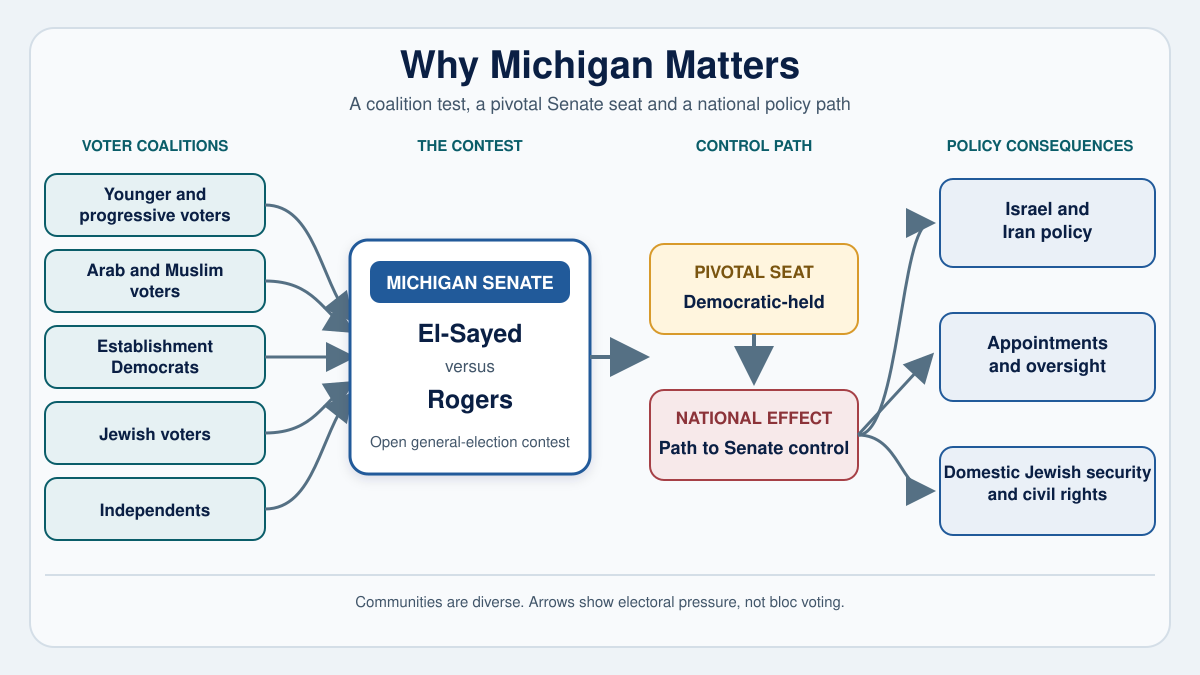
Michigan is now the clearest test. Abdul El-Sayed defeated Representative Haley Stevens for the Democratic nomination by less than one percentage point. He will face former Representative Mike Rogers, the Republican nominee, for a Democratic-held open seat. El-Sayed is associated with the party’s progressive wing but is neither a DSA member nor a DSA-endorsed candidate. He campaigned against unconditional American military aid to Israel. Pro-Israel groups, led by AIPAC and its affiliates, spent nearly $30 million supporting Haley Stevens, according to the Associated Press. She still lost.
This result is important, but its meaning should not be exaggerated. It shows that large outside spending could not determine a Democratic primary. It does not show that El-Sayed’s foreign-policy position can win a Michigan general election. Early polls are mixed and close. Michigan will test whether El-Sayed can keep the enthusiasm of younger, Arab and Muslim, and progressive voters while rebuilding trust with establishment Democrats and Jewish voters. Losing Michigan would force Democrats to capture five Republican Senate seats instead of four.
The House Race That Matters
This week, the most instructive House race is Missouri’s 5th District, represented by Democrat Emanuel Cleaver. The decisive development was not a speech or poll; it was the court decision on the map: If the older district remains in place, Democrats avoid one threatened loss. If the U.S. Supreme Court reverses the state court, the arithmetic changes again. This is why the model follows institutions as well as voters: Courts, postal rules and election administrators can alter the field on which campaigns compete.
What Control Would Change
The House offered a concrete example on September 3. It passed a bill that would withhold federal aid from universities that boycott Israel. The vote was 237–169, with 33 Democrats joining most Republicans, according to Reuters. The Senate must still act.
For American Jewish communities, this debate concerns campus life, civil rights, free expression and the boundary between criticism of Israel and antisemitism. These communities are not politically uniform. AP–NORC found that Jewish adults, like Americans generally, place the economy and health care near the top, while assigning more importance than the public overall to foreign policy and Israel. For Israel, congressional control affects military assistance, Iran policy, arms-transfer oversight and diplomatic support. It changes which bills receive hearings and votes, who leads committees and what conditions may be attached to funding. It does not guarantee any particular policy.
What Could Change My View
I would revise this assessment if living-cost perceptions improve sharply; the Iran war ends or expands; Michigan polling settles outside the margin of error; or the Supreme Court changes the Missouri map or mail-ballot rules. Until then, the House is close, the Senate leans Republican, and Michigan is the race where ideology, Israel and control of Congress meet most directly.
Method Note
The model distinguishes facts from interpretations and scenarios. Polls are snapshots, ratings are judgments, and elections remain choices made by voters.
Come back for another installment in a week…
***
Related Topics
Related Posts