Violence wins, peace waits: Kurdistan and the politics of recognition
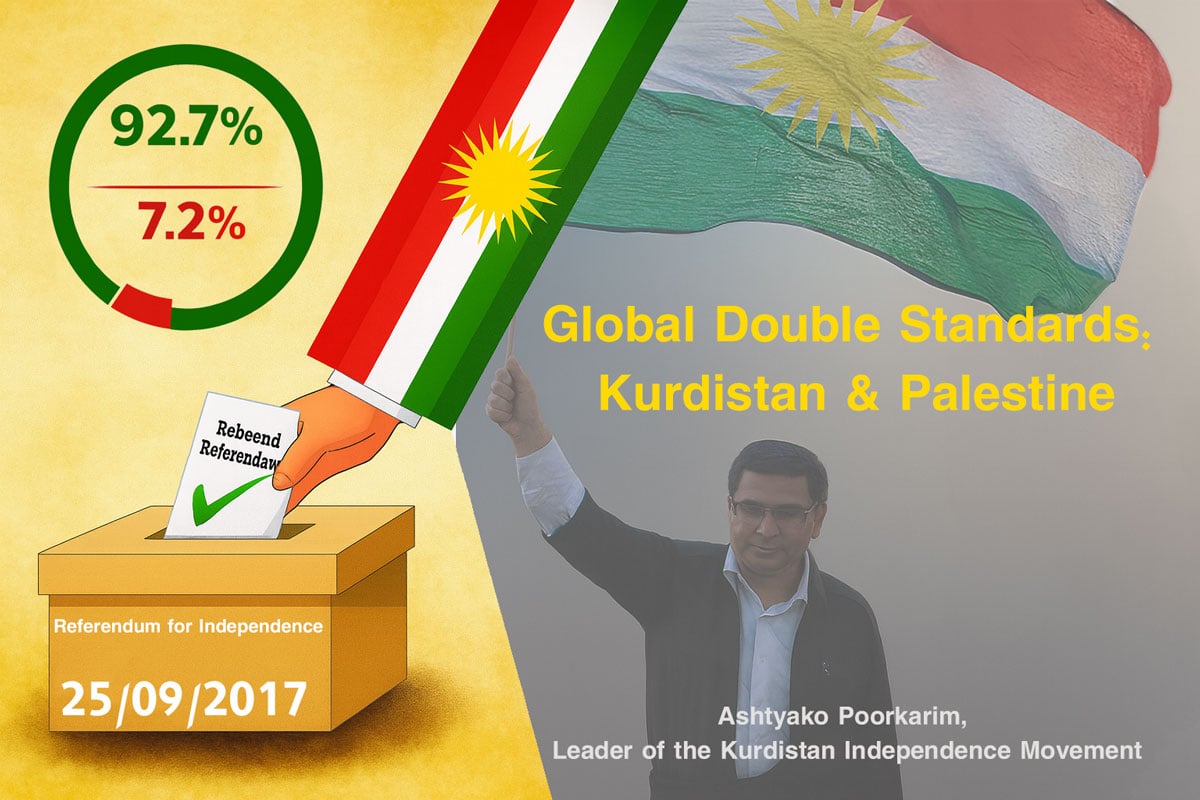
On September 25, 2017, the people of the Kurdistan Region, under Iraqi occupation, in a free and transparent referendum with broad participation and public oversight, voted “yes” to independence by more than 92 percent. This vote was not an emotional move but a coherent expression of the national will of a people who, for a century, have lived under colonial partitions, denial of identity, structural discrimination, and state violence. Nevertheless, the response of the region and the world was coordinated pressure from Baghdad, Tehran, Ankara, and Damascus on the one hand, and silence or denial by the world powers on the other.
Seven years later, the same blocs that did not see the “right time” for Kurdistan – at the height of the consequences of the bloody October 7, 2023, attack on civilians – set off a wave of official recognition of the “State of Palestine.” This move, at least at the level of messaging and public perception, instead of consolidating legal and ethical standards, strengthened the dangerous notion that violence can create political concessions. Here lies the obvious contradiction: Why are the Kurds, with their long record of resisting terrorism through structural struggle and the choice of a democratic path, still deprived of the right to independence, while the Palestinians achieve successive recognitions despite the prominent role of armed groups officially recognized as terrorist organizations?
To understand this inconsistency, we must return to the starting point: the moment when the European powers – some of whom today have raised the banner of Palestinian recognition – drew the map of the Middle East behind closed doors. The 1916 Sykes-Picot Agreement established the division of spheres of influence, and the 1923 Treaty of Lausanne consolidated it, without granting the Kurdish nation the right to representation, consent, or even a voice.
The result was fateful: the contiguous land of Kurdistan was carved up among the occupying, newly established, and fabricated states of Iran, Iraq, Turkey, and Syria. Over each piece, a regime was installed that either denied Kurdish identity or pushed it to the margins: from the slaughters of Anfal and Halabja and forced displacements in Ba’athist Iraq, to the revocation of citizenship and cultural repression in Assad’s Syria; from express policies of “identity denial” in Turkey to systematic discrimination and political-security repression in Iran. This is no mere sequence of events for the history books; it is a chronicle of the moral culpability of those very powers that today, in the name of justice, turn a blind eye to another injustice.
A different path
In the face of this weighty legacy, the Kurds have chosen a path fundamentally different from the model of groups such as Hamas. The Kurds in Ba’athist Iraq were victims of organized genocide and chemical bombardment yet stood against state terrorism. In Syria, they faced the erasure of their identity and the destruction of their villages, while at the same time defending civil society, education in the mother tongue, and equal participation. In Turkey, they face security operations and policies of structural denial; in Iran, they were among the first groups to resist a regime that exports transnational terrorism and, by creating and arming proxy networks in Lebanon, Syria, Iraq, Yemen, and some Palestinian factions, has taken the region’s security hostage.
The global turning point, however, was the 2014-2019 war with ISIS, when the Kurds became the backbone of the defeat of the terrorist caliphate and paid the price so the world would be safer. This record establishes a fundamental identity difference: the Kurds have, in practice, been anti-terrorism, not proponents of terror for concessions.
From the perspective of international law, there is no shortage of foundations. The UN Charter, in Articles 1 and 55, recognizes the right of self-determination, and the human rights covenants (ICCPR/ICESCR) affirm it. UN General Assembly Resolutions 1514 and 2625, along with customary practice, open the way for nations persistently deprived of meaningful participation in government.
The doctrine of “remedial secession” explains that when structural repression, systematic discrimination, and chronic closure of internal solutions prevail, secession can be a legitimate remedy. Reasonable analogies such as Timor-Leste and Kosovo show that the international community has, in similar conditions, left the path to independence open.
The Montevideo criteria – permanent population, defined territory, government, and capacity to enter into international relations – are also attainable with regard to Kurdistan. The Kurdistan Region under Iraqi occupation has, over the years, demonstrated practical capacity in governance, internal security, institution-building, and external engagement. Therefore, the Kurdistan question is not the absence of a legal framework; it is the absence of political will at the international level.
Within this framework, we must recall the principle of a state’s right to self-defense (more on this here). Article 51 of the UN Charter recognizes the inherent right of defense against an “armed attack,” and after 9/11, the scope of this concept extended to the actions of organized non-state networks with state support. October 7, 2023, was a clear example of such an armed attack, and Israel’s right of defense – conditioned by necessity and proportionality (known as the “Caroline test”) – is legally explicable.
Entrenching a double standard
But the contradiction begins here: the same states that accept this logic for themselves or their allies suddenly retreat to the sanctuary of “regional security” and “the wrong time” when it comes to the Kurds’ right to self-determination, as if the structural state support for terror networks in the four occupying countries of Kurdish lands were not a threat to the survival of the world’s largest stateless nation. If defense against terror is a right – and it is – what message does immediate political reward after a crime like October 7 send to the world other than entrenching a double standard?
In practice, violence has been the engine of global attention in the Palestinian case. Suicide operations, rocket attacks, and ultimately the October 7 catastrophe have repeatedly kept the Palestinian issue at the top of the global media and political agenda, even if the human cost has been heavy and unjustifiable.
By contrast, the moral capital the Kurds built through heroism in the war with Iran’s terrorist Revolutionary Guards Corps, the defeat of ISIS, and the choice of a democratic strategy was met with calculated indifference. The absence of a “spectacular” crisis and the lack of an immediate threat to others do not stimulate the short-term attention of politicians. The implicit message of this pattern is simple and dangerous: violence is seen and sometimes rewarded; pacifism is seen and postponed. It is precisely this message that must be at the center of our moral and strategic critique of the international community.
Nevertheless, the right path for the Kurds is never to imitate the Hamas model. Such imitation would squander the Kurds’ moral capital and international legitimacy and place them in a frame their enemies have long tried to cement. It behooves the international community to reward the correct model – democracy, anti-terrorism, human rights – not the inverse. The recognition of Kurdistan must be the reward for peace-seeking and responsible governance, not the result of threats. This proposition is not only a moral plea but also a regional security necessity: an independent Kurdistan can act as a democratic anti-terror hub, organize durable agreements on water, energy, and transit, protect the rights of minorities and women as a social shield against extremism, and, by replacing a governance vacuum with a legitimate state, constrict the maneuvering room of proxy networks. Put plainly: an independent Kurdistan is a stability asset, not a threat to it.
Thus, the roadmap is clear: reliance on the 2017 referendum as the unmediated expression of national will; reasoned invocation of “remedial secession” on the basis of the documented record of repression in the four countries; demonstration of Montevideo capacities with concrete institutional data; embedding guarantees for minority rights and good-neighborliness treaties; institutional steps from membership in UNPO and obtaining ECOSOC consultative status to submitting shadow reports to treaty bodies and pursuing an advisory opinion from the International Court of Justice on the Kurds’ right to self-determination; and, simultaneously, a campaign for parliamentary and municipal resolutions in Europe and North America, along with the drafting of a roadmap for referendums under international supervision for all four occupied parts of Kurdistan, with clear security–border guarantees. This path offers a convincing alternative to the status quo and shows governments that recognizing Kurdistan is not a leap in the dark but a managed transition toward sustainable peace.
Ultimately, the Kurdistan issue is not only a test for the region but also a test of the global community’s sincerity. If Palestine – with all its complexities and despite the manifest crime of October 7 – advances on the road to recognition, while Kurdistan – with a decisive democratic mandate, an anti-terrorism track record, and governance capacity – remains exiled to the waiting line, the world’s message is this: we see violence and reward it; we see peace-seeking and postpone it. This logic is neither sustainable, nor ethical, nor reasonable. Correcting it is possible only by admitting one truth: so long as the Kurdish nation does not have a state, the Middle East will not see real stability and calm. Recognizing Kurdistan is not a political luxury; it is a precondition for sustainable peace and the repair of a historical error in which the international system itself had a hand.