
War on the Jews, Part II: The Warning is Now a Pattern
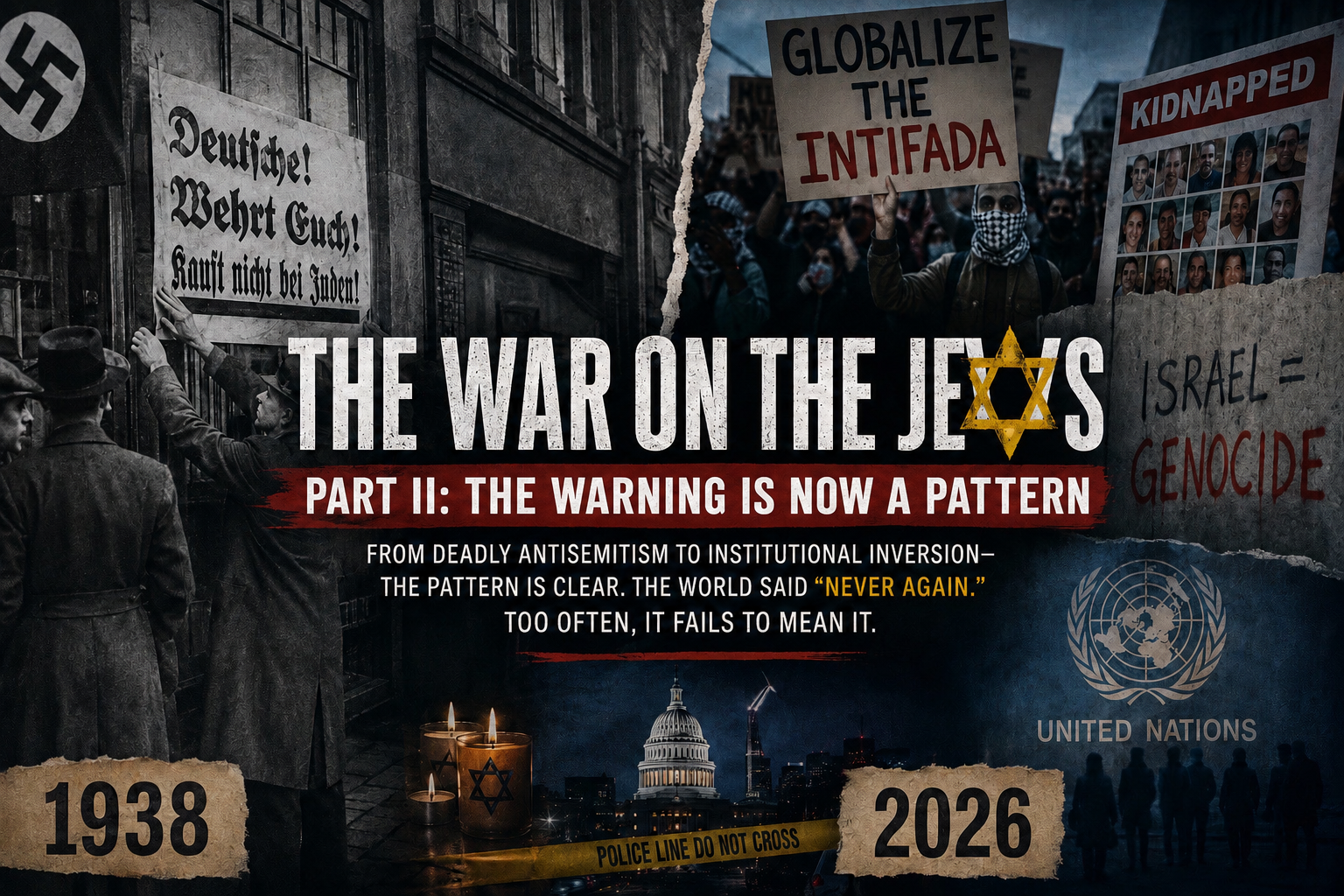
“First comes the presumption of guilt. Then the social normalization. Then the institutionalization.”
In October 2025, I warned that the world was entering a dangerously familiar moral climate surrounding Jews and Israel — one increasingly defined by the normalization of anti-Jewish hostility, the presumption of Jewish and Israeli guilt, and the selective application of moral standards.
At the time, many dismissed the comparison to 1938 as alarmist but the events that followed did not weaken the warning. They reinforced it.
The Violence Is Escalating
On April 13, 2026, Tel Aviv University released its Antisemitism Worldwide Report 2025, documenting the deadliest year for Jews outside Israel in more than three decades. Researchers recorded 20 Jews murdered in four antisemitic attacks worldwide during 2025 — the highest toll in over 30 years.
Specific horrors included:
- The May 21, 2025 shooting outside the Capital Jewish Museum in Washington, D.C., where two Israeli embassy staffers, Yaron Lischinsky and Sarah Milgrim, were murdered as they left an event.
- The June 1, 2025 firebombing at a pro-hostage rally in Boulder, Colorado, which killed 82-year-old Karen Diamond.
- Coordinated mob violence against Israeli soccer fans in Amsterdam, described by many Jewish observers as reminiscent of earlier eras of European anti-Jewish street violence.
- The broader surge exemplified by attacks in Australia and elsewhere, underscoring the global reach of the phenomenon.
Taken individually, each incident can be contextualized as local or reactive. Taken collectively, they reveal something much more disturbing: the re-emergence of anti-Jewish violence as an increasingly normalized feature of Western, and global, public life.
The Anti-Defamation League reached parallel conclusions. On May 6, 2026, the ADL reported 6,274 antisemitic incidents in the United States during 2025, the third-highest total ever recorded, including a record 203 physical assaults and deadly attacks on American soil. ADL CEO Jonathan Greenblatt described 2025 as “one of the most violent years” for American Jews, even amid some decline from the immediate post–October 7 surge.
Holocaust historian and former U.S. Special Envoy Deborah Lipstadt repeatedly warned throughout 2025 that:
antisemitism was mutating rather than disappearing. She emphasized that criticism of Israel crosses into antisemitism when Jews worldwide are collectively held responsible for the actions of the Jewish state.
This is precisely the atmosphere many Jews increasingly feel surrounding them today.
The Presumption of Guilt
Simultaneously, anti-Israel rhetoric once confined to extremist fringes entered mainstream institutional culture.
Chants such as “Globalize the Intifada”, with their historic association with the Second Intifada, became socially fashionable across Western campuses and street demonstrations. Hostage posters featuring kidnapped Israelis were routinely torn down, while Hamas atrocities were minimized, denied, or reframed as “context” or “resistance.”
The issue is not criticism of Israeli policy. Democracies must withstand scrutiny.
The issue is the growing willingness of international institutions, media, activists, and cultural spaces to selectively abandon evidentiary caution, moral consistency, historical sensitivity when Jews or the Jewish state are involved and any semblance of critical thinking.
These are not just my claims.
As HonestReporting and others documented, allegations against Israel often achieve global moral certainty before independent verification occurs. UN Watch’s Hillel Neuer highlighted the same pattern: double standards in international discourse send dangerous signals to the mob.
“The moral verdict increasingly arrives before the investigation.”
Then came the Global Sumud Flotilla in May 2026.
Within hours of Israel intercepting dozens of vessels carrying more than 430 activists attempting to breach the Gaza naval blockade, allegations of severe Israeli abuse: including beatings, torture, and sexual assault. These allegations spread rapidly through activist networks, media, and diplomatic channels. International condemnation accelerated before any transparent independent evidentiary review occurred.
Israel denied systematic abuse, pointed to documented ties between some organizers and pro-Hamas networks, and emphasized that aid could flow through secured land crossings.
Regardless of where the full truth lands, the pattern was unmistakable: the moral verdict arrived before the investigation. Another textbook case of presumption of Israeli guilt.
When Institutions Blur Moral Reality
This pattern reached new institutional heights with the United Nations Secretary-General’s annual Report on Conflict-Related Sexual Violence.
Hamas was blacklisted for patterns of sexual violence tied to October 7, including verified rapes, gang rapes, and hostage abuses. This was a long-overdue acknowledgment.
In the same reporting cycle, Israeli armed and security forces faced documented scrutiny for alleged incidents involving Palestinian detainees, including allegations connected to Sde Teiman. Many Israelis and Jews viewed this as creating an obscene moral equivalence — placing rigorous scrutiny on a democratic state’s self-defense alongside a terror group that weaponized mass rape.
When international institutions blur distinctions between aggressor and defender, they do more than distort facts. They distort moral reality itself.
No history never repeats itself identically but societies reveal themselves through the standards they selectively abandon. Especially, when Jews are involved.
First comes the presumption of guilt, then the social normalization, and finally the institutionalization. The echoes of 1938 are not echoes anymore. They’ve become real.
The world learned to say “Never Again,” but too often fails to mean it when Jews defend themselves from slaughter.
We must demand evidence-based scrutiny, reject false moral equivalence, and affirm that Jewish lives, and Israel’s right to defend them, are non-negotiable.