We are still waiting for someone to say: We failed you
This speech was given at a protest outside the Knesset in Jerusalem on October 7, 2026, at 6:29 a.m.
Daybreak
Three years ago, at this very hour, the day began that divided our lives into before and after. An earthquake that pulled the ground out from under our feet and shrouded the horizon in fog.
My name is Aron Troen. I am the son of Ilan and Rachel, members of the founding generation of Ben-Gurion University of the Negev. Devoted Zionists, they immigrated to Israel from the United States with four small children, another on the way, a sixth still to come – and with great hope. They built their lives in the Negev out of a simple, profound belief: that it is possible – and that we are obliged – to build an exemplary society here.
I am a professor of nutrition and public health at the Hebrew University. I am married to Susan and a father of two. Like my brothers and sisters, I chose, out of a sense of mission and commitment, to build my life here and to work for the development of this country for the benefit of all its residents, come what may.
But on October 7, everything was shaken. And this morning I stand here as a brother. A bereaved brother. And as a parent raising a war orphan.
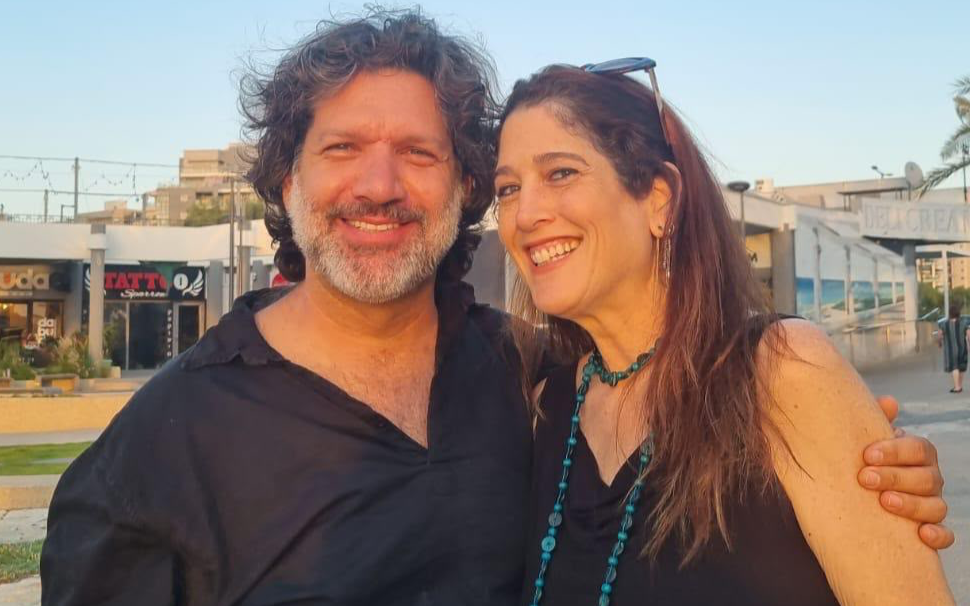
My sister Shahar and my brother-in-law Shlomi Mathias were murdered at this hour three years ago in their home in Kibbutz Holit. They were musicians, teachers, lovers of life, of people, of truth, and of peace. They chose to make their home and raise their three children in the Negev, on the country’s border, and to take part in realizing a vision and building a community.
At 6:29 on the morning of Simchat Torah, October 7: Red Alert. More than a thousand rockets and mortar shells fell in the Holit area during the first hour of the attack. Under the heavy barrages, they entered the safe room with their son Rotem – and waited.
We now know that in the first hour everything collapsed: the Nukhba forces breached the fence within minutes, and shortly afterward entered the kibbutzim and began their killing spree. At the same time, in a meticulous and coordinated military operation, they incapacitated the chain of command from the division level down to platoon commanders, collapsed the IDF’s command-and-control system, and disrupted communications and intelligence. The few forces at the front were pinned down, fighting for their own lives, unable to save the civilians.
In our family, as in every home in the Gaza border communities, the WhatsApp messages began racing back and forth: rumors of terrorist infiltrations. Expressions of concern. Gunfire drawing nearer, then receding. Glass shattering. The house breached. Calls for help. Prayers for rescue. And the terror rising.
Left to their fate
They believed the state would come to save them. They waited for the army to arrive. They were wrong. They were abandoned, alone, to their bitter fate.
As they barricaded themselves in the safe room, Shahar lay over Rotem and shielded him with her body. Shlomi held the safe-room door. Both were brutally murdered when the door was breached with a grenade or explosive charge and bursts of gunfire, and their home was set ablaze to the cheers of the killers. Rotem was shot in the abdomen, wounded by shrapnel in his forehead and leg, and lay motionless beneath his mother’s body, either hidden from view or left for dead.
After some time, as he lay wounded by gunfire in the burning house, he sent our family a devastating message that has been seared into us forever:
“Mom and Dad are dead. Sorry.” – 8:01 a.m.
His sisters, Shir and Shaked, cut off from contact, survived nightmares of their own, each alone, elsewhere in the kibbutz. They were the last to be rescued toward evening, about 14 hours after the nightmare began.
An entire family waited for hours for the army that was so long in coming.
Three years have passed – and to this day, not a single minister, not a single representative of the government, has come.
Not to visit. Not to explain. Not to comfort.
Not to look us in the eye and say the obvious: We are sorry. We failed.
Not to say: We were wrong.
Not to say: We will investigate fully, and do everything possible so that it never happens again. But we are no longer waiting. And we no longer have any expectations.
During the festivals of Tishrei, according to tradition, the world stands in judgment, and we are called to give a public accounting before the Lord of Truth and Peace. Hoshana Rabbah is the final opportunity for repair and repentance. And on Simchat Torah, we begin again – from Genesis, from the beginning.
In the Book of Genesis, God calls to Adam: “Ayeka? – Where are you?”
Not because He does not know where Adam is hiding, but because Adam must come out of hiding, step forward, and answer.
So this morning I ask our elected representatives: Ayekhem?! Where are you?!
Where are you now, in the face of the trust and responsibility you asked the public to place in you – and received?
And I ask the public as well: What is the nature of a state? What purpose does its government serve? If it demands that all its citizens obey the law, pay taxes, send our children to the army, shoulder the stretcher – some of us literally – serve in the reserves, and build homes on the border, but when it fails in its most basic duty to protect us (or to enforce compliance on draft evaders and lawbreakers), there is no one to answer: Hineni. Here I am. I am responsible.
On October 7 and ever since, the citizens have said: Hineni.
The residents of the Gaza border communities – in safe rooms, in the fields, in factories, in their communities and local security squads – said: Hineni. The reserve soldiers said: Hineni.
Pilots, doctors, teachers, drivers, farmers, Jews, Muslims, Bedouins – citizens ran into the inferno to save their brothers and sisters without asking about their religious or political identity.
And where is the government? Ayekhem?! Where are you?!
The right – and the duty – to search for truth
I stand here also as a scientist.
In science there is a simple rule: reality does not vote in elections. Facts do not belong to the coalition or the opposition, and they cannot be rewritten as right-wing or left-wing.
The Knesset can pass a law abolishing gravity. Paper – and populism – can tolerate anything.
But anyone who jumps from the roof – even if he is one of the 36 righteous people that Jewish tradition says walk the earth – will shatter on the ground of reality.
Because reality is stronger than any spin or lie.
Albert Einstein, one of the founders of the Hebrew University, put it beautifully:
“The right to search for truth also implies a duty: one must not conceal any part of what one has recognized to be true.” Even when the truth is uncomfortable or unpleasant.
I see this malignant political disease – the denial of truth – in my professional life as a professor of nutrition and public health as well. Israel is a world leader in amputations caused by diabetes, not only by war. I have seen how a policy built over years on evidence – the tax on sugary drinks – was turned overnight into a weapon in an identity war. Instead of asking what is good for public health, and what especially protects the most vulnerable populations, elected politicians betrayed their responsibility and their voters, turned evidence into spin, and the health of all citizens into a tool for mobilizing their base.
To me, that was a symptom of a deep, contagious disease far more dangerous than diabetes: complacency, arrogance, strong-arm politics, a cult of personality, and petty politics of division and identity – politics that prefers loyalty to camp and leader over loyalty to reality and the common good.
That same disease became deadly on October 7, and in the stoking of divisions in society during the attempted constitutional coup that preceded it. The government and its leader ignored experts, advisers, and those sounding the alarm, who identified the growing threat and warned of it: from the young women serving as IDF lookouts, who saw what was happening with their own eyes and reported it until their last breath; through the Hamas plan, which had been known to Israel in one version or another since 2018; to warnings reportedly conveyed shortly before the massacre by the Egyptians and Emiratis, originating with Sinwar himself. But instead of listening, the government and its leader buried the warnings, rejected criticism, entrenched themselves in the prevailing conception, channeled Qatari money, dismissed other views, and buried their heads in the sand.
And when you bury warnings and bury your head in the sand – in the end, you bury people.
We buried civilians, foreigners, the elderly, women and children, parents, children, brothers and sisters. People dancing at parties. Muslims, Christians, Bedouins, and Druze children. We buried hostages. We buried soldiers.
We buried my sister Shahar and my brother-in-law Shlomi.
And now we must not – God forbid – allow the truth to be buried, and with it the possibility of healing!
We are still wounded in body and soul, bereaved, stunned, scarred, and bleeding. As long as we remain on the brink of total failure, the wound will remain open and unable to heal.
People speak of October 7 in the past tense, as though it happened and is over. They say, “We will not forget and we will not forgive.” But the disease is not a thing of the past. And when it spreads from the head into the heart of the State’s institutions – distorting decision-making, corrupting the public service, tearing apart mutual responsibility in society, and undermining our very capacity for reality-testing – then it threatens our very existence and our ability to defend ourselves. That is why I stand here this morning to warn again: You have been warned!
In medicine, you cannot cure a disease without diagnosing it. You have to know what went wrong, where, and why.
That is precisely the role of a State Commission of Inquiry.
Not revenge. Not a ceremony. Not a political committee that confirms what each camp already believes.
Diagnosis. Truth. Responsibility. Learning lessons. A prerequisite for repair and healing.
Because if we do not diagnose the disease, it will return and worsen. And if we continue to deny it, the next price may be heavier still.
This is not a partisan call. Nor does it presume guilt in advance. On the contrary: it asks what can be learned from mistakes and what can be learned from successes. A call for a commission of inquiry leaves room for doubt and for hard questions, out of a commitment to discovering the truth and judging fairly and objectively. Because we know the results, but not all the causes of the terrible collapse have yet been diagnosed. Not only on that black day. Not only at the tactical level. But in the political and strategic collapse that we are still in the midst of, with its end nowhere on the horizon.
The existential challenge facing the State of Israel, and any government that is elected, will be to chart a path that can bring about change, bring peace and security, guarantee a horizon for our children, and not persist in endless war. We have tried force, and then more force; it has not brought us better outcomes. Hamas is growing stronger; Israel is being worn down; solidarity and resilience are at a low ebb; Israel is steadily losing its legitimacy; and our international standing and economy stand at the edge of an abyss.
The army’s inquiries are important. But they are not enough. The army cannot investigate the government. The Shin Bet cannot investigate the full range of policy. And the government cannot investigate itself.
It was precisely for this purpose that the State of Israel enacted the Commissions of Inquiry Law. The government decides to establish the commission and defines the subject of the inquiry – but its members are appointed by the President of the Supreme Court. This is not a defect in the law. It is the mechanism that guarantees its independence. A person who may be investigated cannot choose his investigators.
The fact that three years have passed and a State Commission of Inquiry has still not been established under this law attests to the magnitude of the failure, the continuation of the abandonment, and the ongoing danger: a disaster on this scale requires the most independent mechanism the existing law gives us, lest we fall again.
Anyone who made a mistake must know what the mistake was. Anyone who is certain he acted correctly – why should he fear the facts coming to light? And anyone who did not err – an independent commission of inquiry is the best way to prove it.
We deserve an accounting from those who ask for our vote and our support, without spin or falsehood. Without division. Without incitement. And without a cowardly flight from the truth.
What comes next?
Just this week we received another reminder of the corrosive culture of shirking responsibility. The first officer on a flydubai flight struck the captain and tried to seize control of the aircraft; the courage of ordinary citizens prevented disaster. The State Comptroller had warned of the danger of such an incident. As early as 2024, the Comptroller called for a system-wide review and clear responsibility for security arrangements for foreign flights entering Israel – and the government did nothing.
We are fond of saying that we have an extraordinary people. But how many times will we wait for an ordinary citizen to use his own body to close the gap the state has left? How many more times will we rely on a miracle?
We must replace the captains at the helm of the state before they fly the country into the ground!
As I said, my sister Shahar was a singer, and in one of her songs she wrote:
“A storm is drawing near, clouds heavy with black…
and for now, no rainbow, no horizon, no light.”
The next storm is not a natural phenomenon or a decree of fate. It is man-made and foreseeable.
But if we are wise enough to open our eyes, we can prepare for it, defend ourselves against its damage, and perhaps even delay or prevent it entirely.
Only then will we be able to see the horizon and the light again.
David Ben-Gurion said: “Israel’s fate depends on two things: its strength and its righteousness.” This principle also found expression as a founding value in the Declaration of Independence, in which Israel committed that the state would be based on “freedom, justice and peace as envisaged by the prophets of Israel,” as well as on “full equality for all its citizens.”
Shahar and Shlomi believed in and stood for these values. They were among the founders of the Hagar bilingual school. They believed that it is possible to be strong without hating; to fight and defend when necessary – but also to show compassion and pursue peace; to demand justice – but not revenge. And their children, even after looking absolute evil in the eye, continue to choose life. To me, that is Israeli resilience and a condition for our continued existence.
This is not a denial of reality but the way to shape it: through the ability to look at it with open eyes – and change it.
The discourse around October 7 speaks a great deal about the past: to remember and not to forget.
But October 7 is not only the past. The war and its consequences continue to strike us and our neighbors. And it will also be our future – until we truly investigate, until we accept responsibility, and until we learn the lessons.
The great question is: What comes next?
In 20 days, the State of Israel goes to elections.
After three years of evading responsibility, I do not believe this government will lead the independent and unflinching investigation the country needs. For me, replacing the leadership is a prerequisite for opening the way to investigation, repair, and restoration of trust.
Each of us will decide at the ballot box according to our conscience.
But if you love this country and fear for its fate, do not say, “The day will come” – bring the day!
Do not lose hope. Stand up. Answer: “Hineni – Here I am.”
Demand our right – and the state’s duty – to get to the truth in accordance with the law, and demand that those who seek our vote uphold the basic contract between the state and all its citizens. And those who failed to uphold it – send them home.
This is the imperative of the hour, for our children’s safety and well-being, and for our future. The writing is on the wall. But the future is still open. And the choice is ours. I, like Rotem, Shir, and Shaked – the surviving children of the Mathias family – choose life. And I invite you, too: stand with us.