
Greek Jewish roots. New York voice. Unfiltered perspective.
What Does ‘Free Palestine’ Actually Look Like If It Wins?
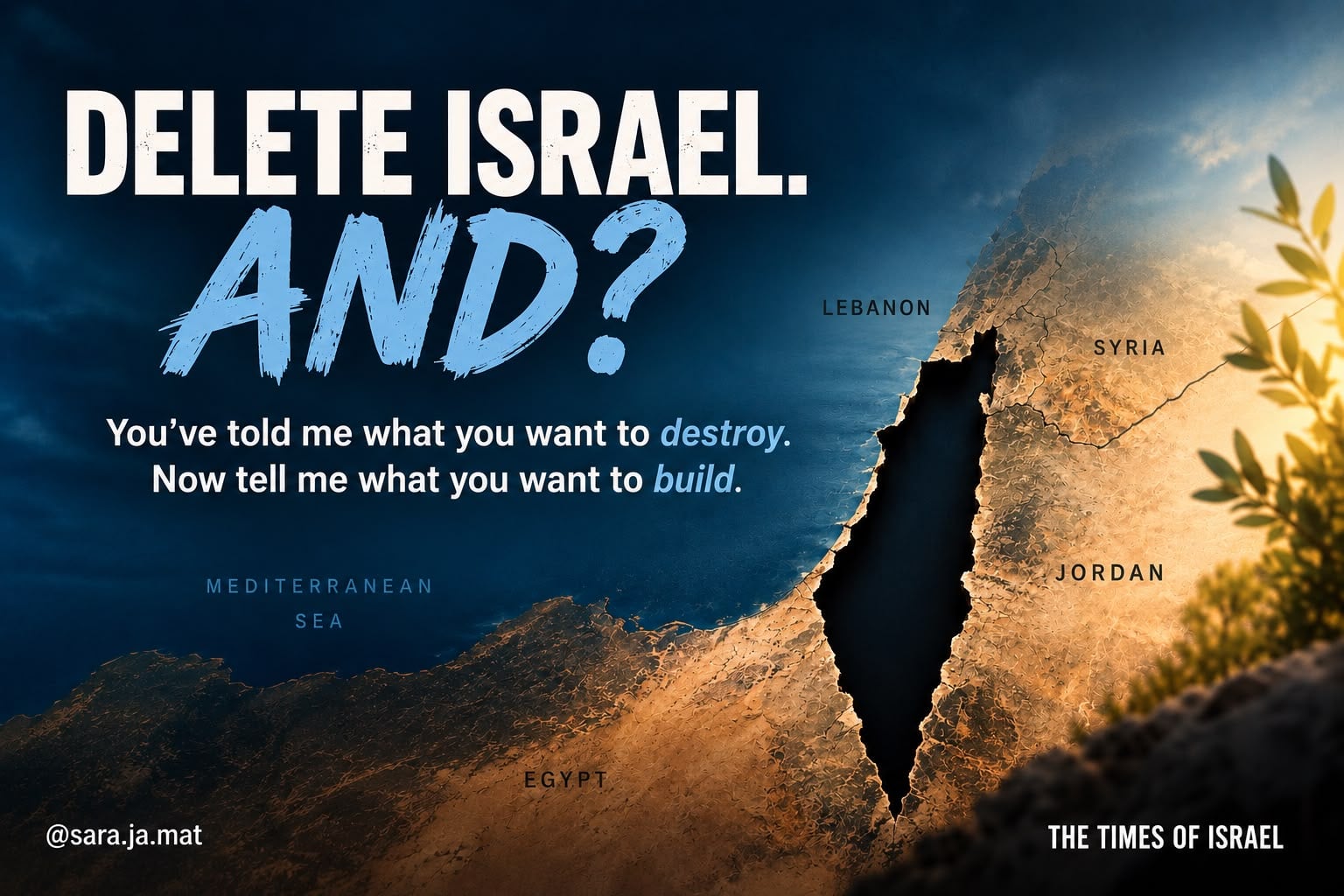
Part I: “Delete Israel.” Okay. And Then What?
This is the first in a three-part series exploring a question that began with two words I kept encountering across social media: “Delete Israel.” Rather than stopping at the slogan, I wanted to follow it to its logical conclusion. If Israel disappeared tomorrow, what actually happens the morning after — to Gazans, to Israelis, to the region and, ultimately, to the rest of us?
Terminology note: Wherever possible, I use “Gazans” when referring specifically to the people of Gaza. I use “Palestinian” primarily when quoting or referring to the terminology used by others. This is a deliberate choice and should not be read as my endorsement of the historical or political claims associated with the term “Palestinian.”
I have been writing publicly about Israel, antisemitism and Jewish identity with increasing frequency since October 7, 2023.
And over the past few months, I started noticing the same two words everywhere across social media:
Delete Israel.
Sometimes they appeared beneath something I had written.
Sometimes they appeared in someone else’s comment section.
Sometimes, especially on platforms like Threads, they appeared as the entire post.
No context.
No explanation.
No argument.
Just:
Delete Israel.
Not: Delete Israel because we have a better plan.
Not: Delete Israel so Gazans can build schools, create jobs, establish a functioning government and have better lives.
Not even an attempt to explain what should come next.
Different people. Different platforms. Same two words.
Eventually, those two words got me thinking.
Okay.
And then what?
Complete the thought.
If, G-d forbid, Israel is destroyed, what happens the next morning?
What replaces it?
Who governs?
Who builds the economy?
Who protects Gazans?
Who protects Israelis?
Where do millions of Israeli Jews go?
And what happens when they refuse to go anywhere?
So I started asking.
And apparently, “And then what?” was a much harder question than I realized.
It seemed to hit a nerve.
Because when I asked people to complete the thought, something fascinating happened.
Many couldn’t.
I had already given them the outcome they said they wanted. This was their hypothetical. Israel was gone. Deleted. There was nothing left to protest, boycott or dismantle.
So I asked:
Now tell me what you build.
Tell me about the lives Gazans are going to have.
Tell me about the schools.
The jobs.
The government.
The economy.
The rights of women.
The protection of minorities.
The freedom to criticize Hamas.
Tell me what happens when the thing you have spent years demanding finally happens.
And remarkably often, there was no answer.
Others responded with still more descriptions of what should happen to Israelis — more death, more suffering, more punishment, more settling of scores.
Which left me genuinely confused.
But I already gave you Israel.
In the hypothetical you demanded, Israel no longer exists.
You cannot destroy it twice.
So why, when I ask you to imagine what comes after Israel, are you still talking about Israel?
And why are you saying virtually nothing about the people you have spent years telling me this movement is supposed to be for?
That was the moment this stopped being a social-media exchange and became an article.
Because I began to wonder whether some of the people I was talking to could actually imagine a “Free Palestine” at all.
Not the flag.
Not the chant.
Not the destruction of Israel.
The life.
Could they picture a Gazan waking up the morning after their supposed victory?
Where does she work?
Where do her children go to school?
Can she criticize her government?
Can her daughter live differently from her?
Can her gay son live openly?
Can she vote Hamas out?
Who protects her if she protests?
What does her government look like?
What does her economy produce?
What is being built?
Those questions should be easy for a movement ostensibly centered on Gazan freedom.
Instead, I kept encountering people who could describe, sometimes in disturbing detail, what they wanted destroyed — but struggled to tell me what they wanted created.
And that distinction matters.
Because opposition to Israel is not, by itself, a vision for Gazan life.
If I remove Israel completely from your hypothetical and your imagination immediately puts Israel back into it because you still need Israelis to punish, then I have to ask what your movement is actually centered on.
Is it building something for Gazans?
Or is it destroying something belonging to Jews?
Those are not the same objective.
So let’s do something social media rarely asks us to do.
Let’s finish the sentence.
Delete Israel.
Okay.
And then what?
Start With the History They Are Not Teaching
There has never been a sovereign Palestinian state in the modern sense — not under Ottoman rule and not under the British Mandate.
And this is where I think language begins doing work that history cannot.
When people speak about “Palestine” as though Israel simply replaced a previously existing sovereign country, I ask basic questions:
Who was its president?
What independent government governed it?
What were its sovereign borders?
What was its national currency?
When was that sovereign state established?
Before 1948, the answers do not lead to a sovereign Palestinian nation-state, and no sovereign Palestinian state came into existence in 1948. The territory had been part of the Ottoman Empire and was subsequently administered by Britain under the League of Nations Mandate. Mandatory Palestine was a distinct political entity under British administration — not an independent Palestinian state.
Today there is a Palestinian national identity and a Palestinian Authority. Mahmoud Abbas is its president. But the Palestinian Authority does not issue its own national currency. Instead, the Israeli shekel circulates as an official means of payment, alongside widespread use of the Jordanian dinar and US dollar.
None of that means Arab communities did not live in the land. They did. Nor does it mean people today cannot identify as Palestinian. A distinct Palestinian national consciousness developed gradually, particularly during the late Ottoman and British Mandate periods, and was later politically organized and institutionalized through movements such as the PLO in the 1960s.
But identity is not the same thing as historical sovereignty.
A people can develop a national identity without that identity retroactively creating a country that did not previously exist.
If you want to argue for the creation of a Palestinian state in the future, make that argument.
But that is fundamentally different from claiming that a sovereign Palestinian country existed until Israel came along and erased it.
Jewish connection to the land, meanwhile, is not a modern political invention.
It is archaeology.
It is history.
It is scripture.
It is an enduring Jewish presence spanning millennia.
History does not become retroactive because a political identity becomes powerful later.
History is complicated.
Slogans are not.
And that distinction matters when the slogan you are repeating calls for the disappearance of a country that actually does exist.
Then Look at What Actually Happened in the Region
Jordan took in a large Palestinian population.
By 1970, the confrontation between King Hussein’s government and armed Palestinian factions had escalated into full-scale fighting. Jordan ultimately suppressed the fedayeen in what became known as Black September, and the PLO shifted much of its operation to Lebanon.
Lebanon subsequently experienced its own devastating entanglement with armed Palestinian factions amid the many forces that fueled its civil conflict.
I am not citing Jordan and Lebanon to assign collective guilt to ordinary people.
I am citing them because armed movements do not magically become stable governing institutions merely because a border changes.
That distinction matters to this thought experiment.
And it helps explain why neighboring governments treat questions of borders, armed factions, displacement and political instability as matters of national security rather than social-media theory.
After October 7, Egypt and Jordan both rejected the mass displacement of Gazans into their countries. Their stated reasons included fears that displacement could become permanent and undermine a future political settlement. Egypt also expressed concern about the security consequences of instability spilling into Sinai.
The countries closest to the conflict understand something social media frequently does not:
The morning after matters.
Now Let’s Talk About the Money
Billions of dollars in international assistance have flowed into Gaza and the West Bank over decades.
Yet Gaza entered October 7 under the rule of Hamas, designated a terrorist organization by the United States and other governments, with a vast underground military infrastructure while much of its civilian population remained dependent on outside assistance.
Today, after years of war, Gaza’s economy and physical infrastructure have been devastated. The World Bank estimates Gaza’s recovery and reconstruction needs at approximately $71.5 billion, describes its labor market as largely nonfunctional, and reports unemployment reaching 78 percent in 2025.
So let’s give the “Delete Israel” argument exactly what it asks for.
Israel is gone.
Who pays for what comes next?
Who rebuilds the hospitals, schools and water systems?
Who creates an economy capable of employing people and paying for the government that replaces the one you just destroyed?
Who attracts investment?
And who ensures that international money goes toward building a functioning society rather than financing another generation of warfare?
Because eventually the hashtags have to become a budget.
Will the celebrities who dedicated songs and speeches to “Free Palestine” still be there when liberation stops being a slogan and becomes sewage systems, tax collection, infrastructure, investment and economic development?
Maybe some will.
But liberation is a slogan.
Governance is a job.
And somebody has to pay for it the morning after.
So Paint the Picture. Israel Is Gone. Now What?
Now let’s leave the money aside.
There is no Israel.
The slogan won.
Who governs?
Hamas?
The Palestinian Authority?
A new government?
Who decides?
Who controls the borders and maintains public order?
Who disarms Hamas and Palestinian Islamic Jihad — or do they keep their weapons?
And if competing armed factions decide they should govern, who stops them?
Then come the questions that matter most to the people who actually have to live there.
Who protects religious minorities?
Women?
Gay Gazans?
Journalists?
Political dissidents?
And perhaps the most uncomfortable question of all:
Who protects Gazans who oppose Hamas?
Because we don’t have to imagine why that question matters.
We already know.
Human Rights Watch has documented Hamas security forces and affiliated gunmen using arbitrary detention, severe beatings, torture, deliberate maiming and extrajudicial executions against suspected collaborators and political opponents. Its investigation included people targeted for their Fatah affiliation — and one man who had simply been overheard criticizing Hamas.
Amnesty International later documented at least 23 extrajudicial executions during the 2014 Gaza conflict, along with the arrest and torture of dozens of others, including members and supporters of Hamas’s political rival, Fatah.
And this isn’t merely history.
On August 21, 2026, Amnesty International reported new extrajudicial executions by Hamas-affiliated forces. It cited a June 2026 UN report identifying 249 cases of extrajudicial executions and severe physical violence in Gaza between August 2024 and early 2026, at least 60 involving Hamas-affiliated forces. Amnesty itself documented nine extrajudicial executions and unlawful killings by Hamas-affiliated forces following the October 2025 ceasefire, including public summary executions.
And when I say Gazans can face death for opposing the people with guns, I mean that literally.
In June 2007, Human Rights Watch documented Hamas military forces capturing Muhammad Swairki, a member of Mahmoud Abbas’s presidential guard, binding his hands and legs and throwing him to his death from a 15-story Gaza City apartment building. Fatah forces retaliated that same night by throwing a Hamas supporter from another high-rise.
So when someone tells me the objective is to “free” Gazans, I have a very simple question:
Who frees Gazans from Hamas?
Who protects the Gazan who says, I don’t want Hamas governing my children anymore?
The journalist who reports something Hamas doesn’t want reported?
The political opponent?
The gay Gazan?
The woman who wants a different life?
The person who simply says no?
Who protects them?
Because eliminating Israel is not a plan for Gazan freedom.
Removing the country you blame for everything does not remove the people holding the guns inside Gaza.
And that is where the next part of this thought experiment begins.
Because Israel may be gone in our hypothetical, but millions of Israelis are still there. Hamas is still there. Palestinian Islamic Jihad is still there. Iran is still there. And the armed factions and regional powers competing for influence do not disappear simply because Israel does.
So who fills the vacuum?
Part II of this three-part series will follow the hypothetical one step further: Israel is gone. What happens to the Israelis? What happens to the Gazans everyone claimed this was supposed to be about when Hamas, Palestinian Islamic Jihad and other armed groups are left competing for power? Who fills the vacuum? And how far do the consequences extend beyond Israel’s borders?
Related Topics
Related Posts