
Life in the AI era: Israel and beyond
What Israel Just Learned About AI and Voting
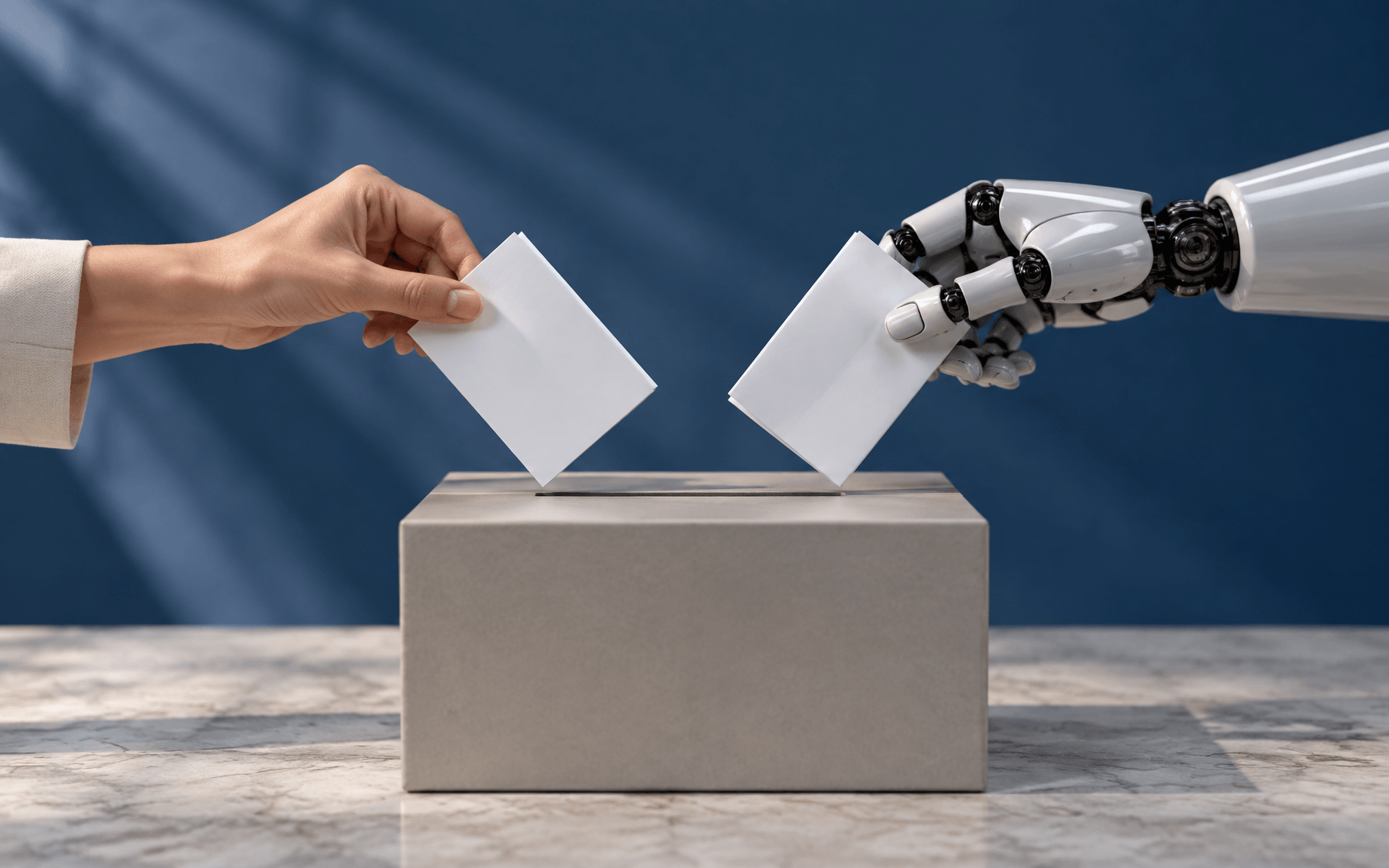
Two Hands. AI illustration by Vainer Marketing.
Israel’s Central Elections Committee put an exact number on honesty. Under rules published on July 26, any campaign material generated or materially altered by artificial intelligence that could pass for something genuinely recorded must carry a label covering at least five percent of the content’s height, or ten points, whichever is larger. On video the label has to stay on screen the whole time. In audio it has to announce itself at the beginning and again at the end.
No other democracy has written it down that precisely. Israelis vote on October 27, which makes this the first national election conducted under a rule that specific, and the most revealing evidence is already in.
The rule did not fail because parties ignored it, and no deepfake has been shown to have swung anything. It ran into something smaller and much harder to legislate: the way a phone draws a screen.
What the regulator actually built
The legal hook is section 2A2 of the Elections (Propaganda Methods) Law of 1959, added as a temporary provision for this campaign. The operating rules were published in the official gazette on July 26 and signed by Justice Noam Sohlberg, Deputy President of the Supreme Court and chair of the Central Elections Committee. The committee’s acting director-general, Dean Livne, sent parties a letter the same day explaining what they now owed.
Two details in the drafting are worth noticing, because both are smarter than the coverage suggests.
First, the duty is narrow on purpose. It attaches only to material that might look genuinely recorded: a person, place, event, document or object that a viewer could reasonably take for a photograph or a real clip. An image that announces its own impossibility is outside it. When the prime minister posted an AI image of a nuclear blast over a city resembling Tel Aviv on October 25, drawing criticism from Yair Golan and from Gadi Eisenkot, who called it hysterical, the thing most people found objectionable was the message, not the realism. The rule was never built to reach that.
Second, a compliant label creates a presumption that the law has been satisfied. That is a real protection for campaigns acting in good faith, and it is the kind of provision that only appears when someone has thought about the people who will try to comply.
What the rules do not contain is a penalty. Enforcement runs entirely on petitions from rival parties to the committee chair.
What 8,611 posts looked like
The best measurement of what actually happened comes from Ze Be AI, a monitoring project led by Prof. Anat Ben-David at the Open University, which has tracked the official accounts of parties and candidates on Facebook, Instagram, X and TikTok since July 28.
By the middle of August the project had collected 8,611 posts, of which 1,097, or 12.7 percent, carried some AI component. Roughly three quarters were videos. Likud accounted for 773 of those items, about 70 percent of everything tagged, followed at a distance by the Democrats on 56, Yisrael Beiteinu on 55, Yashar on 38 and Otzma Yehudit on 30.
That 70 percent figure has been quoted widely and is worth handling carefully, because three things about it are easy to miss. It is Likud’s share of all AI content across every party, not the share of Likud’s own posts that used AI. Netanyahu’s own rate, the one figure reported on that basis, was 16 percent. The project also tags anything containing an AI element, including graphics added to an otherwise authentic clip, which is a far looser standard than the law’s. And Calcalist, reporting the data, attributed much of the volume to Likud’s internal primaries, which gave a large field of candidates a cheap way to produce material.
Ben-David has been careful about this herself. The project, she has said, does not pass judgment on content and is limited to descriptive tagging, it does not treat AI use as inherently wrong, and it looks at everyone rather than selecting targets.
Where it broke
The committee’s own rulings are the honest record, and they cut in every direction.
On July 26, Sohlberg ordered Smotrich’s Religious Zionism to delete a 20-second clip containing an AI scene of Eisenkot shaking hands with Mahmoud Abbas, awarding costs of NIS 5,000 to each of two petitioners. Because the clip had been posted in June, before the new section existed, the ruling rested on the older prohibition on unfair interference.
The reasoning is the part that matters. The clip was not unlabeled. It carried a notice. Sohlberg found the notice inadequate anyway, because of the way the platform displayed it: on a phone, the disclaimer sat inside the caption, behind a “more” tap that most people never press.
That is a rule meeting a product. The committee could specify five percent of image height, and the feed could still fold the text away.
The enforcement that followed landed across the spectrum. In August a petition went against an Eisenkot video. Bennett’s party was ordered to pull operational footage of soldiers. The next day Religious Zionism was told to remove a different AI video, on the separate question of using children under 15. On October 1 a Religious Zionism video was upheld, with the committee noting that it would stand for the judgment of the voter rather than the judgment of election law. On October 15 Eisenkot’s Yashar was ordered to label or remove a digitally altered video of Netanyahu.
The second failure is speed. Dr. Tal Elovits of Reichman University put it plainly to The New Arab:
So the damage was already done even before the committee was able to discuss if it’s illegal.
A clip posted in June drew its order in late July. In a campaign where the peak day saw 138 AI items, a remedy arriving five weeks later is an archival note.
What everyone else should take from it
The alternative approaches are not doing better. In the United States, roughly 31 states have passed AI political advertising laws, mostly disclosure requirements, and the courts have been busy dismantling them. California’s AB 2839 was permanently enjoined in 2025. Hawaii’s law was blocked in January because its mandatory disclaimer swept in satire. One review of recent midterm advertising found that about seven in ten AI-assisted ads carried no disclosure at all. The European Union’s transparency obligations only began applying in August.
Israel built something narrower, more precise and genuinely enforceable, and then discovered the gap between a well-drafted rule and a reader’s thumb. That is not a failure of nerve or of drafting. It is a finding, and it is the most useful thing any democracy has produced on this question so far: the label is not the hard part, the last four inches are, and those belong to the platform rather than the legislature.
Section 2A2 expires one year after polling day unless the Knesset makes it permanent. The question Israel hands the rest of the world is not whether the rule worked. It is whether anyone bothers to keep it and fix it.
Related Topics
Related Posts