
A Moroccan Journalist
When Hassan II Declared Arabs Were the Gravediggers of Their Cause [2/3]
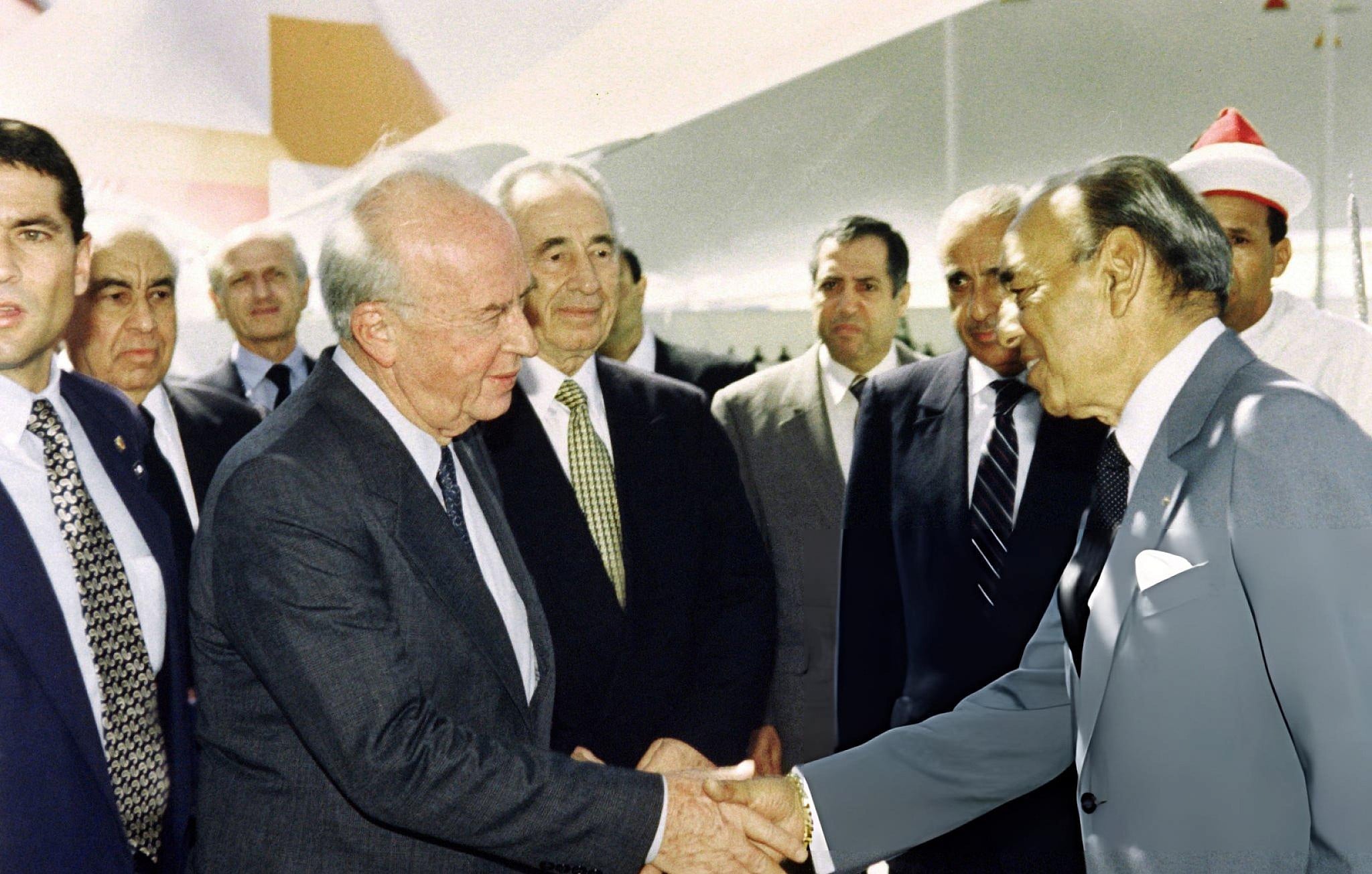
Israeli Prime Minister Yitzhak Rabin (L), flanked by Foreign Minister Shimon Peres, shakes hands with King Hassan II of Morocco on September 14, 1993 in Rabat. Credit: Staff / AFP
This is the second chapter in a three-part series on King Hassan II’s views on Israel. To read the first chapter, click here.
1967: The king predicts disaster – and blames Nasser
The Six-Day War occupies one of the most dramatic chapters in The Memory of a King, not because of the military defeat itself, but because of Hassan II’s brutally honest account of how the Arab world engineered its own catastrophe. The king’s critique is unrelenting. He does not hide behind excuses, conspiracy theories, or the comforting myths that filled the speeches of his contemporaries. He names responsibilities, exposes illusions, and dismantles narratives with an intellectual courage almost unheard of in Arab political discourse.
He begins by recalling how early he understood the danger: “In 1967, I did not mince my words. I stated openly that all responsibility lay with Nasser.” For Hassan II, the path to 1967 did not begin in June of that year. It began years earlier, in the Arab League summits where the leaders shouted slogans, made threats they could not execute, and indulged in a political theater that produced applause at home but disaster on the battlefield.
He recounts the 1965 Casablanca Summit, attended by King Faisal of Saudi Arabia, Nasser, Arif of Iraq, Sallal of Yemen, al-Hafez of Syria, Ismail al-Azhari of Sudan, Boumediene, and King Hussein of Jordan. He watched the most powerful Arab leaders argue, hesitate, and contradict each other. His frustration pushed him to intervene with words that still sound shocking:
“When I saw them hesitating, I asked to speak. There were only two solutions: either we negotiate peaceful coexistence – which, I did not hide, was my preference – or we attack immediately, before Israel’s technological advantage becomes too great. If we refused coexistence, then let us go with one hundred million men, even armed with clubs.”
They listened. But they did not hear. As he puts it with devastating simplicity: “I had only four years of seniority. I was the one who could disturb. They listened to me, but they did not hear me.” This moment is central to understanding the king’s worldview: he believed that Arab politics suffered not from lack of options, but from lack of intellectual courage.
The king’s frustration was not personal. It was systemic. He believed the Arab world had trapped itself in a fatal cycle of rhetoric, self-deception, and political intoxication. He had warned them, but the warnings were swallowed by the noise of slogans.
He describes the flaw in Arab political culture with an unforgettable line: “The Arabs were victims of one of their greatest qualities, but also their greatest flaw: their rhetoric.”
The word – el-kalam – had become a drug. Leaders competed in speeches, not strategies. Promises of victory replaced planning. And nothing symbolized this distortion, Hassan II recalled, more than the words of Ahmad Shukeiri, then head of the Palestine Liberation Organization (PLO), whose pronouncements both stunned and shocked him with their brutality and sheer violence: “We will throw the Jews into the sea, we will rip open the bellies of pregnant women, we will pull out the children and trample them.” For Hassan II, this was not resistance – it “was madness – pure barbarity.” And it poisoned the entire political climate.
And he delivers one of the sharpest critiques ever articulated by an Arab leader: “Destroying Israel, throwing the Jews into the sea – these had become political aphrodisiacs… Any regime that felt shaky absorbed the aphrodisiac labeled ‘anti-Israel.’”
This level of candor – frankly unimaginable in any other Arab memoir of the era – positions the book as a foundational document for understanding why Morocco diverged from mainstream Mashriqi narratives. These passages demonstrate not only his analysis but also his courage. No other Arab ruler of the time dared to describe anti-Israel rhetoric as “an aphrodisiac” that regimes used to maintain internal legitimacy. His realism stands in stark contrast to the atmosphere of the period.
‘The Arabs were the gravediggers of their own cause’ – Hassan II’s political heresy
Hassan II did not shy away from controversial interpretations of Arab political failure. Among the most explosive statements in the book is Hassan II’s harsh assessment of the Arab handling of the Palestinian question: “In this Arab-Israeli affair, the gravediggers of the Arab cause were the Arabs themselves.” He continues: “If the Arabs had accepted the first partition of 1947, we would never have arrived at this point.”
On the build-up to 1967, he adds his most biting line, as he explains the fatal Egyptian error: “You must not threaten Israel without attacking. If you threaten in the morning, you must attack in the evening. Otherwise, say nothing until you are ready.”
And he recounts how Nasser himself privately admitted the scale of the disaster: “In his own words – I would never distort the words of the dead – Nasser told me: ‘When I saw all my squadrons bombed on their tarmac, it was as if the Egyptian army had suffered a heart attack.’”
The king’s realism stands in stark contrast to the delusions around him. He says openly that he never believed Israel would strike first, having become accustomed to Arab noise. But once the war started, the consequences were irreversible. The entrance of Jordan into the conflict – triggered by Nasser’s false claim of victory – resulted in the loss of East Jerusalem.
This is the moment Hassan II describes with unmistakable horror: “The worst was Jordan’s entry into war… because Nasser phoned King Hussein saying: ‘What are you waiting for to come share the victory? We are victorious.’”
The king then delivers a verdict that no other Arab leader of the time would have risked saying aloud: “In 1967, we were humiliated by ourselves. In 1948, we could invoke the sellers who tampered with our weapons. In 1956, we could invoke France and England. In 1967, the responsibility was entirely ours.”
In these pages, the king offers not only history, but a political philosophy – one grounded in realism, self-criticism, and an understanding of Israel that no other Arab leader of his generation possessed. He understood Israel was not an alien body, not a temporary intruder, not a state waiting to collapse. It was a permanent actor in the region, and only intelligent diplomacy – not mythology – would shape the future.
Related Topics
Related Posts