
CFO | Empower Society for Good I Author
When the World Stops Making Sense
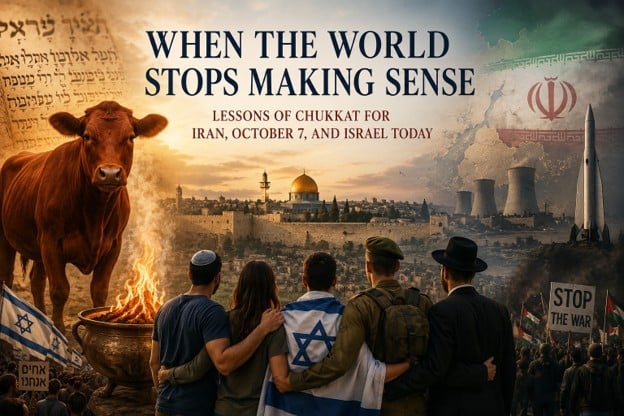
The emerging Trump-Iran deal has left many Israelis uneasy. After years of being told that Iran represents the greatest strategic threat to the region, after watching Tehran finance and arm Hezbollah, Hamas, the Houthis, and other proxies dedicated to Israel’s destruction, and after living through a war that exposed the reach of Iranian influence across the Middle East, Israelis are now being asked to consider the possibility that diplomacy and accommodation may offer a path to greater stability. Perhaps it will. Perhaps it will not. The truth is that none of us knows.
That uncertainty is what makes this week’s Torah portion, Chukkat, feel surprisingly relevant.
Parshat Chukkat opens with the law of the Red Heifer, perhaps the most famous mystery in the Torah. The ritual purifies those who are impure while simultaneously rendering the one who performs it impure. Even King Solomon, whose wisdom became legendary, admitted that this commandment ultimately remained beyond his understanding. The Torah’s message is not that reason is unimportant. Judaism has always encouraged questioning, debate, and intellectual inquiry. Rather, it reminds us that there are moments when events unfold in ways that do not fit neatly into our expectations.
Since October 7, many Israelis have experienced precisely that feeling. We watched Hamas commit the largest massacre of Jews since the Holocaust, expecting that the horror of the attack would generate lasting international solidarity. Instead, within weeks, much of the global conversation shifted away from the crimes of Hamas and toward accusations against Israel. University campuses erupted in protest. International institutions focused their attention on Israel. Antisemitism surged across much of the Western world. Whether one looks at media coverage, diplomatic forums, or public demonstrations, many Israelis have been left asking the same question: how did this happen?
Yet before we focus on the world’s response, it may be worth reflecting on our own.
The months preceding October 7 were among the most divisive in Israel’s modern history. The judicial reform debate was no longer simply a disagreement about constitutional structure or the balance of power between branches of government. It had become a struggle over competing visions of the state itself. Families argued, friendships fractured, and public discourse grew increasingly bitter. Prominent voices warned of constitutional crisis and even civil conflict. For a prolonged period, Israelis seemed more preoccupied with one another than with the threats gathering around them.
Then came October 7. In the face of tragedy, something remarkable happened. The divisions that had appeared insurmountable suddenly seemed secondary. Reservists reported for duty in extraordinary numbers. Religious and secular communities mobilized together. Volunteers filled hotels, hospitals, farms, and military bases. Israelis rediscovered what had always been true: beneath our disagreements lies a shared destiny.
Today, however, we find ourselves once again wrestling with profound internal tensions. The debate surrounding Haredi enlistment raises legitimate and difficult questions about equality, responsibility, Torah study, military service, and the future character of the Jewish state. These issues deserve serious discussion. But what should concern us is not the disagreement itself. Jewish civilization has always been built on argument. The concern is whether our disagreements are once again becoming so consuming that we lose sight of our common purpose.
The sages taught that the Second Temple was destroyed because of sinat chinam—baseless hatred. They did not deny the role of Rome. Rome conquered Jerusalem and destroyed the Temple. Yet the rabbis insisted that external enemies alone could not explain the catastrophe. Something had already weakened within Jewish society itself. A people divided against itself became vulnerable.
We should be careful not to draw simplistic conclusions from history. None of us can claim to know why October 7 happened. None of us can claim to understand God’s intentions or to draw a direct line between contemporary events and ancient teachings. But Jewish history repeatedly presents the same challenge: when confronted with crisis, our first instinct should not only be to examine the actions of others but also to examine ourselves.
The world’s reaction after October 7 exposed uncomfortable truths about international politics, moral inconsistency, and the persistence of antisemitism. Yet it also reminded us of something else. The Jewish people have never survived because the world treated them fairly. We survived because we remained a people. We survived because, despite fierce disagreements, we ultimately understood that our future was bound together.
The Trump-Iran deal may succeed or fail. The international community may continue to disappoint us. The region may become more stable or more dangerous. Much remains uncertain. But one lesson emerges clearly from both Jewish history and the message of Chukkat: when events stop making sense, our greatest responsibility is not to predict the future but to strengthen the foundations that have sustained us in the past.
The mystery of the Red Heifer remains unresolved after thousands of years. The importance of Jewish unity, however, is not a mystery at all.
Questions for Reflection
- When events seem confusing or contradictory, do we look first outward or inward?
- What lessons, if any, should we draw from the divisions that existed in Israel before October 7?
- Have we already begun to lose some of the unity that emerged in the months after October 7?
- Can a Jewish state remain strong if its tribes stop seeing themselves as one people?
- What does sinat chinam look like in modern Israel?
- Is there a difference between passionate disagreement and destructive division?
- What responsibilities do religious, secular, Haredi, and national-religious communities owe one another?
- How should we balance deeply held convictions with the need for national cohesion?
- Why has Jewish unity been such a recurring theme throughout Jewish history?
- Are today’s internal tensions simply political disputes, or do they point to deeper questions about Israel’s identity and future?
- What can we learn from the extraordinary solidarity displayed immediately after October 7?
- If Chukkat teaches us that not everything can be understood, what should our response be when history appears to make little sense?
Perhaps the most important question is this:
In a time when so much feels uncertain, what can each of us do to strengthen the bonds that hold the Jewish people together?
I also wrote another reflection, which I shared on Substack -titled – Can we build peace with our Enemies?
This reflection explores an ancient desert crisis, the story of Merivah, and its surprising relevance to our world today.
When fear spreads, blame often follows. But history’s greatest leaders and societies have found another path: turning adversity into innovation, conflict into opportunity, and scarcity into growth.
From Moses in the wilderness to the pioneers who helped make the desert bloom, this is a reflection on leadership, resilience, and the challenge of building a future that is not held hostage by the past.
Do we strike the rock in anger—or find a way to bring forth water?
https://upgradingesg.substack.com/p/can-we-build-peace-with-our-enemies
Related Topics
Related Posts