Argentinian-Israeli-American Jew. Zionist, curious, committed to embracing complexity.
Where Are You After the Ruins? On Facing What it Takes to Rebuild
The Talmud tells us the Second Temple was destroyed because of sinat chinam, baseless hatred between siblings (Yoma 9b). Anyone who knows the history has to ask the obvious question: didn’t the rabbis know Rome destroyed the Temple? Of course they knew. Legions did the burning. But the rabbis made a choice, and it was a wise one. Rome was not something they could fix. What was happening between us was.
This wasn’t naive history. Later voices in the tradition, the Netziv and the Chafetz Chaim among them, kept complicating the picture, insisting sinat chinam alone doesn’t account for the fall. They knew it was partial. They taught it anyway, because a partial truth you can act on beats a complete truth that leaves you helpless. If we ever wanted a home again, dwelling on Rome’s responsibility wouldn’t get us there. Looking at our own fractures might.
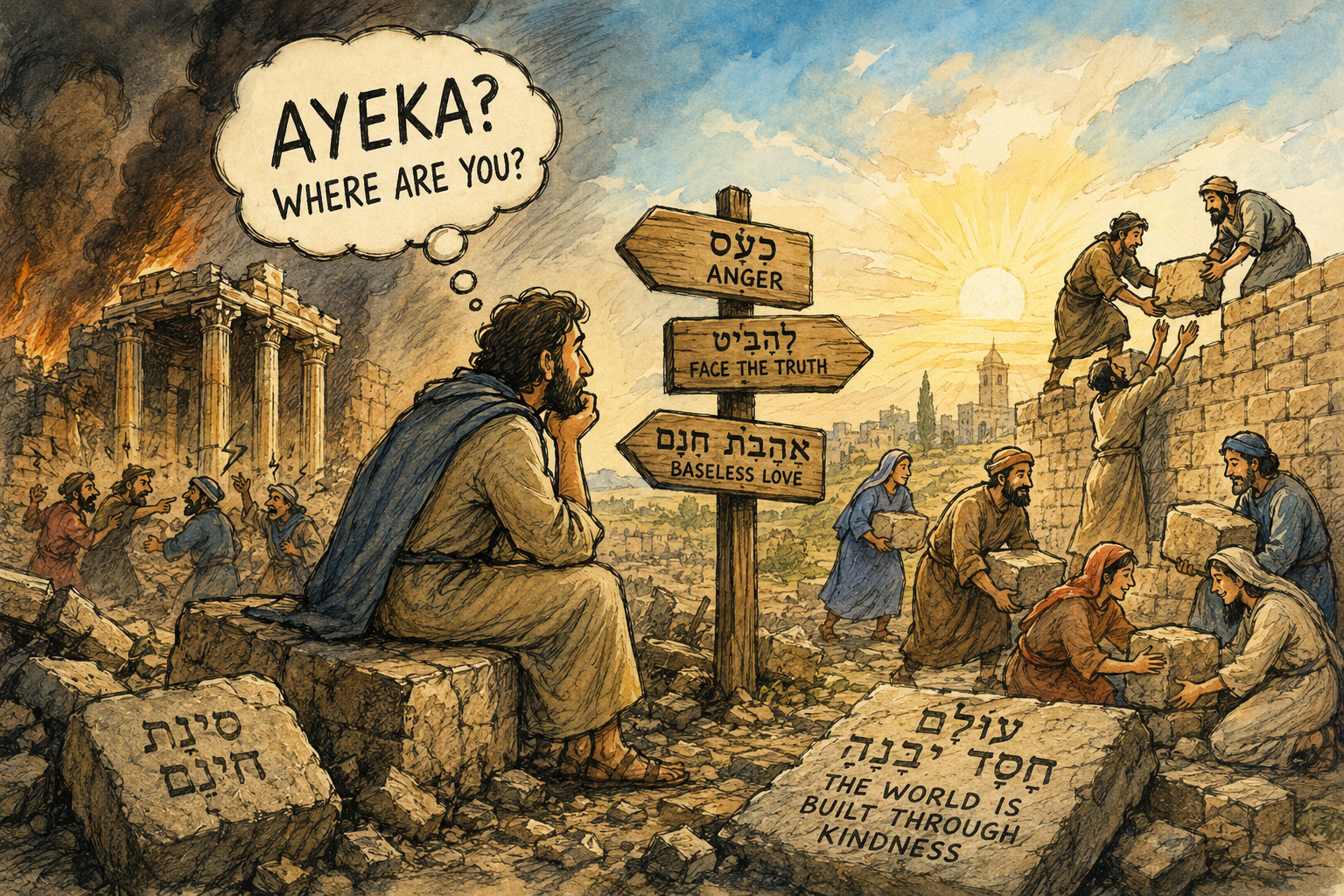
So the question the rabbis leave us with isn’t only “eicha,” how could this happen. It’s the older question underneath it, the one God asks Adam in the garden: “ayeka,” where are you? Same letters. The cry of devastation and the call to self-awareness turn out to be the same word.
Here’s where I think the tradition is pointing, and where I want to push it further. Rav Kook read the moment this way: if we were destroyed by baseless hatred, we rebuild through baseless love, ahavat chinam. The psalmist puts it plainly: olam chesed yibaneh, the world is built through kindness (Psalm 89:3). Not through anger, not through grievance, even when anger is the thing that first gets us moving. Anger can start a march. It can’t lay a foundation.
But love alone is also not the whole answer, and I don’t think the tradition means it that way either. Construction takes something anger often burns off: patience, the willingness to stay in the room, the discipline to name what’s actually wrong instead of talking around it. You don’t build with people you refuse to see clearly.
Which is where I think the real danger sits, and it isn’t hatred. Elie Wiesel said it better than I can: hatred at least admits the other person is real enough to fight. What corrodes a people is indifference, looking away because looking is too much. On Tisha B’Av we sit on the floor and let the grief in precisely because we’ve spent the rest of the year managing it by looking elsewhere.
There’s a concept from trauma work worth borrowing here: invalidation, the denial of someone’s pain becoming part of the wound itself. Tikkun olam, repairing the world, cannot start while we’re still looking away from what hurts. It has to start with recognizing pain. Our own. The pain of the person across from us. This year the reminder feels especi ally timely. We in the United States are already living inside the sting of midterm election slogans, and Israel has been feeling its own version for a while now: elections are about a hundred days out, but the campaigning started earlier, visible in Knesset laws passed with indifference to more than half the society’s pain, timed for the political capital they’d bring. In both places, the loudest voices on every edge of the spectrum are the ones profiting from ignoring what’s painful to others.
The way through that is not only love. It’s facing what’s already in us, naming it honestly, and refusing to look away from it or from each other. That’s the harder mitzvah. It’s also the only one that ends in a home instead of a ruin. Where are you?
Related Topics
Related Posts