CFO | Empower Society for Good I Author
Where Can We Make a Difference?
This reflection has been through many revisions. Perhaps that is appropriate for this time of year. I began with the familiar Rosh Hashanah idea of taking stock. As a CFO, that language comes naturally to me: look honestly at the accounts, understand the assets and liabilities, reconcile what does not reconcile, and use what we learn to make better decisions about the future.
But as I kept writing, another question emerged. We are living through a period in which so much seems beyond our control. Israel is still at war. Families continue to carry the extraordinary burden of reserve duty. Antisemitism has returned with frightening intensity. Governments debate boycotts and sanctions against Israel, while Zionism itself is increasingly portrayed as morally illegitimate. Beyond Israel, we face the ordinary uncertainties of family, health, work, technology and ageing.
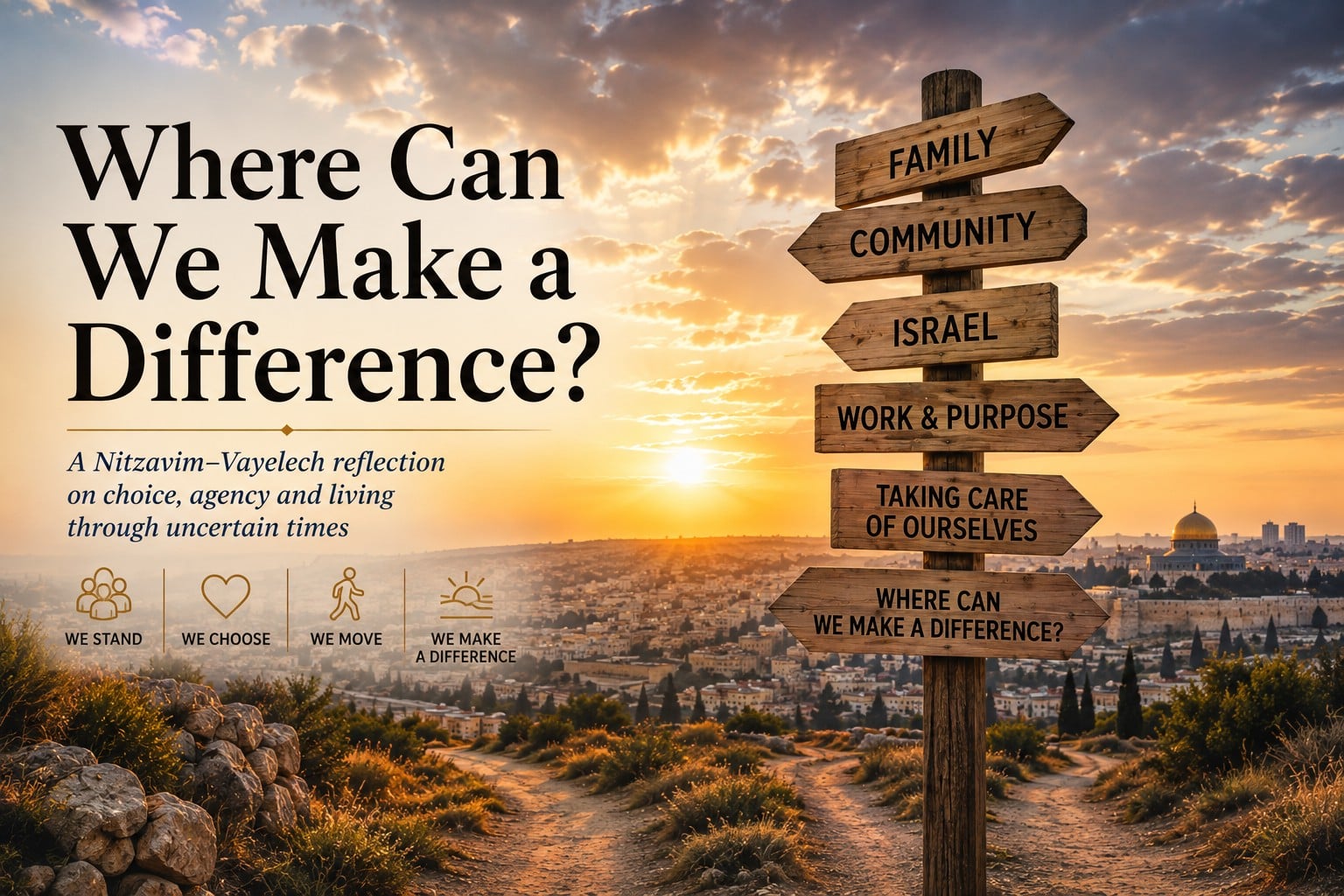
Faced with all this, where do we still have agency? By agency, I mean something quite simple: our ability to make choices and act on them, even when we cannot control the circumstances around us.
That distinction between control and agency has become increasingly important to me. We may not be able to determine the outcome, but we can still decide how we respond, where we put our energy and where we might make a difference.
That question seems to run through Nitzavim–Vayelech. The parsha begins, “Atem nitzavim hayom kulchem”—you are standing today, all of you. The Torah names leaders and elders, men and women, children and strangers, even the woodchopper and water-drawer. Later comes “U’vacharta bachayim”—choose life. And then comes Vayelech: Moses goes.
We stand. We choose. And then we move.
Standing together
The kulchem—all of you—feels particularly important in Israel today. We are religious and secular, Haredi and national-religious, right and left, immigrants and native-born Israelis. We disagree passionately about what this country should become. The challenge is not to eliminate those differences but somehow to continue carrying responsibility together.
My son-in-law Aviad and the men of his tank company have served more than 400 days of reserve duty since October 7. He describes the company as a mosaic of Israeli society—religious and secular, centre and periphery, Hapoel and Beitar. They disagree about plenty, but when required, they stand together.
There is something very Nitzavim about that. It also makes the continuing inability of parts of our leadership, including Haredi leadership, to find a fair and sustainable way of sharing the burden of national service particularly troubling. Perhaps taking stock as a society requires asking not whether we all agree, but whether we still understand that we are responsible for one another.
I chose to come home
Thirty-one years ago, I chose to make aliyah. It remains one of the defining choices of my life. Aliyah means ascent, but for me it also meant attaching my life and my family’s future to the still-unfinished project of rebuilding Jewish national life in our ancient homeland.
The irony is that the Zionism that brought me here is once again presented in parts of the world as morally suspect. This is not entirely new. In 1975, the United Nations General Assembly adopted Resolution 3379, declaring that “Zionism is a form of racism and racial discrimination.” It was revoked in 1991, four years before I made aliyah, yet half a century later some of its assumptions feel strangely familiar.
For me, Zionism meant something very different. After centuries of exile, persecution and ultimately the Holocaust, the Jewish people could return home and recover responsibility for their own future.
This week, I also wrote a separate reflection on Who Writes Israel’s Future — Israel, or the rest of the world?
https://blogs.timesofisrael.com/who-writes-israels-future/
But today there is another question.
What do we do when we have come home and parts of the world tell us that coming home was itself wrong?
After 31 years here, I am not waiting for the world to validate my decision. Nor can I determine what Europe thinks about Zionism, when our wars will end or how this ideological battle will develop. Those things matter deeply to me, but they are largely outside my control. The more useful question is what I do with the life I have chosen.
A question from Zambia
That question has followed me professionally too. Several years ago, my search for ways business might contribute to a better society led me to ESG—Environmental, Social and Governance—and to writing Upgrading ESG: How Business Can Thrive in the Age of Sustainability. I was fascinated by the possibility that business could create economic value while also being a force for good.
I explored agriculture and other ideas that might improve lives beyond my immediate world. During that journey I came to know a nurse living in a poor rural part of Zambia. I hoped that through agricultural ideas and connections I might somehow help her build a more secure future.
I couldn’t. Agriculture is not my field. Good intentions did not give me the knowledge, resources or ability to transform her circumstances.
Recently she contacted me again. Her questions were wonderfully ordinary: How have you been? How is your lovely family?
I replied that my family was well. Then I added something that has become almost ordinary for Israelis: we are still at war.
In a way, perhaps this entire reflection is my longer answer to her question.
How have I been? I am living in a country at war. People close to me have spent hundreds of days defending it. I worry about Israel and its future. There is much about the world I cannot change.
But life is also being lived.
Perhaps my experience with her taught me something important about agency. There is a difference between caring about something and having the agency to change it. We can care deeply and still have to acknowledge the limits of what we can actually do.
Finding some agency
Over time I realised that my professional search needed to move closer to what I actually know. Today I am building PersoFi, an AI-powered CFO platform designed to empower business owners and finance teams with better financial visibility, control and the ability to act.
After decades working as a CFO, this is familiar territory. AI now provides tools that did not exist for most of my career, allowing me to apply accumulated experience in new ways.
For me, PersoFi is ultimately about empowerment. Can an owner understand the business better? Can a CEO make a better decision? Can a CFO or controller gain greater visibility and control? Can a bookkeeper spend less time on repetitive processes and more time doing valuable work?
It may not change the world. Perhaps that is no longer the test. If we can make one business stronger or enable someone within it to become more effective, we have made a difference where we actually have some knowledge and ability.
That brings me back to Nitzavim’s woodchopper and water-drawer. A functioning society depends not only upon its leaders but upon people doing ordinary work with dignity and purpose. The same is true of a business. The CEO matters, but so does the bookkeeper. Empowerment does not always require grand transformation. Sometimes it means giving someone better tools with which to do what is already theirs to do.
Choosing our agency
Most choices that shape our lives are much smaller than making aliyah or starting a business. Perhaps “U’vacharta bachayim”—“Choose life” is lived through hundreds of ordinary decisions: where we put our time, whom we help, what we build, what we let go, and where our efforts might genuinely matter.
Choosing our agency also begins closer to home—with ourselves.
This year, somewhat unexpectedly, I became obsessed with pickleball. For a few hours a week I play, compete, relax and think about very little else. It has become my timeout.
That may seem trivial alongside war, antisemitism and the other subjects occupying my thoughts. Perhaps that is precisely why it matters. A balanced life cannot consist only of carrying the weight of serious things. Choosing life must leave room for taking care of ourselves, for family and friendship, exercise, enjoyment and the ordinary things that restore us.
From there our agency extends outwards—to our families, communities and professional lives. We cannot control them completely. Nor can we solve every person’s problems, end every war or determine what governments and international institutions will do.
Agency is not believing we can change everything. It is recognising where we can make a difference and accepting responsibility for what we do there.
The fact that we cannot do everything does not absolve us from doing something. But neither does doing something require us to do everything.
That is where Vayelech follows naturally. Moses knows he will not enter the Land and has no illusion that Israel’s future will be straightforward. Yet life moves forward. Joshua is told, “Chazak ve’ematz”—be strong and courageous.
I began this reflection thinking about Rosh Hashanah as an annual set of accounts. Perhaps I have come back to something simpler. Taking stock matters because eventually we have to decide what to do next.
This is my story. Yours will be different, and the places in which you find purpose and agency may be very different from mine. But in another sense, we are all in the same boat. None of us controls the world around us. We all face uncertainty. We all care about things we cannot fix. And each of us is challenged to discover where, within those limits, we still have agency.
Perhaps that is why Nitzavim is so powerful as we enter 5787: “Atem nitzavim hayom kulchem.” We are all standing here. Our circumstances are different, our responsibilities are different and the difference each of us can make will be different. But the challenge is shared.
Nitzavim asks us to understand where we stand. U’vacharta bachayim reminds us that we still have choices. Vayelech reminds us that, however uncertain the road ahead, we still have to keep walking.
As we enter 5787, perhaps we should spend a little less time asking how we are going to fix everything that is wrong with the world and ask something closer to home. Where can we take better care of ourselves? Where can we strengthen our families and communities? Where can we use what we know to empower someone else? And where do we need the humility to accept what we cannot change?
Our stories are different. Our challenge is shared: where can we make a difference?
We cannot do everything. But we are not powerless.
Related Topics
Related Posts