
Where difference becomes power
An Ethics of Position in Parashat Ki Teitzei
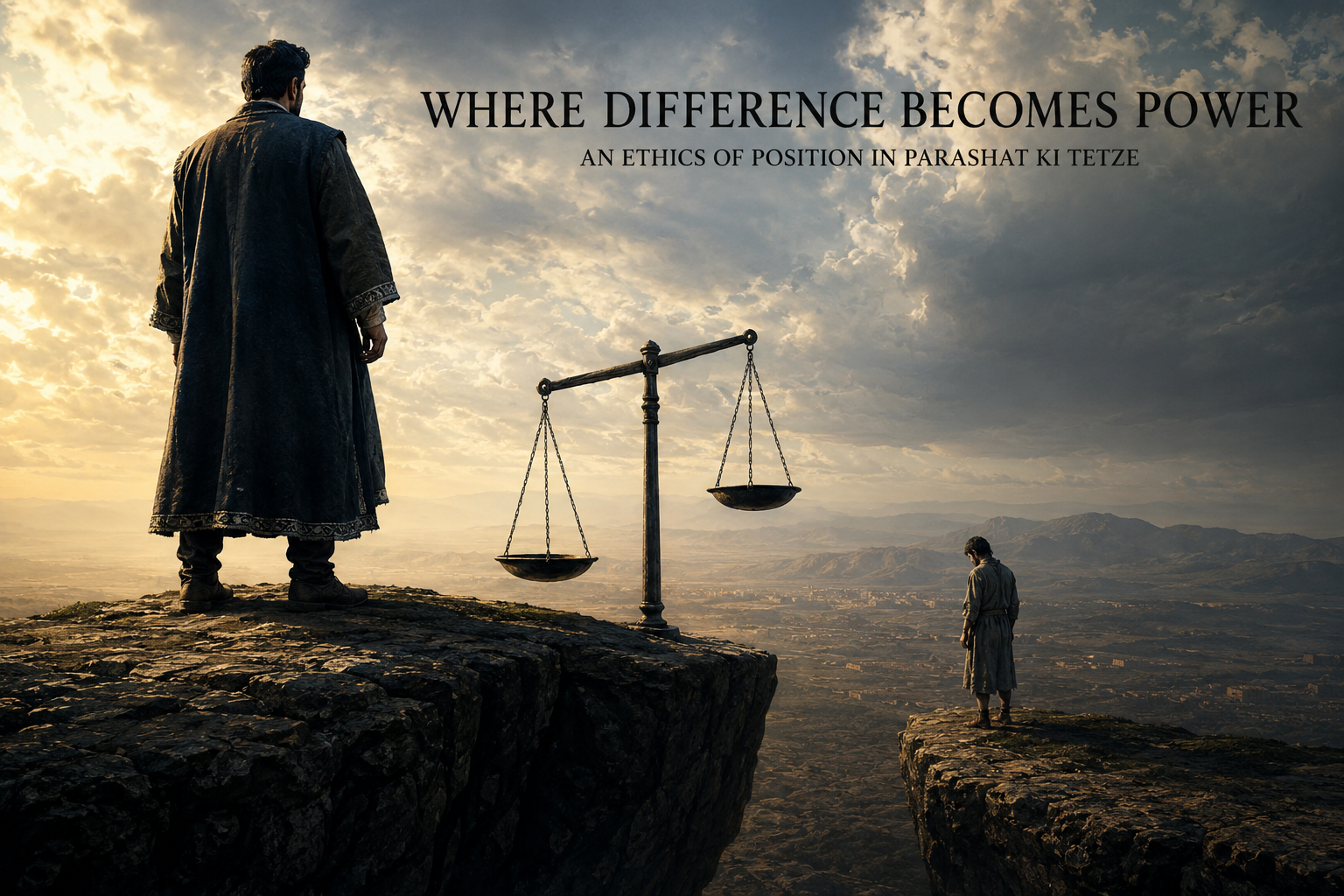
I think, based on my structural and epistemological reading of the parashah, that Ki Teitzei is not primarily constructed as a collection of scattered laws. It is a discipline of consciousness in the face of asymmetry.
Its deeper unity does not lie in the similarity of its cases. They are, in fact, remarkably different. The unity lies elsewhere. In each scene, one person possesses something the other does not possess in equal measure: ability, position, knowledge, strength, an advantage. The structural question running through the parashah is what happens when that difference comes into contact with human freedom.
This is why its message is not simply moral in the sense of ‘be good’. It asks more than that. Human freedom needs an architecture. Without structure, advantage can become appropriation, strength can become abuse, knowledge manipulation, ownership something absolute. The Torah introduces limits — not to destroy human capacity, but to give it order.
Seen this way, Ki Teitzei offers a remarkably precise understanding of the human being. We are not dangerous only when we hate. We can also become dangerous when we desire, when we possess, when we know more, when we hold authority, when we can decide for someone else — or simply when we can profit without being seen. The problem is not only open violence. There is also the quieter possibility of turning a legitimate difference into domination.
That is why I think the parashah is building something close to an ethics of position. It does not begin by asking, ‘What kind of person are you?’ It asks, ‘Where do you stand in relation to the other person, and what do you do from that position?’ The distinction matters. Responsibility does not arise from an abstraction. It arises from a concrete relationship.
Epistemologically, this also explains why the parashah can appear fragmented when viewed from the valley, yet coherent when seen from the helicopter. Down in the detail, we see different laws. From above, we see the same function recurring under different conditions: an asymmetry is identified, its exploitation is restrained, and the relationship is brought back into the field of responsibility.
The ending with Amalek pushes this structure to its extreme. Amalek is not simply an external enemy. Functionally, Amalek represents the extreme use of advantage: finding the vulnerable precisely because they are vulnerable, then turning that weakness into an opportunity. The ending therefore does not introduce a new subject. It takes what has been present from the beginning and drives it to its limit.
For me, then, the central message of Ki Teitzei is this:
Human strength is measured not by how far it can impose itself, but by how far it can govern itself when it has the power to impose itself.
And there is another message beneath it, perhaps deeper still:
Responsibility begins where the difference between two human beings ceases to be merely a difference and becomes power.
That is the heart of Ki Teitzei.
Responsibility appears when difference ceases to be simply difference and becomes power.
And then the Torah asks only one question:
What do you do with that power?