Who Are We Negotiating With? A Deal Can’t Work
Two months into a war with the United States and Israel, Iran doesn’t have a functioning chain of command. And yet the entire world is waiting for Tehran to sign a deal.
I live in Modi’in. I have kids. I’ve spent more time in my mamad this year than I have in my living room. So when I watch the coverage of these Pakistan-mediated negotiations, the ceasefire extensions, the proposals and counter-proposals, I have one question that nobody in the international press seems willing to answer clearly.
Who, exactly, are we negotiating with?
Because from everything coming out of Tehran this week, the answer appears to be: nobody who can actually deliver.
A Supreme Leader Who Can’t Lead
Mojtaba Khamenei was severely wounded in the February 28 strike that killed his father. He has not appeared publicly and communicates through IRGC aides or limited audio links. According to insiders, his role has become one of assent rather than command, endorsing outcomes forged through institutional consensus rather than imposing authority.
The man at the apex of the Islamic Republic’s system is, by all credible reporting, a rubber stamp. He owes his elevation to the Guards, who backed him as a reliable guardian of their hardline agenda. He didn’t earn the role. He inherited it while bleeding on a hospital bed. And the people who installed him are now running the country through him.
The IRGC Fills the Vacuum
The IRGC is no longer operating behind the scenes but is openly emerging as the dominant force in Tehran. According to reporting from Reuters and Iran International, IRGC commander Ahmad Vahidi has insisted that all critical positions must be managed directly by the Revolutionary Guard under wartime conditions.
Iran’s elected president, Pezeshkian, has repeatedly sought an urgent meeting with the Supreme Leader but has been unable to establish contact. A military council of senior IRGC officers now controls access to the center of power, preventing government reports from reaching Mojtaba and effectively isolating him from the civilian government.
Think about that for a moment. The elected president of Iran cannot reach his own Supreme Leader. The civilian government has been walled off by generals. And these are the people the world expects to negotiate a nuclear deal.
Negotiators Without Authority
Secretary of State Rubio described this problem with unusual bluntness: American negotiators have to negotiate with Iranians, who then need to negotiate with other Iranians to determine what they can agree to or offer.
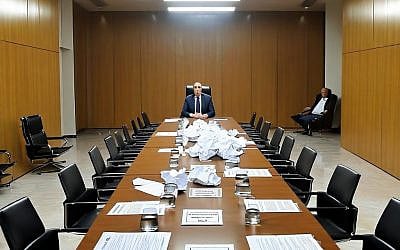
A senior Pakistani official involved in the mediation said it takes the Iranian side two to three days just to respond to basic proposals because there is no single decision-making structure.
The practical consequences are staggering. When Vice President Vance prepared to fly to Islamabad for a second round of talks, IRGC generals blocked the civilian negotiators from traveling to Pakistan. Air Force Two sat on the tarmac at Joint Base Andrews for hours before the trip was scrapped entirely. The negotiators who had discussed terms in the first round were overruled by the same military establishment that put Mojtaba in power.
Hardliners Fighting Hardliners
Even within the hardline camp, there’s no unity. Ultra-hardline lawmakers supporting former nuclear negotiator Saeed Jalili refused to sign a joint statement supporting the negotiating team that went to Islamabad. Jalili publicly demanded that Mojtaba state whether the negotiations were conducted under his instructions, calling Ghalibaf’s team “coup plotters.”
IRGC-affiliated media outlets are attacking each other in print, with Tasnim News and Raja News trading accusations of undermining national unity.
Rubio summed up the Iranian system this way: there are hardliners who understand they need to run a country and an economy, and there are hardliners driven by an apocalyptic theological vision who don’t care. According to him, the apocalyptic faction holds ultimate power.
So who signs a deal? The diplomats who get overruled by generals? The generals who answer to a wounded leader they installed? The wounded leader who can’t even meet with his own president? Or the ultra-hardliners who think the negotiators are traitors?
The Enforcement Problem
Even if, by some miracle, all these factions align long enough to put ink on paper, the enforcement question is enormous. Iran submitted a proposal that would set aside the nuclear issue entirely and focus on ending hostilities and reopening the Strait of Hormuz first. Washington insists the nuclear question must be addressed from the start. Neither side can afford to show flexibility because both sides view concessions as weakness.
But the deeper issue is structural. A deal requires a counterparty who can commit and deliver. Iran doesn’t have one. The IRGC can veto any agreement the diplomats reach. The Supreme Leader can’t override the IRGC even if he wanted to. And the ultra-hardliners are already framing any compromise as treason.
Former American negotiator Aaron David Miller captured the shift: Iran has moved from divine power to hard power, from the influence of the clergy to the influence of the IRGC. That transition means that the old model of negotiation, where the Supreme Leader had final say and could cut through internal disagreements, is gone.
Israel Lives in the In-Between
What the analysts and diplomats and cable news panels don’t have to sit with every night is the uncertainty.

Will the ceasefire hold through Shabbat? Will it collapse on Sunday? Is Iran using every day of stalled talks to rebuild what was destroyed in February? Are centrifuges spinning again somewhere underground that the IAEA can’t access? Iran has already stated it must retain the right to enrich uranium and that the amount and level are “negotiable,” which means the nuclear infrastructure isn’t going anywhere. It’s being repositioned as a bargaining chip, not a concession.
And then there’s the question that keeps me up more than any other: what if a deal gets done, and it’s the wrong deal?
Washington’s priorities are not our priorities. The U.S. wants the Strait of Hormuz reopened. American consumers are paying $4.30 a gallon and midterm elections are approaching. Trump wants a win he can post on Truth Social. If Iran offers to reopen shipping lanes in exchange for sanctions relief and the nuclear file gets pushed to “phase two” or “later talks,” Washington may take that deal. Former U.S. official Henry Ensher said openly that separating the nuclear issue from the Hormuz question would be a potential strategic victory for Iran.
A strategic victory for Iran is a strategic disaster for Israel.
Every day the nuclear question gets deferred is a day Iran has to reconstitute. Every “phase two” that gets kicked down the road is a phase that never arrives. We’ve seen this movie before. The 2015 JCPOA was supposed to include ballistic missiles in follow-up talks. Those talks never happened. Sunset clauses expired. Enrichment resumed. And Israel was left staring at an adversary with a shorter breakout timeline and a longer list of proxy armies.
The American calculus is understandable. Gas prices, midterm politics, global trade disruption. But our calculus is different. We measure outcomes in kilometers from the border. In flight time of ballistic missiles. In whether the sirens will sound during school hours.
Israel’s military intelligence chief has stated plainly that the country remains in a multi-front operation and must be prepared for continued combat throughout 2026. Israel’s defense minister publicly said he’s waiting for U.S. approval to resume strikes against the Khamenei lineage and cripple Iran’s economic infrastructure. That’s the posture of a country that doesn’t trust the negotiating table to deliver security. Because every round of talks that collapses or produces a half-measure leaves us holding the risk.
And what about the days between? The ones nobody writes about? The Tuesday afternoon when the news alert says the ceasefire has been extended by another week, and you feel relief for about four seconds before you realize “extended” means “still temporary.” The Wednesday morning when you read that Iran’s proposal was “better than expected” and you wonder: better for whom? The Thursday night when your kid asks if we’re going to the park this weekend and you say yes, even though you have no idea what the weekend holds.
That’s life here. Not the geopolitics. Not the cable news chyron. The in-between. The constant recalibration of normal. The knowledge that the biggest players in the room are negotiating over shipping lanes and enrichment levels, and the 10 million people who live closest to the consequences aren’t at the table at all.
No Deal May Be Better Than a Bad Deal
The uncomfortable truth is that there may not be a deal to make. Not because the terms can’t be agreed on, but because there’s no one in Iran with both the authority and the willingness to agree. And even if there were, a deal that satisfies Washington’s economic and political needs while leaving Iran’s nuclear program intact and its missile arsenal untouched would be worse than no deal at all.
Israel doesn’t need a ceasefire announcement. Israel needs a security architecture. Those are two very different things. One makes for a good press conference. The other keeps families alive.
We’ve been here before. We signed on to frameworks that had expiration dates. We watched the international community celebrate agreements that deferred the hardest questions. And every time, when the ink faded and the follow-up talks never materialized, we were the ones left recalculating how many minutes we had between the siren and the impact.
So when I hear that talks are progressing, that proposals are being exchanged, that the ceasefire has been extended again, I don’t feel optimism. I feel the weight of the question that no one on the world stage seems willing to ask out loud: will this deal protect Israel, or will it protect everyone except Israel?
And until someone can answer that with specifics, not promises, I’ll keep the mamad stocked and the flashlights charged. Because the people negotiating this deal don’t live here. And the people who live here don’t get a vote.