
Russian-American-Israeli Palestinian. Palestine is Israel.
Who Decides What Is Real?
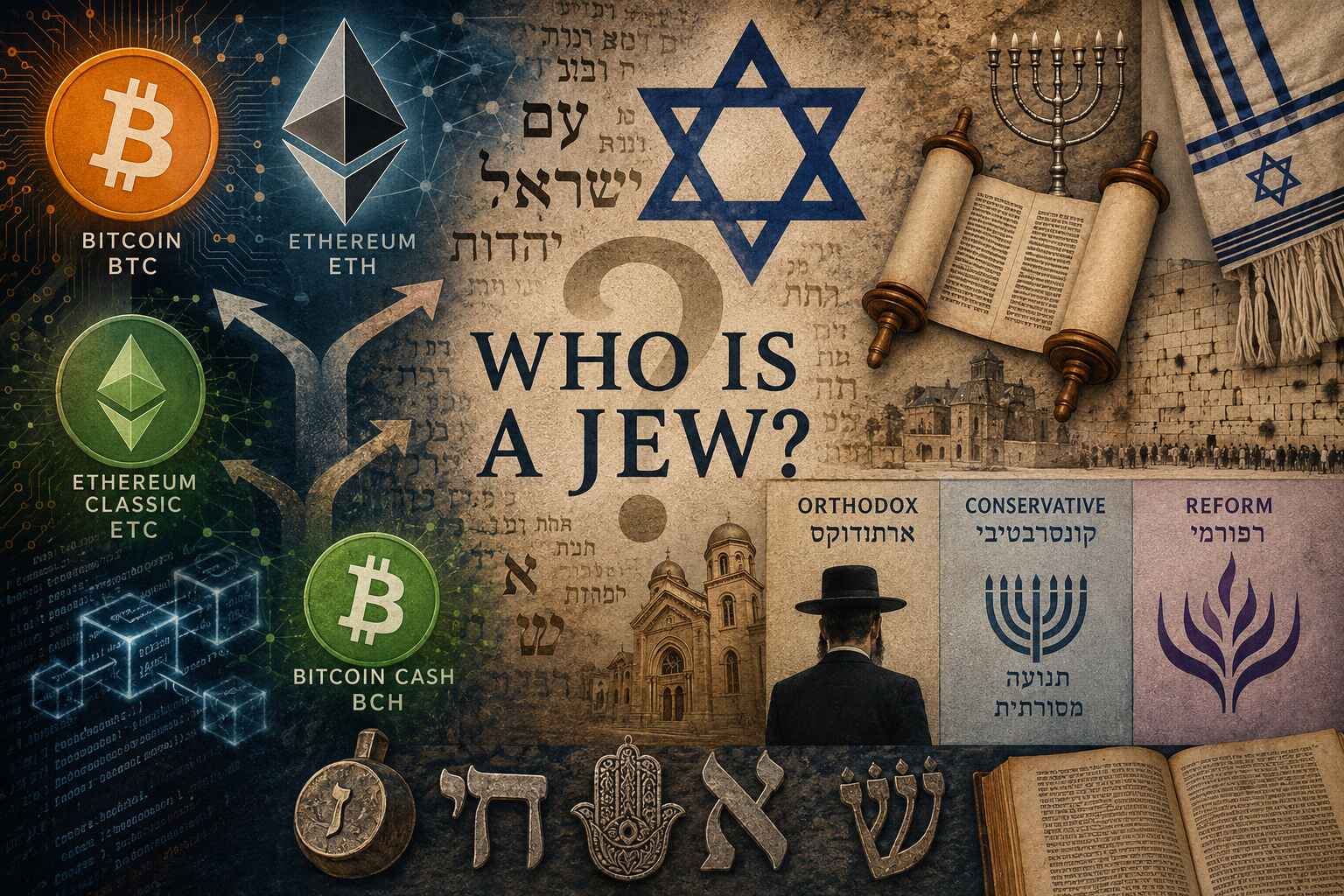
Who is a Jew? Who Decides What Is Real? Crypto meets religion. Image © Ivan Bassov, 2026. Licensed under CC BY 4.0.
Bitcoin, Ethereum, and the Question of Identity
When people argue about Bitcoin, Ethereum, or even questions like “Who is a Jew?”, they often assume there must be a single correct answer hidden somewhere.
But in reality, many questions of identity work in a surprisingly similar way:
They are not solved by mathematics or history alone—they are settled by continuity and recognition.
In my three-part series Religions as Blockchains (Part I, Part II, and Part III), I explored the surprising structural similarities between religious traditions and blockchain systems. Beginning with genesis events, forks, and schisms, the series examined how both religions and blockchains preserve continuity while adapting to change. It then explored questions of authority, legitimacy, heresy, consensus, and interpretation. The final installment reversed the lens entirely, asking whether blockchain communities themselves can be understood as quasi-religious systems organized around competing visions, shared narratives, and collective belief.
This raises a deeper question. If both religions and blockchains experience splits, competing claims of legitimacy, and rival interpretations of continuity, how do we decide which branch is the “real” continuation of the original? The answer turns out to illuminate not only Bitcoin and Ethereum, but identity itself.
When One Thing Becomes Two
Cryptocurrencies make this visible in a very clean way.
Occasionally, a blockchain community reaches a profound disagreement about the future of a project. Sometimes the disagreement becomes so deep that the blockchain itself splits into two separate versions.
This happened with Bitcoin and Bitcoin Cash, which emerged from a dispute over how Bitcoin should scale. It also happened with Ethereum and Ethereum Classic after a controversial decision to reverse the effects of a major hack. In both cases, each side believed it was preserving what mattered most about the original project.
After the split, both chains share the same past. They literally begin from the same history.
From that point on, however, they diverge.
And now the key question appears:
- Which one is Bitcoin?
- Which one is Ethereum?
There is no technical command in the system that answers this.
Instead, something else happens.
Identity follows recognition
After a split, the “real” version is not chosen by code. It is chosen by recognition.
In practice, recognition comes from the parts of the ecosystem that people rely on:
- exchanges
- wallets
- developers
- major users
- financial infrastructure
When these groups mostly agree, identity stabilizes.
That is how:
- BTC became “Bitcoin”
- ETH became “Ethereum”
Not because a central authority declared it, but because the ecosystem aligned.
The other chains—Bitcoin Cash or Ethereum Classic—did not disappear. They simply became alternative continuations of the same starting point that did not receive the dominant recognition.
Yet many supporters of those projects continue to view their own chains as the authentic continuation of the original vision. To this day, some Bitcoin Cash advocates argue that BCH better embodies Bitcoin’s founding purpose as peer-to-peer electronic cash, while many Ethereum Classic supporters maintain that ETC preserves the original, unaltered Ethereum ledger.
In other words, the debate never fully ended. One interpretation became dominant, but alternative claims to legitimacy survived.
Identity Is About Continuity, Not Origin
A common intuition is:
“The real version must be the one that came first.”
But in systems like blockchains, that is not enough.
After all, both branches come from the same origin. Before the split, they were literally the same blockchain, sharing the same history, transactions, and community.
Once a fork occurs, neither side can claim a unique connection to the past. Both inherit it.
So the question shifts:
Not “Which came first?”
but “Which continuation is recognized as the ongoing one?”
Identity, in this sense, is about which path the world treats as the continuation of the story.
The past may be shared. What distinguishes the branches is not where they came from, but how they continue—and how that continuation is recognized by others.
The Same Pattern in Human Identity
This pattern is not unique to technology.
In many social and historical questions, identity also depends on recognition of continuity.
For example, when asking:
“Who is a Jew?”
different communities may give different answers based on different criteria of continuity:
- descent through lineage
- religious conversion standards
- self-identification
- communal recognition
These criteria do not always align, and there is no single global authority that all groups accept.
The divisions among Orthodox, Conservative, and Reform Judaism illustrate this dynamic. All trace their roots to the same historical tradition, yet they sometimes disagree about conversion standards, religious authority, and the boundaries of membership. As a result, a person recognized as Jewish by one community may not be recognized by another.
So again, the question becomes less about a hidden fact and more about:
which continuity rules a community recognizes as defining membership.
Shared Structure: Competing Continuations
Both cryptocurrency forks and identity questions like religious belonging share a simple underlying structure:
- There is a shared starting point (history or origin)
- There is a divergence (multiple continuation paths)
- Different groups choose different criteria for continuity
- One interpretation becomes dominant through recognition and practice
This is why debates over “real Bitcoin” or “real Ethereum” feel familiar to debates over identity in human communities.
They are not disagreements about data.
They are disagreements about which continuity counts as the continuation of the story.
Why These Debates Persist
These questions remain open not because people lack information, but because:
- there is no single authority that defines continuity for everyone
- different groups value different criteria of legitimacy
- identity is enforced socially, not mathematically
Once recognition stabilizes, the system feels obvious in hindsight.
But during the split, multiple “real versions” can exist at the same time.
Beyond Forks: When New Claimants Appear
Not all identity disputes arise from forks.
In Religions as Blockchains, I distinguished between forks and clones.
A fork inherits the ledger. It shares a common history before diverging.
A clone copies ideas, structures, or beliefs, but does not inherit the same historical chain of continuity.
The distinction appears in both technological and religious history.
Orthodox, Conservative, and Reform Judaism resemble forks. They share a common historical lineage while disagreeing about authority, interpretation, and membership.
Clones, by contrast, emerge when a group attempts to recreate or reconstitute an earlier tradition rather than continue an existing institutional lineage.
Examples include restorationist religious movements such as the Church of Jesus Christ of Latter-day Saints and Jehovah’s Witnesses in their self-understanding as restorations of an earlier faith tradition.
In a similar way, movements such as Black Hebrew Israelites represent claims of identification with an ancient lineage that are not recognized as continuations of the historical Jewish communal chain by mainstream Jewish denominations.
Black Hebrew Israelites are a decentralized religious movement whose followers believe that African Americans—and, in some interpretations, Hispanic and Indigenous American populations—are the true descendants of the ancient Israelites. The movement is highly fragmented and ranges from peaceful, observant communities to extremist and antisemitic sects.
This introduces a different kind of identity question. Instead of asking which continuation of a shared history is authentic, the question becomes whether a newly established claimant can acquire legitimacy relative to an older tradition at all.
Identity Reversal Narratives
At the institutional level, Israel’s framework is grounded in its legal structure, including the Basic Law: Israel as the Nation-State of the Jewish People. Within this framework, questions of Jewish identity are not determined solely by competing historical narratives, but also by state-defined legal criteria that govern citizenship and immigration.
This is where identity disputes move from historical debate into the domain of state sovereignty.
As discussed in The Words We Surrender, some anti-Israel commenters attempt to construct narratives that blur and confuse questions of identity. Some have claimed that Ashkenazi Jews are not Jews at all, but merely Europeans falsely claiming Jewish identity. Others argue that Mizrahi Jews are simply Arabs pretending to be Jews. Still others assert that today’s “Palestinians” (UNRWA clientele) are the “real Jews,” allegedly descended from ancient Israelites who converted first to Christianity and later to Islam, while today’s Jews are impostors.
From this perspective, the argument often shifts into a kind of identity reversal, in which Arabs are framed as the “real Jews,” and Jews as impostors. Some even extend this logic to claim that groups such as Black Hebrew Israelites—or any group they selectively endorse—should be recognized as the legitimate Jewish people for purposes such as immigration to Israel.
The underlying rhetorical move is to turn every identity category into a question of accusation and inversion: who is “real” and who is “fake.”
Sovereignty and the Definition of Jewish Identity
My response to such narratives is that Israel, like the United States, is a sovereign country. It determines its own immigration laws, its own criteria for citizenship, and who is permitted entry.
For the purposes of immigration, Israel defines who it recognizes as Jewish, and this definition does not need to conform to external narratives, interpretations, or competing standards of Jewish identity.
That is what sovereignty means.
In practice, different groups, institutions, and movements may define Jewish identity according to different criteria, and they often do. Religious authorities, denominations, communities, and political frameworks do not always agree, and each operates within its own system of recognition.
In that sense, multiple “definitions” of Jewish identity can coexist, just as multiple blockchain forks can exist under different names and communities.
However, coexistence does not imply mutual recognition. A definition accepted within one system is not automatically accepted within another.
Sovereignty is not the claim that all definitions are equal. It is the claim that a state operates under its own recognized authority in defining legal categories such as citizenship and immigration, regardless of external interpretations.
Conclusion: Realness as Recognition
Whether in blockchains or human identity questions, “realness” is rarely a purely technical property.
It is the outcome of a process:
shared history + divergence + collective recognition
This pattern appears both in forks—where competing continuations emerge from a shared origin—and in clones, where identity claims arise outside an inherited chain of continuity and depend instead on whether they are recognized as legitimate within relevant communities.
That is why Bitcoin and Ethereum are not defined only by code, why religious and communal identity cannot be reduced to facts alone, and why sovereignty ultimately determines legal recognition in human societies.
In both cases, what is “real” is ultimately what a sufficient part of the world continues to treat as real.
–
See Also
Related Topics
Related Posts