
Using science background to write rationally about Israel, Jews and Academia
Why Britain Did It: From Belfast to Ramallah
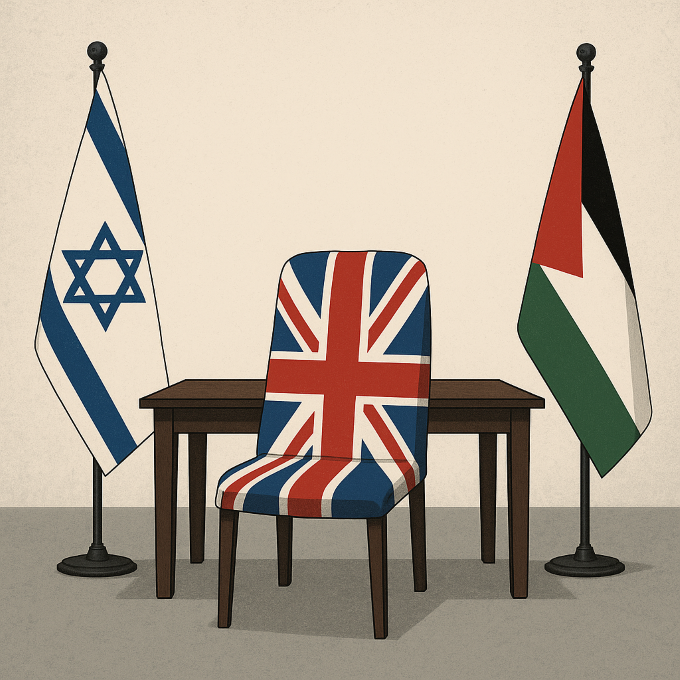
Everybody is discussing recent recognition of Palestinian state by major European countries. Supporters of Israel respond in unison, condemning the move as a surrender to terror and a reward to Hamas for the atrocities of October 7. This view is shared across the Israeli political spectrum, government and opposition alike, as well as by most of Israel’s supporters in Europe and the United States. At a risk of appearing imprudent I will repeat what I have argued in one of my previous posts: this position is irrational as well as intellectually hollow. I have already been called “an enemy of Israel” by one of former functionaries of currently dysfunctional Avoda party, a member of Rabin cabinet during Oslo process, so I do not think I can be called anything worse than that.
In this post, however, I want to shift focus. Rather than debating the rationality of Israel’s response to this diplomatic tsunami, I want to examine the arguments that try to explain its causes. I try to understand in a way, which would be satisfactory to me, why, say, Britain and France have done it, and why now. Typical answers circulating both in social media posts and in essays by respected pro-Israel political scientists and mainstream journalists form a familiar trifecta: pressure from growing Muslim constituencies, the persistence of European antisemitism, and the mobilization of the younger voters radicalized by prevailing academic discourse that frames anti-Zionist rhetoric as anti-colonial struggle and reinforced by mass media as morally justified.
I admit that these factors are real and influential, but to treat them as a sufficient explanation of the actions of Starmer, Macron, and their peers is, in my view, an intellectually lazy and dangerously cynical approach. None of these factors can be meaningfully influenced by Israeli government, academics and public intellectuals, and framing the problem in this way denies Israel any agency in shaping its own diplomatic future. If this framework is adopted, Israel indeed does not have another option but autarky and the Spartan destiny recently invoked by Netanyahu. I see this approach as leading Israel to a catastrophe.
Here I want to propose an alternative way of looking at the situation, one that, if taken seriously, could allow Israel’s leaders to shape the diplomatic process rather than merely endure it. I have no illusion that my words could influence the thinking of Israeli politicians or their supporters. I write mainly to clarify my own understanding of the situation, and perhaps to help others see that there is an alternative to the prevailing orthodoxy.
In what follows I focus on Britain in particular, and I begin with a critique of the orthodox trifecta.
First let me address the argument about electoral pressure. Yes, the Muslim share of the UK population grew from around 4.5% in 2011 to 6.5% in 2021. That is a demographic fact. What it is not, despite the shrieks of the right, is evidence that Britain is ‘turning into a Muslim country.’ Still, it is a shift with real potential political consequences. However, because Muslim voters are heavily concentrated in specific urban constituencies, their influence is geographically limited. Analysts estimate they could decisively affect the outcome in perhaps 30 to 80 marginal seats — a meaningful bloc, but far from determinative in national terms. Even though more than 150 Labour MPs signed a letter urging Starmer to recognize Palestine, this does not seriously endanger his working majority of 157 seats. Only a small fraction of those signatories represents constituencies where Muslim voters are numerous enough, and mobilized enough, to pressure them into breaking party discipline or threatening the stability of the government.
Next let’s talk about British antisemitism as a factor in Starmer’s decision. There are several problems with this assertion. First, Starmer inherited Labour Party from Jeremy Corbyn, under whom antisemitism in the party became a national scandal. From the start of his leadership, Starmer worked hard to get rid of this stench suspending Corbyn and rebuilding relations with major Jewish organizations. It is therefore implausible to suggest that Starmer himself was motivated by antisemitism. Second, while antisemitism undeniably exists in Britain, it is nothing new. During the Mandate period, many British officials in Palestine expressed prejudices against Jews and sympathies for Arabs. Yet those personal attitudes did not directly determine British policy, which was shaped far more by imperial strategy and pragmatic considerations. Many officials privately disliked Jews while at the same time respecting the drive and organization of the Zionist movement. The same people enjoyed cordial relations with Arabs being courted by Arab courtesy and manners while doubting their political capacity. Prejudice may have colored opinions, but it was not the decisive factor in Britain’s policy then, and it is not a convincing explanation of Starmer’s actions now.
Finally, let’s consider the impact of radicalization among non-Muslim left-wing voters. They make a lot of noise, especially on social media and televised protests, but its direct threat to Labour’s majority seems limited. The sort of people we see carrying Palestinian flags and wearing keffiyehs are overwhelmingly from the radical left and are hardly natural Conservative voters. At most, their actions might shift votes among left-leaning parties (Labour → Green, Labour → independent), not push them across the aisle. Crucially, while their visibility is amplified, their numbers are still small compared to core electorates. So, although this radical fringe may move the mood or influence discourse, it is unlikely in itself to flip enough seats to endanger a high working majority.
I hope these arguments expose the weaknesses of the orthodoxy. Let me now propose an alternative: Britain’s recognition of Palestine is driven not by short-term political pressures, but by much deeper strategic ambition to reassert itself as a power still capable of shaping events in a region it once ruled.
Let me begin by stating the obvious: the Israeli–Palestinian conflict has defied resolution for more than a century because it is not simply a quarrel over territory. It is a clash of two national movements, each convinced that its very survival depends on sovereignty over the same land. For Palestinians, justice means recovering a homeland they believe was stolen. For Israelis, security depends on the permanence of the state they have built there. When both sides frame their claims in existential terms, compromise becomes nearly impossible.
History offers few hopeful precedents for such conflicts. Most struggles between rival nations over the same land end in one side’s defeat, assimilation, or permanent subordination. Rarely do both emerge with their identities intact and their rights acknowledged. There is, however, one case which brings hope – the Good Friday Agreement of 1998 ending the Troubles in Northern Ireland.
Of course, the two situations are very different. Northern Ireland was a dispute within the United Kingdom over sovereignty and identity, not a confrontation between two fully separate nations. The conflict between Israel and Palestine Arabs, by contrast, pits two distinct peoples against each other, each aspiring to exclusive sovereignty over the same land. It is a conflict between established statehood and a people still struggling for national recognition. Yet despite these differences, the core challenge in both cases lies not in drawing borders but in recognizing legitimacy. In Northern Ireland, the Good Friday Agreement succeeded because unionists and nationalists, while holding fast to their opposing aspirations, accepted each other as legitimate political actors entitled to a voice in governance. Sovereignty was left unresolved while legitimacy was affirmed. In the case of the Israeli–Palestinian conflict, the missing first step is precisely this: Palestinians must come to terms with the permanence of Israel as a sovereign Jewish state, and Israelis must acknowledge the Palestinians as a people with a right to self-determination. Supporters of Israel must stop insisting that Palestinians as a people do not exist and were invented by the Soviet KGB to be used against Israel. This assertion, widespread at least in social media posts, is both deeply offensive and factually wrong.
Palestinian national identity began to crystallize long before Soviet involvement in the Middle East. After the collapse of the “Southern Syria” project in 1920 and the disintegration of Faisal’s Arab Kingdom in Damascus, Arabs in Palestine increasingly defined themselves as distinct from Syrians, Jordanians, and Egyptians. The 1920 Nabi Musa riots, the 1921 Jaffa disturbances, and especially the Arab Revolt of 1936–39 all demonstrate the rise of a specifically Palestinian political consciousness. While it is true that Palestinian nationalism only took fully institutional form with the creation of the Palestine Liberation Organization (PLO) in 1964, and while Rashid Khalidi in his book The Hundred Years’ War on Palestine overstates the early distinctiveness of Palestinian identity, there is no doubt that Palestinian Arabs recognized themselves as a separate community decades before the creation of Israel and well before the Soviets became involved in Middle Eastern politics.
Without that dual recognition, no peace between Jews and Palestinian Arabs is possible. For Palestinians, it offers a horizon beyond indefinite occupation and signals that diplomacy can yield results. For Israelis, it affirms that their state’s permanence does not require denying Palestinian identity.
Tony Blair and Mo Mowlam are credited as architects of the Good Friday Agreement (in cooperation with Irish and American politicians), and British government has institutional memory of this success. Starmer may see recognition of Palestine as a first step in applying that lesson abroad, made possible by Mahmoud Abbas’s repudiation of Hamas and promises of reform. One can see the Britain’s recognition of Palestine as, in essence, an attempt to transplant the Good Friday logic to Middle East: peace begins not with borders, but with acknowledgment of mutual legitimacy.
Such a move could return Britain to the Middle East as a diplomatic actor of weight. Consequently, Britain’s recognition of Palestine can be interpreted to be not only about Middle East but also about Britain itself. For Palestinians, Britain’s name is inseparable from the Balfour Declaration of 1917, the Mandate period that followed and brutal suppression of Arab revolt of 1936-1939. Recognition of Palestine a century later serves as moral redress, but also as a bid to restore credibility where Britain’s influence has long faded. The Good Friday Agreement elevated London’s reputation as a successful mediator. Post-Brexit Britain, eager to prove it remains a serious power, is now seeking a similar diplomatic dividend in the Middle East. Recognition of Palestine allows it to reclaim some of that moral authority, this time in the service of reconciliation rather than empire.
One can also argue that assuming Starmer acted from narrow partisan motives runs against an oldest British political tradition: the long-term interests of the Crown outweigh short-term party gains. Many will laugh at this assertion as naïve, and perhaps they are right. The tradition was never pure, and today it is weaker than before. But to write it off entirely is to adopt a cynicism so total that it blinds us to one of the deeper continuities in British political life.
And then there is France. For decades, Paris cultivated its role as the Western power most sympathetic to Arab causes. Since 1967, French leaders have routinely positioned themselves as champions of Palestinian statehood, earning goodwill in the Arab world. London’s recognition of Palestine sends a message: Britain will not leave that mantle to Paris alone. The Anglo-French rivalry that once divided the Middle East into mandates now resurfaces in softer form, as both powers vie for diplomatic prestige.
Britain’s recognition of Palestine will not end the conflict, any more than the Good Friday Agreement erased every grievance in Northern Ireland. Violence persisted in Belfast even after 1998. But the framework of recognition changed the trajectory, replacing permanent denial with the possibility of coexistence. That, too, might be Britain’s hope in Palestine: not an instant solution, but a reorientation of the conflict toward acknowledgment rather than erasure. Seen this way, the recognition of Palestinian state could be more than mere symbolism. It might have been the product of three converging motives: a reckoning with history, a lesson carried over from Belfast, and a bid for renewed influence against France. Whether it will matter on the ground depends less on Britain’s intentions than on what Israelis and Palestinians do with it. But for London, recognition is a reminder to the world that even in a region where its past casts a long shadow, it still seeks to act, not merely to watch.
If Britain’s recognition of a Palestinian state is understood not as a tactical ploy in domestic politics, but as an honest attempt to revive its role as mediator, it creates space for Israel to engage rather than withdraw. If Israel accepts that London’s purpose is not to undermine its security but to reassert diplomatic relevance, it gains room to act. By working with Britain, Israel can help ensure that recognition of Palestinian statehood is bound to recognition of Israel’s permanence, and that reforms within the Palestinian Authority are substantive. To dismiss Britain’s step as hostility is to surrender influence, but to treat it as an opening is to preserve agency.
Related Topics