
Russian-American-Israeli Palestinian. Palestine is Israel.
Why Eurussia?
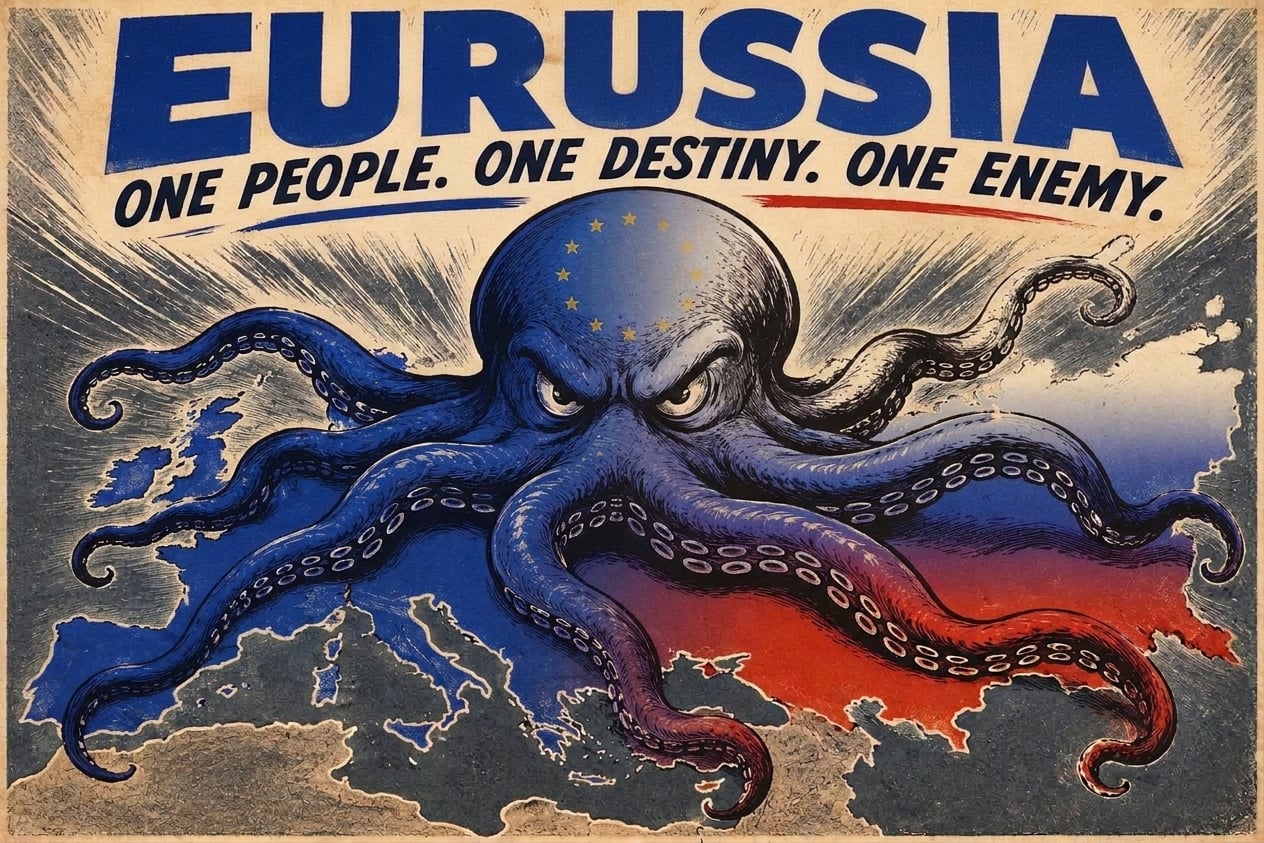
If “the West” can be one monster, why not Eurussia? Image © Ivan Bassov, 2026. Licensed under CC BY 4.0.
If We Can Have the West, the East, and the Arab World, Why Not Eurussia?
We often hear about the East versus the West, the Global North versus the Global South, the Arab world versus Israel, Russia versus Europe, Russia versus NATO, and the West versus the rest of the world.
My recent article, Bye-Bye Eurussia, deliberately played with this habit of geopolitical categorization. The reaction was interesting: some readers objected that Eurussia wasn’t a meaningful geographical or political entity. That objection actually brings us to a much broader question: Who gets to decide which geopolitical abstractions are legitimate and which aren’t?
We divide the world into geographical, political, cultural, economic, and civilizational blocs. Sometimes these divisions make sense. Sometimes they are crude oversimplifications. And often they are arbitrary or downright absurd.
But there is something interesting about the way we use them: we divide and combine the world according to whatever narrative we want to tell.
The same countries can belong to different blocs depending on who is doing the talking and what argument they want to make. Boundaries shift. Definitions change. Internal differences suddenly become irrelevant—or critically important—depending on the circumstances.
Consider some familiar examples.
The World According to Convenient Geography
Geographically, we have East and West, North and South, the Old World and the New World, Europe and Asia, and the Americas versus everyone else.
Economically, we have the developed and developing worlds, the industrialized nations, the Global North and the Global South, the G7, and the emerging economies.
Politically, we have the Free World, the authoritarian world, the collective West, the multipolar world, NATO versus Russia, and democracies versus autocracies.
Culturally and civilizationally, we have Western civilization, Eastern civilization, the Arab world, the Muslim world, the Christian world, and the supposedly distinct Russian civilization.
These categories are not necessarily meaningless. They can describe real geographical, historical, economic, or cultural patterns.
The problem begins when a convenient classification becomes a collective identity, and that identity is then treated as though it represents a single political actor.
Suddenly, dozens of countries with different governments, interests, histories, and internal conflicts are assigned a common intention, responsibility, or enemy.
A geographical label becomes a political actor. A collection of countries becomes a party to a conflict. An abstraction becomes an explanation.
The map becomes an argument.
When Europe Attacked Russia
Consider the Russian narrative of World War II.
In 1941, Nazi Germany invaded the Soviet Union. Yet in some Russian historical narratives, this becomes an attack by Europe on Russia.
The transformation requires just a few convenient substitutions.
Nazi Germany becomes Europe. European countries whose industries contributed to the German war effort become part of a collective European aggressor. The Soviet Union becomes Russia.
And suddenly, World War II on the Eastern Front becomes a war between Europe and Russia.
Never mind that Britain had been fighting Nazi Germany since 1939. Never mind that the Soviet Union was a multinational state, not simply Russia under another name. Never mind the different positions and experiences of individual European countries.
Those details complicate the narrative. So they disappear.
The resulting story is much simpler: Europe attacked Russia.
It is a remarkable example of how geopolitical categorization can rewrite history without necessarily changing a single historical event. All you need to do is change the labels.
Russia Versus the West
We see the same mechanism today.
Russia launched its full-scale invasion of Ukraine in February 2022. Yet Russian narratives describe the resulting conflict as a war between Russia and NATO, Russia and Europe, or Russia and the West.
But what exactly is the West?
Is it the United States? NATO? The European Union? Britain? Norway? Switzerland? Israel? Japan? Australia?
Are these countries one political entity? Do they share identical interests, policies, and attitudes toward Russia?
Of course not.
They have different governments, political traditions, economic priorities, security concerns, and relationships with one another. They frequently disagree, sometimes quite seriously.
Nevertheless, the narrative conveniently bundles them together.
NATO enlargement becomes an action by the West. Military assistance to Ukraine becomes participation in a war against Russia. Individual disagreements among Western countries become irrelevant.
And when someone points out that these countries are not a homogeneous entity, the differences are simply brushed aside.
The response, in its more colorful formulation, goes something like this:
“We don’t concern ourselves with the different varieties of shit.”
There you have it. No need to examine distinctions, national interests, political disagreements, or historical circumstances. They are all shit, and that’s good enough for the argument.
It’s difficult to imagine a more efficient way to dismiss inconvenient complexity.
The Arab World and Other Collective Identities
The same applies to the expression Arab world.
It encompasses numerous countries with different political systems, competing national interests, religious communities, historical experiences, and sometimes outright military adversaries.
Consider Saudi Arabia, Qatar, Egypt, Jordan, Lebanon, Iraq, and Morocco. They are not one political actor. Their governments don’t necessarily agree, their interests frequently diverge, and their relationships with one another can be complicated.
Yet we routinely hear what the Arab world wants, believes, supports, or opposes.
Sometimes the term is perfectly useful. Other times, it conceals more than it explains.
The same applies to the Muslim world, which is even more diverse.
And when someone points out the differences, the response is often some variation of the same dismissive attitude:
“We don’t concern ourselves with the different varieties of shit.”
And what about the Global South? Does it have a common political identity, a shared agenda, or a collective position on international affairs? Or is it simply a convenient label for countries that happen to occupy a particular position in someone’s geopolitical narrative?
Again, the issue isn’t whether these categories can be useful. It’s whether we remember that they are categories, not necessarily coherent political entities.
So, Why Not Eurussia?
This brings me to the central term of my previous article: Eurussia.
Why not combine Europe and Russia into one geopolitical entity?
If we can have the West, the East, the Arab world, the Global South, and the collective West, why can’t we have Eurussia?
Why not assign Europe and Russia a common geopolitical identity, discuss their collective interests, assess their shared prospects, and repeat the familiar slogan:
“We don’t concern ourselves with the different varieties of shit.”
And eventually declare the whole project irrelevant?
After all, if other people can draw convenient geopolitical boundaries, why can’t I?
I initially wanted to call the project Eurasia.
There was, however, one small complication.
Geographically, Eurasia encompasses the entire European and Asian landmass, including the Middle East and Israel. And I certainly wasn’t saying goodbye to Israel.
But there’s another interesting observation: when many people hear Eurasia, they don’t necessarily think of the entire Eurasian continent. They don’t think of Taiwan, India, or Israel. They think of something much narrower: the geopolitical space connecting Europe and Russia.
Hence, Eurussia.
The name was intentionally provocative. It borrowed the same conceptual shortcut used in countless geopolitical narratives: combine different countries, assign them a collective identity, and treat the resulting abstraction as a meaningful political entity.
I wasn’t proposing a new geographical classification or claiming that Europe and Russia constitute one civilization. I was playing with the very habit of geopolitical lumping that we encounter everywhere.
And so came Bye-Bye Eurussia.
The Grain of Joke
Of course, Eurussia is not necessarily a real geopolitical project. It may never have been on the table. Geographically, it may make some sense. Politically and culturally, Europe and Russia may be fundamentally different.
But then again, consider the internal diversity of both.
Europe itself is hardly a homogeneous entity. What do a Portuguese fisherman, a German engineer, and a Polish farmer necessarily have in common beyond sharing a continent? Their languages, histories, traditions, political priorities, and everyday experiences can be worlds apart.
Perhaps a new common identity will eventually emerge from Europe’s changing demographics. Perhaps Islam will provide the glue that European history, culture, and national identities never quite managed to supply.
And Russia is no less diverse. Chechens, Yakuts, and ethnic Russians from central Russia come from vastly different cultural, linguistic, and historical backgrounds. Put representatives of these communities around the same table, and they might discover that they have surprisingly little in common beyond the passport they hold and the country they inhabit.
Yet we routinely speak of Europe and Russia as though each were a coherent, unified entity.
Fine.
But that is precisely the point.
If we are willing to accept other broad geopolitical abstractions, why should Eurussia be particularly offensive?
The world is complicated. Countries disagree. Civilizations are internally divided. Alliances change. Interests conflict. Political identities overlap.
Yet we keep drawing imaginary lines across the map and treating everything on either side as though it belonged to a single political organism.
Sometimes these categories help us understand the world. Sometimes they help us avoid understanding it.
And sometimes they are simply useful for assigning collective guilt, inventing collective enemies, or manufacturing a convenient historical narrative.
Eurussia was my way of playing that game.
And yes, I intended to provoke.
But there is a grain of joke in every joke.
Bye-bye Eurussia.
—
The Original Article
Related Topics
Related Posts