
Why Somaliland Should Be on the Global Investment Map
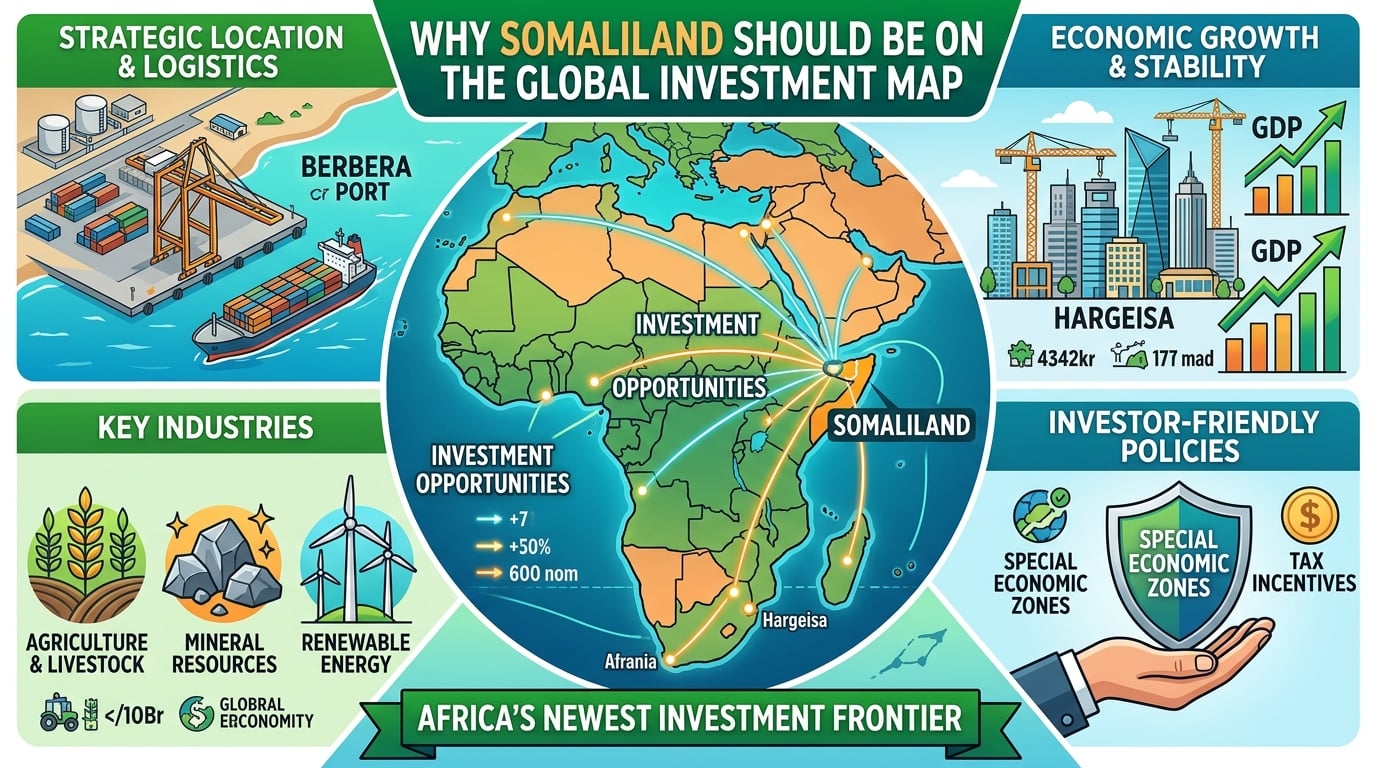
Across the Horn of Africa, a quiet economic transformation is taking shape. For decades, Somaliland has often been discussed primarily through the lenses of politics, security and regional diplomacy. Yet another story deserves greater international attention: the emergence of Somaliland as a potential destination for investment, trade and economic partnership. For global investors looking beyond traditional markets, Somaliland presents a combination that is increasingly difficult to ignore strategic geography, access to regional trade routes, an expanding port and logistics infrastructure, a young population, an entrepreneurial private sector, and significant opportunities in sectors ranging from logistics and livestock to renewable energy, fisheries, manufacturing and technology. The question, therefore, is no longer simply whether Somaliland has economic potential. The more important question is whether international investors are paying sufficient attention to that potential.
Geography has always mattered in international commerce. Somaliland occupies a strategically significant position along the Gulf of Aden, facing one of the world’s important maritime corridors and situated close to the Red Sea and Bab el-Mandeb. Its most visible economic asset is Berbera. The development of Berbera Port has changed the economic conversation surrounding Somaliland. With international investment supporting the modernization and expansion of the port, Berbera is increasingly positioned as a gateway connecting Somaliland and the wider Horn of Africa to international markets. Yet the significance of Berbera is larger than the port itself. It is the beginning of an economic ecosystem in which maritime trade can connect with logistics, warehousing, manufacturing and regional distribution.
The development of the Berbera Economic Zone adds another dimension to this opportunity. Rather than viewing the port as an isolated infrastructure project, it is more useful to understand Berbera as part of a wider economic corridor connecting maritime trade with markets in the Horn of Africa. This creates potential opportunities for logistics companies, manufacturers, food-processing businesses, distributors, technology companies and financial institutions. A port becomes more valuable when it is connected to roads; roads become more valuable when they connect producers to markets; and markets become more valuable when logistics, finance, energy, technology and industrial capacity develop around them. This is the economic logic behind Berbera’s emerging role.
Somaliland’s traditional economic strengths also provide opportunities for investment and diversification. Livestock remains an important part of the economy, but the greater opportunity lies in moving beyond the export of raw products toward greater value creation. Investment in modern meat-processing facilities, veterinary services, animal health and certification, cold-chain infrastructure, leather processing, animal-feed production and agricultural technology could help develop more sophisticated value chains. The same principle applies to agriculture, where investment in irrigation, storage, processing, transportation and technology could contribute to productivity, food security and export potential.
Renewable energy represents another promising area. Affordable and reliable electricity is fundamental to almost every modern economy. Manufacturing facilities, cold-storage systems, hospitals, telecommunications networks and digital businesses all require dependable energy. Somaliland’s geography offers opportunities for solar and wind investment, while the growing demand for electricity creates potential for private-sector participation in generation, storage and distribution. The integration of renewable energy into emerging logistics infrastructure also demonstrates how energy investment can support broader economic development.
Somaliland’s coastline presents another largely underdeveloped opportunity through the development of a modern blue economy. Fisheries could contribute significantly to employment, food production, exports and private-sector growth if supported by sustainable fishing practices, refrigeration, processing, packaging and maritime infrastructure. The objective should not simply be to catch more fish, but to create an integrated value chain in which sustainable fishing is connected to processing, cold storage, transportation, branding and export markets. Such an approach could allow a greater share of the economic value generated by marine resources to remain within Somaliland.
Technology may prove to be one of Somaliland’s most important long-term investment opportunities. The country has developed a highly entrepreneurial private sector, particularly in telecommunications and digital financial services. The next stage of development could involve moving beyond telecommunications into a broader digital economy encompassing fintech, e-commerce, digital government, cybersecurity, cloud services, artificial intelligence, online education, health technology and logistics technology. These industries are not necessarily limited by the size of a domestic market. They can connect Somaliland’s entrepreneurs and companies with customers, partners and investors across the region and beyond.
Investment is ultimately about people. Infrastructure matters, geography matters and capital matters, but markets are built by people. Somaliland’s young population represents both an economic opportunity and a responsibility. International investment should not simply bring capital into the country; it should also contribute to skills development, technology transfer and the strengthening of local supply chains. International companies operating in Somaliland can become partners in developing human capital through vocational training, professional certification, technology transfer and local entrepreneurship. The most sustainable investment relationships are those in which capital, knowledge, technology and local enterprise reinforce one another.
The development of the Berbera Economic Zone could further strengthen this investment ecosystem. Companies seeking to establish production, distribution and logistics operations closer to regional markets may find opportunities in food processing, construction materials, packaging, consumer goods, warehousing and light manufacturing. The broader objective should be to transform Berbera from a place where goods simply arrive and depart into a location where economic value is created. That transition from a transport gateway to a productive economic hub is one of the most important possibilities in Somaliland’s economic future.
A serious investment argument, however, must also acknowledge the challenges. Investors require predictable regulations, transparent procedures, reliable infrastructure, access to finance, skilled labour, enforceable contracts and clarity regarding market access. Somaliland’s continued economic development will therefore depend not only on attracting foreign capital but also on strengthening the institutional environment in which investment takes place. Incentives can attract attention, but institutions create confidence. The long-term objective should be to make investment easier, more predictable, transparent and sustainable.
For countries with strong capabilities in technology, agriculture, water management, renewable energy, cybersecurity and logistics, Somaliland’s emerging economy presents areas where commercial interests and development needs can potentially intersect. Israel, in particular, has developed internationally recognized expertise in areas such as agricultural technology, water efficiency, desert agriculture, renewable energy, cybersecurity and innovation. The opportunity is not simply to import foreign solutions, but to develop partnerships that create locally appropriate solutions. Water technology could support agriculture; agricultural innovation could improve productivity; solar technologies could expand energy access; cybersecurity could protect the growing digital economy; and innovation partnerships could contribute to developing a new generation of entrepreneurs.
The global investment landscape is changing. Investment is no longer concentrated exclusively in traditional economic centres. Investors increasingly examine strategic locations, emerging markets, resilient supply chains, new logistics corridors and sectors where early participation can create long-term value. The Horn of Africa is part of this changing landscape, and Somaliland possesses a combination of geography, infrastructure, entrepreneurial capacity and natural resources that deserves closer international attention.
Somaliland’s investment story should therefore not be exaggerated, but neither should it be overlooked. It remains an emerging market, and responsible investors will need to conduct careful due diligence regarding regulation, legal conditions, infrastructure, market access and commercial risks. Serious investors do not look only at what a market is today; they also consider what it could become. This is where Somaliland’s story becomes particularly significant.
For decades, Somaliland has often been viewed primarily through a political and security lens. The coming years offer an opportunity to view it through an economic lens as well. The transformation of Berbera demonstrates what can happen when strategic geography is combined with infrastructure and international capital. The development of the economic zone illustrates how a port can become the centre of a wider commercial ecosystem. Meanwhile, opportunities in agriculture, livestock, fisheries, renewable energy, technology, manufacturing and logistics suggest that Somaliland’s investment story could extend far beyond Berbera.
The world is searching for new economic corridors, resilient supply chains and emerging markets. The Red Sea and the Horn of Africa will remain important to global commerce, and Somaliland occupies a strategic position at the intersection of these developments. For global investors willing to look beyond conventional markets, Somaliland deserves a place on the global investment map not simply as a political story, but as an emerging economic opportunity.
The question now is not whether Somaliland has challenges. Every emerging market does. The more important question is whether its strategic geography, expanding infrastructure, entrepreneurial society and untapped economic potential can be translated into sustainable investment and inclusive growth. If that transformation continues, Somaliland may increasingly be understood not only as a place of strategic importance, but as a place of economic possibility.