
Founder & Principal, Line of State
Being Pro-Israel Means Knowing the Settlements Are Not Israel
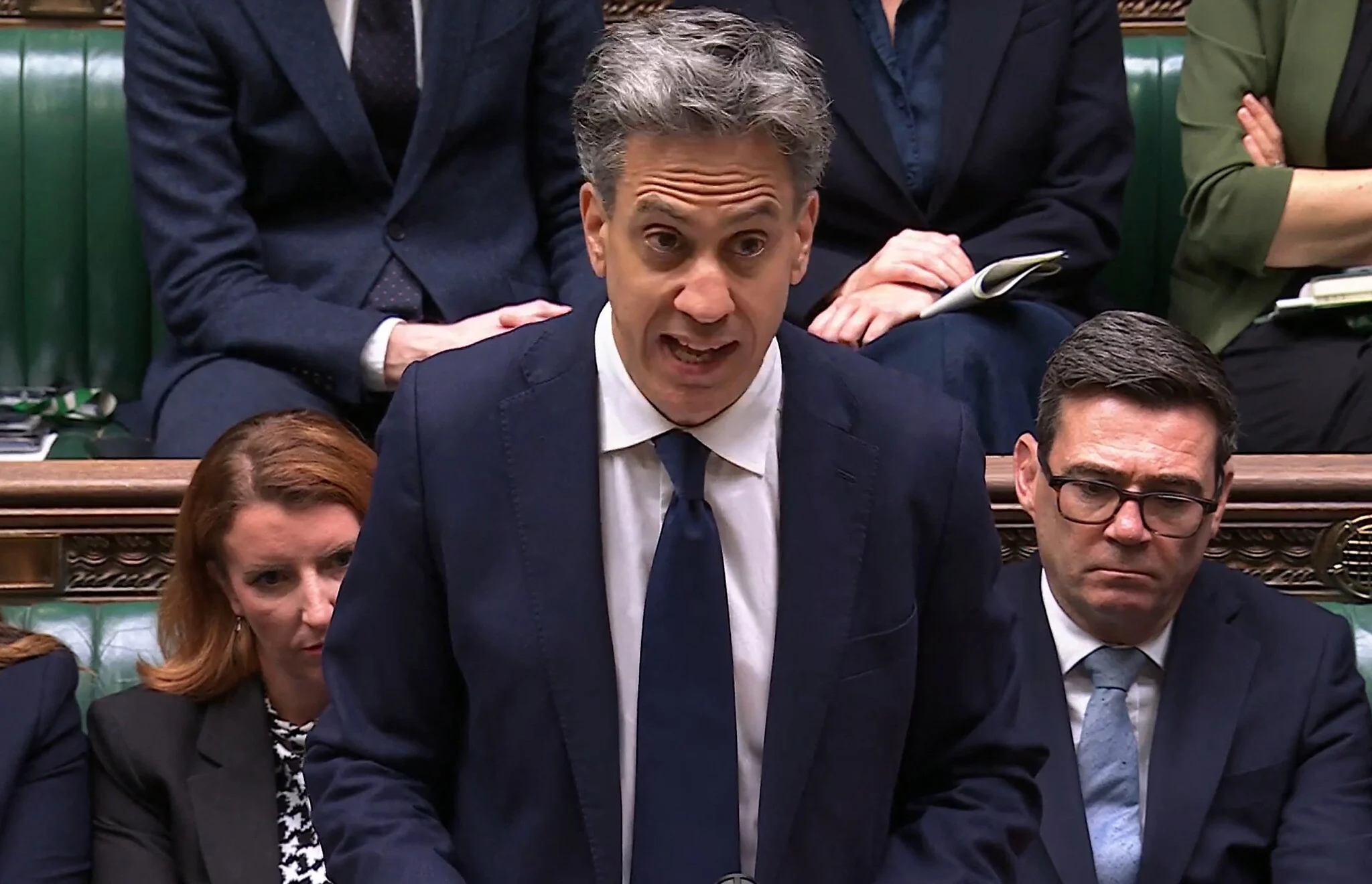
Britain’s Foreign Secretary Ed Miliband addresses the House of Commons on plans to ban imports from West Bank settlements, September 8, 2026. The legal distinction is sound; the punishment risks vindicating those who claim the world sees no distinction at all. (UK Parliamentary Recording Unit/Parliament TV via AFP)
Distinguishing sovereign Israel from the West Bank is legally correct and strategically necessary. Turning that distinction into a trade ban on settlement goods backfires: it punishes civilians, strengthens annexationists and makes separation politically harder.
Britain, France and Canada have announced plans to introduce national bans on trade in goods from Israeli settlements, saying the measures are intended to protect the two-state solution. They are right about the premise. Israel and the West Bank are not the same legal space. Israel itself preserves that distinction: it has never annexed the West Bank, and Israeli law does not apply there territorially as it does within sovereign Israel. Certain laws apply personally to Israelis living there – to the people, not the territory. [1]
Thirty-three years after the 1993 Oslo Declaration of Principles was signed, it has been attacked, eroded, violated and pronounced dead countless times. Israel has never revoked it. Oslo II divided the West Bank into Areas A, B and C, assigning different degrees of Palestinian and Israeli civil, administrative and security authority. That architecture still governs security, administration, taxation and relations with the Palestinian Authority. No Israeli government, including the most right-wing, has superseded Oslo’s interim order. [2]
Oslo transferred civilian governance of millions of Palestinians to the Palestinian Authority without incorporating them into Israel or compromising Israel’s security requirements. It did not produce the final-status agreement it was meant to deliver, but it preserved a fundamental fact: Israel and the Palestinians are not one polity.
Across Israel’s political spectrum, separation persists: Yair Lapid retains a two-state horizon, Naftali Bennett proposes Palestinian autonomy, Yair Golan advocates separation and eventual demilitarised Palestinian statehood, Gadi Eisenkot preserves room for Palestinian territorial contiguity, Benjamin Netanyahu supports Palestinian self-government under overriding Israeli security responsibility, and Avigdor Liberman advocates territorial separation.
“No Palestinian state” is a veto, not a doctrine. It rejects one outcome without defining Israel’s own. Annexation with full citizenship changes the demographic balance of the Jewish state; annexation without political equality changes its democracy; permanent rule without annexation perpetuates friction between Israeli soldiers and Palestinian civilians and empowers terrorism to shape Israel’s future.
If every terrorist attack postpones separation and every massacre becomes an argument for endless rule, terrorism acquires the power not only to kill Israelis but to determine their borders.
Indecision is not neutrality. It chooses permanent rule and gives the enemy the power to shape the outcome.
Security is the condition; threat denial, not territorial ownership, is the objective: Hamas disarmed, Palestine demilitarised, and enforcement mechanisms resilient to breach, institutional collapse or hostile government. On those terms, partition is not a favour Israel does for Europe or the Palestinians. It is the means to preserve Israel as Jewish, democratic, secure and sovereign without permanent rule over another people.
Election declarations are not statecraft. Annexation was promised before the April 2019 election, again before the September 2019 election and again in 2020. [3] It did not happen, and it will not happen.
Nor will E1 be built. E1, the planned settlement corridor between Jerusalem and Ma’ale Adumim, sits at the centre of the dispute over Palestinian territorial continuity. It was advanced in 2012, revived days before the March 2020 election and repeatedly presented as a fait accompli. The declarations came. The neighbourhood did not. [4]
The distinction between Israel and the settlements is correct. Turning that distinction into collective economic punishment of their residents is not. Living beyond the Green Line, the 1949 armistice line, is not a crime.
The Israelis who live there reside in communities that successive Israeli governments established, authorised, subsidised and connected to national infrastructure. State policy entails state responsibility; culpability remains individual. A child born in Ariel does not inherit guilt for policies they did not choose.
Time creates rights in people, not sovereignty in states. Decades of life beyond the Green Line do not annex the territory to Israel, but they create rights that cannot be erased by a boycott.
Economically, the ban has almost no leverage. Settlement exports are a fraction of Israeli exports. [5]
Most of the Israeli settlement network in the West Bank functions in practice as commuter-belt Israel beyond the Green Line: most employed Israeli residents work outside the area. [6] Nor does a final-status agreement require uprooting most of them. The 2000 Clinton Parameters envisaged Israel retaining settlement blocs containing roughly 80 per cent of settlers; [7] the 2003 Geneva Initiative reached a similar outcome for about three quarters through agreed land swaps. [8]
Less than seven weeks before Israel’s election, Britain, France and Canada have handed a gift precisely to those who seek to erase the distinction between Israel and the West Bank. Those politicians have told Israelis for years that the world does not oppose a particular Israeli policy but Israel itself; that territorial compromise brings not legitimacy but the next demand; that every withdrawal merely moves the line from which the next pressure begins.
A measure designed to save the two-state solution therefore hardens the Israeli public, rewards annexationists, weakens those arguing for partition and turns an Israeli national interest into a foreign diktat.
Being pro-Israel does not mean automatically supporting every Israeli government or every policy it adopts. Sometimes opposing Israeli policy is precisely the pro-Israel position.
To stand with Israel is to distinguish rigorously between sovereign Israel and territory it has not annexed; defend Israel within secure and recognised borders; build Palestinian capacity for statehood; and make separation safer for Israel, not politically costlier.
–
This English edition, adapted by the author, is based on an article originally published in Hebrew in Walla on September 15, 2026, under the title “להיות פרו ישראלי זה לדעת שההתנחלויות אינן ישראל”.
–
Related by the same author:
“Macron’s Diplomacy of Distraction”, The Times of Israel, July 27, 2025.
“No Hands on Soldiers”, The Times of Israel, November 16, 2025.
“Turkey Does Not Support Palestinians. It Uses Them”, Israel Hayom, April 28, 2026.
“Operational Completion: From Jerusalem of Gold to Nicosia of Law”, SigmaLive English, May 14, 2026.
“Turkey’s Fidan Wants to Write the Region’s Rules. Israel Is Writing Ankara Out”, The Times of Israel, May 31, 2026.
“An Armed Fringe Is Not Defending Israel. It Is Hijacking the State”, The Times of Israel, July 26, 2026.
–
[1] Knesset, Foreign Affairs and Defense Committee, “Approved for second and third readings: Legal powers of state authorities in Judea and Samaria and in PA territories will be extended by five years”, January 17, 2023.
[2] Government of Israel, “Palestinian Compliance with the Oslo Accords: A Legal Overview”, August 6, 2023.
[3] The Times of Israel, “In election pitch, Netanyahu vows to annex Jordan Valley right away if reelected”, September 10, 2019; Knesset, “Knesset approves establishment of Israel’s 35th government”, May 17, 2020.
[4] The Times of Israel, “Netanyahu says he’s ordered 3,500-home project in contentious E1 West Bank area”, February 25, 2020.
[5] House of Commons Library, “UK trade with Israeli settlements in the Occupied Palestinian Territories: Government statements and guidance in 2026”, July 8, 2026. The Library notes that precise settlement-trade figures are difficult to isolate; it estimated total UK trade with the Palestinian territories at about £38 million in 2025, against approximately £6 billion in UK-Israel trade.
[6] Israel Central Bureau of Statistics, Labour Force Survey Data, December 2023, January 29, 2024. In the Judea and Samaria Area, 63.6 per cent of employed residents worked outside their locality; 84.4 per cent of those commuters worked outside the area.
[7] The Clinton Parameters, White House meeting, December 23, 2000: “80% of settlers in blocks.”
[8] Geneva Initiative, “Myths About the Conflict”, explaining that its land-swap model would leave 75 per cent of West Bank settlers under Israeli sovereignty.
Related Topics