
Founder & Principal, Line of State
An Armed Fringe Is Not Defending Israel. It Is Hijacking the State
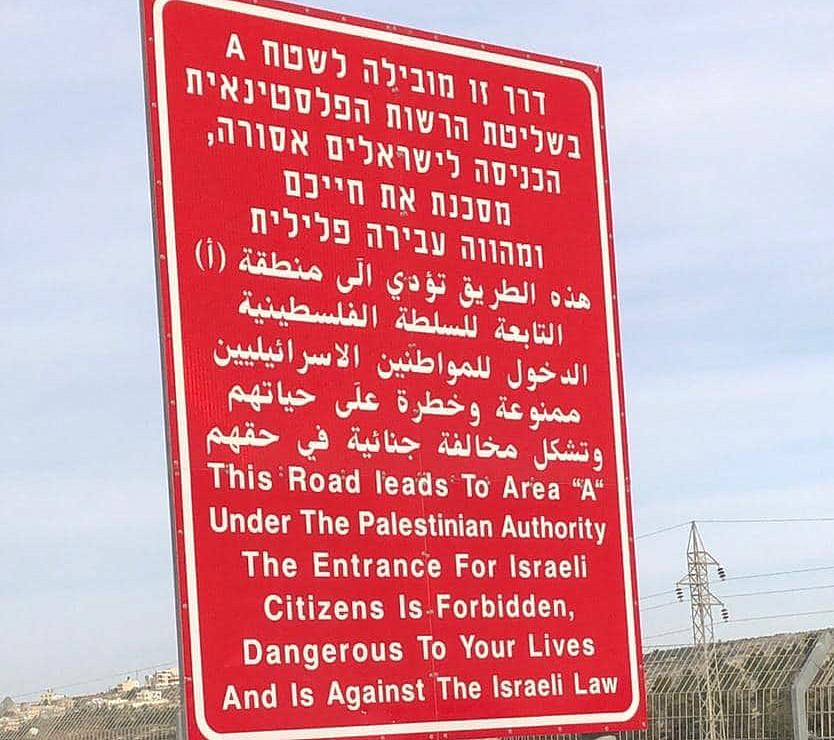
An Israeli warning sign at the entrance to Area A, the parts of the West Bank placed under Palestinian Authority civil administration and internal security control under the Oslo Accords. Entry by Israeli citizens is prohibited, dangerous to their lives and against Israeli law. (Photo: Shay Gal)
A sovereign state alone determines where its soldiers fight, which civilian presence it can defend and how it resolves the political future of millions of Palestinians. No faction may manufacture danger, commandeer the army, convert casualties into political authority and bind future governments through a rewritten past.
On Friday, a group of armed settlers entered a Palestinian area near the village of Tell in Samaria, the northern West Bank. Not a military mission, not an operational need and not the defence of a community: a provocation. The IDF had to divert forces from their missions and extract the instigators. Major Yuval Ezra was killed.
Benyahu Malt was not the soldier the state sent into that arena; he was one of its instigators. The army paid the price.
Months earlier, the pattern recurred in Lebanon. Zeev Ehrlich was brought into a combat zone for an archaeological tour. An IDF force encountered the enemy, and Sergeant Gur Kehati was killed. There too, a civilian initiative diverted the force from its mission and turned a soldier into a rescuer.
In both, the story was rewritten: those who created the danger were cast as its victims, while the soldiers who died were conscripted posthumously to justify the ventures that had dragged them to their deaths. Myth replaced inquiry, halo replaced accountability, and disaster licensed the next adventure.
Whoever knowingly enters hostile territory and forces the IDF to extract him is not asserting sovereignty; he is usurping it. He dictates where the state’s army will operate, which forces will be diverted and what risk the state will bear. The government sets the army’s missions, not an armed civilian.
Most settlers are law-abiding and serve in the IDF. They live there under policies adopted by successive Israeli governments, which encouraged, funded and expanded the settlement presence. If the state decides otherwise, they will resist lawfully but comply.
The rioters do not represent them. They harm them: draining forces from the defence of their communities and from counterterrorism, inviting retaliatory attacks and tainting an entire community.
In the coming weeks, it will be 21 years since Israel’s disengagement from Gaza. It dismantled a system that consumed security instead of producing it. Some 8,500 Israelis lived in enclaves amid more than one million Palestinians. Their existence required roads that could never truly be secured, convoys, military posts, escorts and a vast troop commitment. Civilians and soldiers died defending a system that did not defend Israel. The IDF was the settlements’ defensive perimeter, not the reverse.
Since then, the lesson has been rewritten: Qassam rocket fire predated the disengagement by years, yet is blamed on it; the IDF defended the settlers inside Gaza, yet they are now cast as the defenders of the Israeli communities around it. October 7 intensified the myth: a system that required defence was retroactively recast as a defensive wall.
The evacuation was not the mistake. Turning it into flight was. A state does not prove its presence with the lives of its citizens. Israel withdrew without an agreement, without a Palestinian counterpart assuming responsibility and without an enforcement mechanism able to exact a price for military buildup. Hamas claimed the withdrawal as a victory for terror and, months later, won the Palestinian legislative election.
Israel corrected geography and failed strategy.
In the West Bank, slogan supplanted policy. Israeli politicians may oppose a two-state solution; opposition does not repeal reality.
Israel has not revoked the Oslo Accords. The Palestinian Authority still administers the civilian affairs of millions of Palestinians. Institutional separation exists but remains incomplete, and Israel’s professional state institutions and security establishment operate on that basis every day.
No government can transfer millions of Palestinians, and none seeks to run the schools of Nablus, the sewage system of Jenin, the hospitals of Ramallah and the municipalities of Hebron. Two alternatives remain: one state with equal citizenship for all, or permanent Israeli rule over millions without political equality.
The violent minority seeks to expropriate that choice. Outposts, provocations and blood raise the price of any future decision until no government dares make one.
A politician who shelters this campaign, even through silence, is not a leader; he hands state authority to the rioters. Whoever declares that “there will be no Palestinian state” and refuses to say what comes instead is lying to the public: he sells a veto without an alternative and sends soldiers to settle the bill.
–
This English edition, adapted by the author, is based on an article originally published in Hebrew in Maariv on July 26, 2026, under the title “מיעוט חמוש כובל את צה״ל ומפקיע את הכרעת המדינה”.
–
Related by the same author:
- “With Law, Without Illusions – Rabin, Leadership and Responsibility”, The Times of Israel, November 3, 2025.
- “No Hands on Soldiers”, The Times of Israel, November 16, 2025.
- “We Did Not Lose the War. We Lost Control of It”, The Times of Israel, April 10, 2026.
- “Aiding the Enemy in Wartime from Within”, The Times of Israel, April 23, 2026.
- “Turkey Does Not Support Palestinians. It Uses Them”, Israel Hayom, April 28, 2026.
- “Turkey’s Fidan Wants to Write the Region’s Rules. Israel Is Writing Ankara Out”, The Times of Israel, May 31, 2026.
Related Topics
Related Posts