
A Moroccan Journalist
Before Calling Others Terrorists, Israel Should Read Its Own History
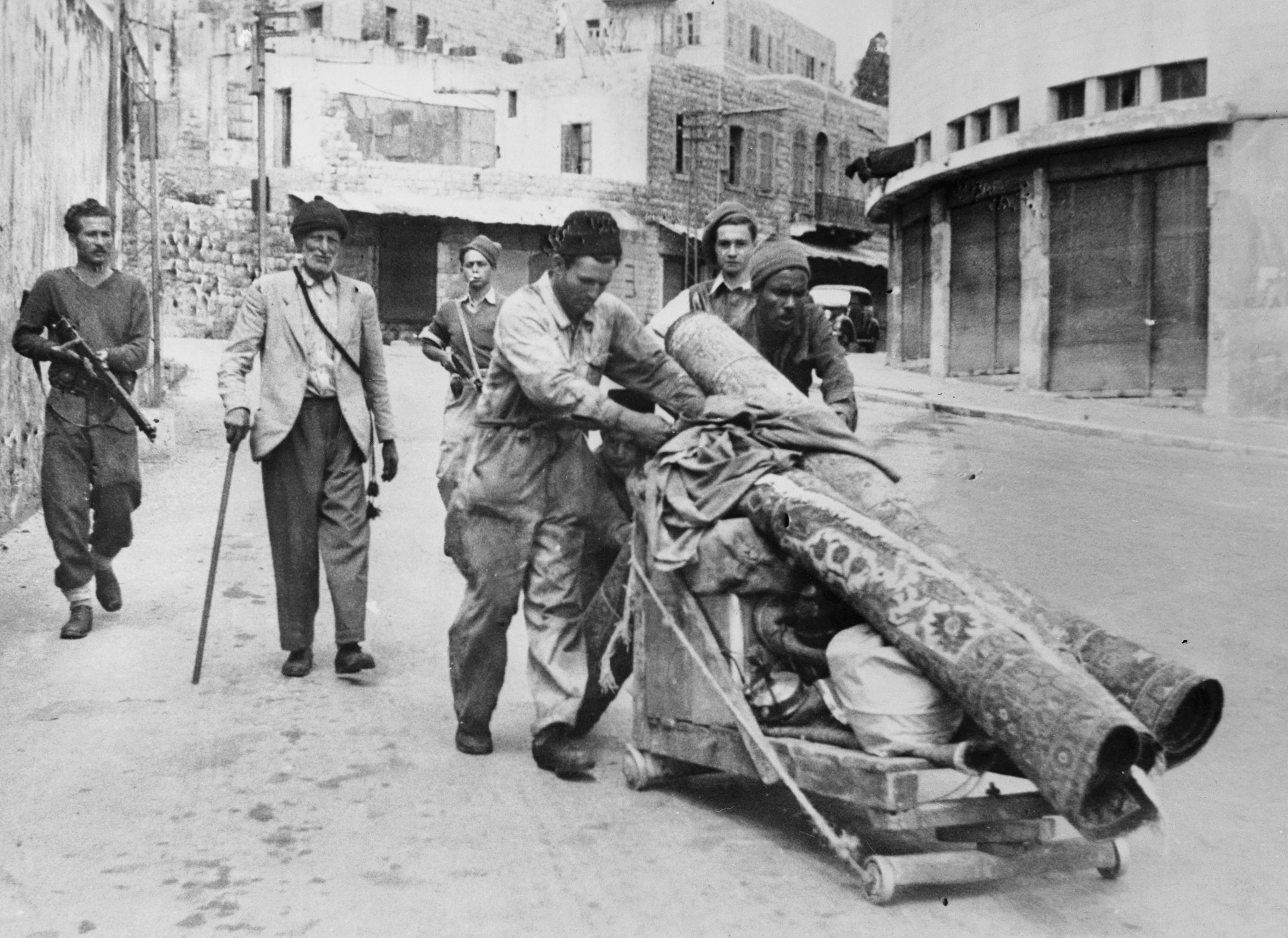
In April 1948, armed Haganah forces drove Arab residents out of Haifa – a haunting snapshot from the days when terror became the foundation of a nation, when the birth of a state was written in bombs and silence, and when Israel began forgetting what it once was. (Wikipedia)
History, if left unexamined, becomes a weapon of hypocrisy. Today, Israel condemns Palestinian resistance movements as “terrorist,” “fanatical,” and “barbaric,” yet its very birth was midwifed by organizations that the British once called the same. Between 1931 and 1948, the Irgun (Etzel), Lehi (the Stern Group), and the Haganah – Zionist paramilitary formations operating in British-mandate Palestine – used insurgent tactics to carve a state from the ruins of empire. They carried out actions that the British, the UN, and even mainstream Jewish leaders sometimes labeled terrorist, subversive, or guerrilla. What we call Israel’s independence was, to the other side, the destruction of a nation not yet allowed to be born.
As early as 1899, even before the first kibbutz, Zionist thinkers such as David Trietsch were urging Theodore Herzl to include “Greater Palestine” in the Basle Programme, arguing that ten million Jews could not be “fit into a land of 25,000 square kilometers.” This vision, as historian S. Shamir Hassan noted, revealed “the inner logic of Zionist policies” – a movement bound to use expansion and force as its political grammar. Violence, from the very beginning, was not an accident of history but an instrument of ideology.
Each movement justified its violence through an idea of redemption. The Haganah (1920-1948) saw itself as a disciplined “defense” force protecting Jewish settlements while preparing for sovereignty. Founded in 1920 as the defense organization of the Yishuv (the Jewish community in Palestine), it aligned with mainstream labor Zionism and generally operated under a doctrine of restraint. Yet it was never purely defensive: its elite strike arm, the Palmach, created in 1941, carried out sabotage and guerrilla missions first against Axis powers, then against Arabs and British forces alike.
By the mid-1940s, David Ben-Gurion and Haganah commanders had accepted that driving the British out was the only way forward. By 1945, the Haganah entered a unified “Resistance Movement” with Irgun and Lehi, coordinating attacks on British railways, police stations, and communications lines. When Israel was founded in May 1948, both the Haganah and its elite strike force, the Palmach, were absorbed into the newly created Israel Defense Forces (IDF), transforming clandestine warfare into state legitimacy and forming the operational backbone of the nascent army.
The Irgun (Etzel – “National Military Organization”), founded in 1931 and led at times by Menachem Begin, who would later become Israel’s prime minister, broke away from the Haganah to embrace Ze’ev Jabotinsky’s Revisionist Zionism – A creed rooted in the conviction that only force, through armed struggle, could redeem and secure a homeland. In July 1938, Irgun bombings tore through Haifa’s Arab market, killing more than seventy civilians.
On July 22, 1946, it blew up the King David Hotel in Jerusalem, killing ninety-one people – Jews, Arabs, and Britons alike. British reprisals were fierce: mass arrests, curfews, and internments swept through the Yishuv after the King David Hotel attack, but Begin hailed the bombing as “the act that made history move,” turning outrage into legend. They also mounted repeated attacks on Arab villages and British installations throughout the 1940s.
To its followers, these were acts of national awakening; to the British and to many Jews, they were indefensible crimes. Such acts, condemned as terrorism by the British and even by Ben-Gurion’s Jewish Agency, were exalted by Irgun’s adherents as moments of rebirth. Yet by 1948, the same militants who had planted those bombs were folded into the newly created IDF, their pasts recast – transfigured – into tales of heroism within the state they had violently birthed.
The Lehi (Lohamei Herut Yisrael, or Stern Gang), born from an Irgun splinter in 1940 under Avraham Stern, pushed militancy to a metaphysical theology of violence – viewing Britain, not Germany, as the ultimate oppressor/occupier even during the war against Nazi Germany – and turned the gun into a sacred instrument, sacralizing violence as a path to redemption. In 1944, its members assassinated Lord Moyne, Britain’s minister resident in Cairo, believing that blood would “open the gates of the homeland.”
In April 1948, Lehi units/fighters joined Irgun in the Deir Yassin massacre, where more than a hundred Palestinian villagers were killed in a spectacle – an orgy – of horror so profound that even the Jewish Agency denounced it as a “disgrace.” Months later, Lehi struck again, murdering Count Folke Bernadotte, the UN mediator – silencing diplomacy that threatened their vision and whose negotiations threatened to slow the march of conquest.
Yet, like Irgun, Lehi’s leaders were not cast out but canonized: Yitzhak Shamir, a former Lehi commander, would one day become Israel’s prime minister. In December 1948, Albert Einstein and other Jewish intellectuals warned that Begin’s Herut party was “closely akin in organization, methods, and political philosophy to the Nazi and Fascist parties,” citing Deir Yassin as “a shocking example.” Even in victory, moral clarity had not yet been extinguished.
By 1948, the distinctions among these factions had blurred into one continuum of armed redemption. The British called them terrorists; Zionist leaders called them freedom fighters. The Irgun and Lehi – labeled terrorist organizations by British authorities and international observers for their bombings, assassinations, and civilian attacks – merged into the broader military framework of the very state they had fought to create.
The Haganah and its elite Palmach, though more disciplined and moderate, also took part in forced expulsions and assaults during the 1948 war. Together, they formed the military and political foundation of Israel – a state born not only from ideals of survival but from the calculated violence of those who believed that deliverance could be achieved through the gun. As Hassan observed, “violence and terror were the backbone of the plan to enforce the Zionist programme”; today, that same logic of force has simply changed its name.
Yet those same men – responsible for the market bombings, assassinations, and massacres – were soon folded into the new IDF when the state of Israel was declared in May 1948, and went on to shape the political elite that still governs. Israel’s founding mythology buried the word terrorism when the flag went up. The gun, once a weapon of fear, became a symbol of liberation the moment the state was theirs. Being an Israeli prime minister in a tailored suit does not cleanse the blood from one’s past; it only dresses history in diplomacy’s fabric.
The genealogy is unmistakable. Menachem Begin, once head of Irgun, became prime minister in 1977; Yitzhak Shamir, a Lehi commander, followed him in 1983. Their transformation from insurgents to statesmen blurred the line between rebellion and legitimacy. Many of their operational doctrines – collective deterrence, reprisals, targeted elimination of enemy leaders – were absorbed into the IDF’s evolving code of security. Home demolitions, introduced during the 1936-39 Arab Revolt as “punitive deterrence,” remain part of Israel’s legal-military vocabulary to this day.
And now, with tragic irony, the descendants of those same fighters condemn others for doing what they once did – resisting dispossession. Zionism and Islamism, stripped of rhetoric, are both ideologies of liberation born in pain. The first sought a refuge for a people haunted by centuries of exile and genocide; the second, seen today in Hamas’s emergence in 1987, arose as a voice for those suffocating under occupation and siege – seeking, often violently, to reclaim dignity where diplomacy had failed. One narrative succeeded and wrote its own legality; the other is demonized and criminalized. The difference is not moral – it is temporal. Yesterday’s insurgent, once branded a “terrorist,” has simply lived long enough to become today’s head of state.
I do not justify bloodshed; I describe its logic. Violence begets nations, and nations forget. Israel’s leaders invoke morality while their tanks level neighborhoods built on the same yearning that once drove Jewish refugees through Europe. Jews, of all people, should understand what it means to be homeless, hunted, and humiliated. But memory in politics is selective – suffering sanctifies only the self. The Nakba of 1948, the occupation of 1967, the checkpoints, the walls, and the endless blockades that followed – all are justified in the name of “security,” the very logic once used to cage Jews behind ghetto walls and herd them into camps. What was once a language of fear turned against them has become the language by which they now rule others.
What I fail to grasp is how a people who rose from the ashes of their own persecution can look upon another people’s ruins and feel nothing. How can a state born from the fire of resistance condemn resistance itself? How can a nation that once fought for existence deny that same right to others? History has no patience for selective morality. The truth is simple, brutal, and unavoidable: what Israel condemns in the Palestinian is exactly what it once celebrated in the Zionist.
Perhaps one day both peoples will stop weaponizing memory and start humanizing it. Until then, every missile, every checkpoint, every speech about “terror” will echo back through time, reminding Israel of a truth it cannot escape: it, too, was born of resistance.
Related Topics
Related Posts