
Middle East Analyst
Bibi’s Iran Gamble Undermined U.S.–Israel Ties
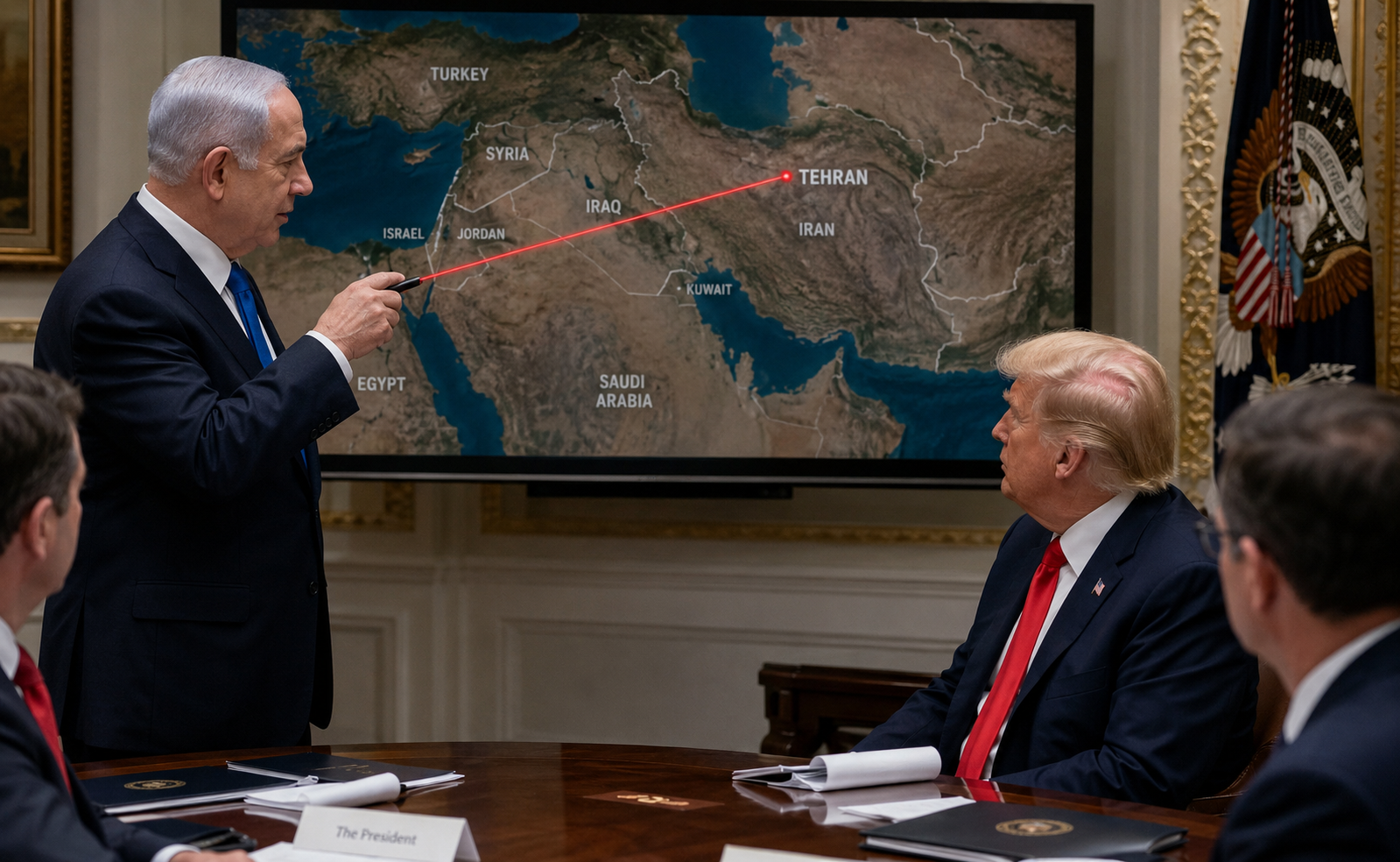
by author (AI)
The November 3 midterm elections may have consequences extending well beyond the balance of power in Washington. The latest Cook Political Report forecast projects Democratic gains of 12 to 22 House seats, with Democrats now favored to win control of the chamber. Prediction markets put their chances of taking the House at approximately 92 percent. The Senate remains more competitive, but a Democratic victory there is a possibility that cannot be dismissed.
How did Republicans arrive at this position? The familiar explanations include President Donald Trump’s declining approval, persistent concerns about affordability, and dissatisfaction with the administration. But another explanation deserves serious consideration: the consequences of the war against Iran, which began on February 28, 2026, and the strategic assumptions that reportedly helped persuade Trump to launch it.
The argument is not that Benjamin Netanyahu alone made the decision for Trump, or that the war explains every change in American politics. It is that the Israeli prime minister appears to have promoted a vision of a relatively short, decisive campaign that would weaken Iran’s military, create an opportunity for regime change and leave the Strait of Hormuz open. If those assumptions materially influenced Trump’s decision, their failure may have produced consequences neither leader adequately anticipated.
Those consequences now extend from the Persian Gulf to American gas stations, from the November elections to the future of the U.S.–Israel security partnership.
The victory that preceded the war
On June 24, 2025, following Israel’s 12-day campaign against Iran and the American strikes on Iranian nuclear facilities known as Operation Midnight Hammer, Netanyahu delivered a televised address to the Israeli public. His language was emphatic.
“We achieved a historic victory, which will stand for generations,” he declared. He went on to say that Israel had sent Iran’s nuclear project “to oblivion.” He credited Trump and the United States with destroying the underground enrichment facility at Fordow and described the American decision to join the offensive as a historic development.
The wording matters. Netanyahu was not simply claiming that Iran’s nuclear infrastructure had suffered serious damage. He presented the operation as a generational strategic achievement, one that had removed existential threats to Israel and fundamentally changed the regional balance.
Yet the precise extent of the damage and the time required for Iran to recover remained contested. An initial American intelligence assessment reported in June 2025 judged that the strikes had delayed Iran’s nuclear program rather than permanently eliminated it. The administration and Israeli government disputed interpretations that minimized the operation’s success. The distinction between destroying facilities and permanently eliminating the underlying capability would become important in the months that followed.
Netanyahu’s June 24 statement, reproduced from the Israeli Prime Minister’s Office
The subsequent decision to launch a much larger war raises an obvious question. If the nuclear threat had been so decisively removed in June 2025, what changed sufficiently to justify a new war in February 2026?
Iran retained enriched uranium, nuclear expertise and the potential to rebuild damaged capabilities. It was reasonable for Israeli and American officials to remain concerned about those possibilities. But the existence of a long-term proliferation threat is not the same as an imminent threat requiring immediate military action. The distinction between those two assessments is central to understanding the decision that followed.
Netanyahu’s pitch for regime change
An April 7, 2026, investigation by New York Times reporters Maggie Haberman and Jonathan Swan provides an unusually revealing account of the deliberations preceding the war. According to their reporting, Netanyahu presented Trump and senior American officials with an ambitious vision of what a joint campaign could accomplish.
During a February 11 meeting in the White House Situation Room, Netanyahu argued that Iran was ripe for regime change. His team presented a scenario in which American and Israeli attacks would destroy Iran’s ballistic missile capabilities within weeks, weaken the regime sufficiently to prevent it from closing the Strait of Hormuz, and create conditions for an internal uprising. Mossad could help foment that uprising, while Kurdish fighters might contribute to a broader challenge to the Iranian government.
The presentation included possible figures who might lead Iran after the Islamic Republic fell. Trump reportedly responded, “Sounds good to me.”
The following day, American officials examined the proposal more critically. According to the Times account, they considered the initial military objectives achievable but regarded the assumptions about a popular uprising and the installation of a new government as detached from reality. CIA Director John Ratcliffe reportedly characterized the regime-change premise as “farcical.” Other senior officials expressed reservations about the plan and the risks of a prolonged conflict.
The New York Times account of Trump’s decision to go to war
This reporting supports an important inference: Netanyahu was not merely advocating another attack on Iranian nuclear facilities. He was selling Trump a broader strategic opportunity in which military force could destroy Iran’s capabilities, precipitate the collapse of its government and avoid a prolonged disruption of regional energy supplies.
Trump had his own longstanding hostility toward the Iranian regime and was not simply a passive instrument of Israeli policy. The decision was his. Nevertheless, Netanyahu’s presentation appears to have reinforced the case for war by offering an optimistic account of its likely duration, military consequences and political outcome.
The distinction is consequential. A decision based primarily on preventing an imminent nuclear breakout would have one strategic rationale. A decision influenced by the prospect of toppling the Iranian government would have a much broader set of objectives—and considerably greater risks.
The Strait of Hormuz: a failed assumption
The most consequential assumption in Netanyahu’s reported presentation may have been that Iran would be too weakened to close the Strait of Hormuz.
The Strait is not an incidental feature of the conflict. It is one of the world’s most important energy chokepoints. Before the war, approximately one-fifth of global petroleum liquids consumption and a substantial share of liquefied natural gas trade passed through it. Although Saudi Arabia and the United Arab Emirates possess pipelines that can bypass the waterway, their alternative capacity cannot replace all the traffic that normally moves through the Strait.
U.S. Energy Information Administration analysis of the Strait of Hormuz
Iran did not need to defeat the American military conventionally to impose enormous costs. Threats to shipping, attacks, mines and the danger of further escalation were sufficient to disrupt normal commercial traffic and send shock waves through energy markets.
This is a familiar problem in asymmetric warfare. A militarily weaker state may be unable to defeat a superior adversary in direct combat while retaining the ability to impose substantial economic costs through geography, disruption and the threat of escalation.
The United States and Israel could inflict severe damage on Iran’s military infrastructure without necessarily eliminating its ability to disrupt shipping. The assumption that a successful opening campaign would make Hormuz secure therefore underestimated the difference between destroying military targets and controlling the strategic consequences of a war.
The result was a conflict whose economic effects extended far beyond Iran and Israel. Energy-importing countries faced higher costs, businesses confronted rising transportation expenses, and American consumers began experiencing the consequences at the gas pump.
From the Persian Gulf to the American gas pump
The political significance of the energy shock becomes clearer when prices are compared.
On June 24, 2025, the national average price of regular gasoline was approximately $3.22 per gallon. By October 24, 2026, AAA reported a national average of about $4.30. That is an increase of approximately $1.07 per gallon, or one-third.
AAA’s historical gasoline-price data
Gasoline is only part of the story. Diesel prices affect trucking, agriculture, freight and other businesses that move goods through the American economy. Higher fuel and transportation costs can feed into prices for groceries and other consumer products. The effects are uneven, but households with long commutes and limited alternatives to driving are especially exposed.
The Strait’s disruption is not the only possible influence on fuel prices. Refinery conditions, seasonal demand, inventories and other market factors also matter. Nevertheless, the scale of the disruption to global energy supplies makes the war a central explanation for the increase. In April, a Reuters/Ipsos poll found that 77 percent of registered voters held Trump at least partly responsible for rising gasoline prices. That included 82 percent of independents and 55 percent of Republicans.
Reuters/Ipsos polling on responsibility for rising gasoline prices
The political danger is straightforward. Voters do not have to follow every development in the war, understand Iran’s nuclear infrastructure or evaluate competing military assessments. They can see the price displayed at the gas station and compare it with what they paid before the conflict.
Nor must voters conclude that every military objective was unjustified. They may accept that Iran presents a genuine security threat while questioning whether the war was necessary, whether its objectives were realistic and whether its economic costs were adequately considered.
A claimed strategic victory becomes harder to sell when its consequences are measured in higher household expenses.
The midterm consequences
Republicans entered the election cycle with vulnerabilities of their own. Democrats had low public approval ratings and had not necessarily demonstrated that they could offer a more convincing economic program. A Democratic victory should not be interpreted as proof that voters have embraced the party or resolved their doubts about it.
But elections do not require voters to regard one party as ideal. They often turn on which party is held responsible for the problems that dominate public attention.
By October 19, Reuters/Ipsos measured Trump’s approval at 31 percent and found Democrats leading Republicans by 47 to 35 percent among registered voters on the generic congressional ballot. Cook Political Report’s October 23 assessment subsequently shifted another 19 House races toward Democrats, concluding that Republicans’ path to retaining the chamber had all but evaporated. Cook projected Democratic gains of 12 to 22 seats.
Reuters/Ipsos, October 19 | Cook Political Report, October 23
These figures do not establish that the Iran War alone caused the change in the political environment. Tariffs, domestic controversies, broader economic concerns and dissatisfaction with the administration also matter. Nor does a national congressional ballot automatically determine individual House races or the outcome of closely contested Senate contests.
Nevertheless, the war has given Democrats a tangible issue on which to challenge the administration. They can argue that Trump chose to join a conflict whose anticipated benefits were overstated, whose risks were underestimated and whose economic consequences are now being borne by American households.
This is where Netanyahu’s reported miscalculation may have had consequences far beyond the Middle East. If the prime minister helped persuade Trump that regime change could be achieved quickly and without a serious Hormuz crisis, the failure of those assumptions may have given Democrats a political opening that their own performance would not otherwise have provided.
Bibi’s miscalculation may have done for Democrats what they might not have been able to do for themselves.
That is an inference, not a demonstrated measurement of causation. But it is consistent with the sequence of events and the polling evidence showing that voters associate the fuel-price surge with the president’s decision to go to war.
The consequences for Israel
A change in congressional control would create another strategic complication.
A Democratic House could intensify investigations into the decision to go to war, demand testimony from administration officials and use appropriations legislation to constrain military operations. A Democratic Senate could add pressure through its role in funding negotiations, confirmations and oversight. Control of either chamber would give Democrats greater leverage over the administration’s foreign policy.
Reuters reported on October 25 that a Democratic-controlled Congress could seek to limit funding for the Iran War and reconsider American military assistance to Israel. The United States currently provides Israel with $3.8 billion annually in military aid under a ten-year agreement.
Reuters on the potential foreign-policy consequences of the midterms
A Democratic majority would not automatically end the war or terminate assistance to Israel. Existing appropriations, legislative procedures, bipartisan support for Israeli security and the president’s veto authority would constrain what Congress could accomplish. But the political environment surrounding those decisions could change substantially.
The concern for Israel is not limited to the immediate availability of military aid. A more contentious relationship could affect future weapons appropriations, diplomatic coordination, regional deterrence and the political durability of American support. Security cooperation that has long enjoyed substantial bipartisan backing could become more vulnerable to disagreements over Israeli policy, the conduct of military operations and the strategic objectives of the war.
This would be a particularly ironic outcome if the war had been intended to strengthen Israel’s long-term security. The campaign may have damaged Iranian capabilities, but it also risks making the American political foundations of Israel’s security partnership more contentious.
A strategic gamble with consequences beyond the battlefield
The chain of events deserves attention precisely because no single link requires a claim of certainty.
Netanyahu’s June 2025 declaration presented the destruction of Iran’s nuclear infrastructure as a historic victory that would endure for generations. His reported February 2026 presentation offered Trump a broader opportunity: a weakened Iranian regime, the prospect of regime change, a relatively short war and a Strait of Hormuz that would remain open.
The subsequent conflict disrupted those assumptions. Iran demonstrated that it could impose substantial costs through the Strait, energy prices rose, American consumers felt the consequences, and the administration’s political position deteriorated as the midterms approached.
The two leaders may have miscalculated the relationship between military success and strategic outcomes. Destroying targets is not the same as achieving political transformation. Weakening an adversary is not the same as eliminating its ability to impose costs. And a military victory cannot be evaluated independently of the economic and political consequences that follow.
If Democrats gain control of the House, and especially if they also win the Senate, Trump could face a Congress less willing to fund the war or provide unconditional support for his wider regional policies. Israel could find itself confronting a more difficult American political environment even as it continues to face threats from Iran and its regional partners.
The November elections will not resolve the strategic questions raised by the war. But they may determine who has the authority to investigate the decision, constrain its continuation and shape the future of American assistance to Israel.
Trump and Netanyahu appear to have made a major gamble on the expectation of a rapid and decisive outcome. The evidence now suggests that the consequences have been more complicated and costly than the original sales pitch implied.
The final irony is that a war intended to strengthen Israel’s security and demonstrate American power may instead weaken the political position of both leaders—and make the future of the U.S.–Israel security partnership more difficult to sustain.
Related Topics
Related Posts