Dave Matthews answered me from the stage. Now comes the hard part
On the night of June 5, my phone lit up with a message from a former sorority sister.
omg. Dave Matthews just gave a speech live in concert about how much he loves Jews. JACKI. IT WAS YOU. it had to be!
I wrote back the only thing a normal person can write back in that situation.
Stfu.
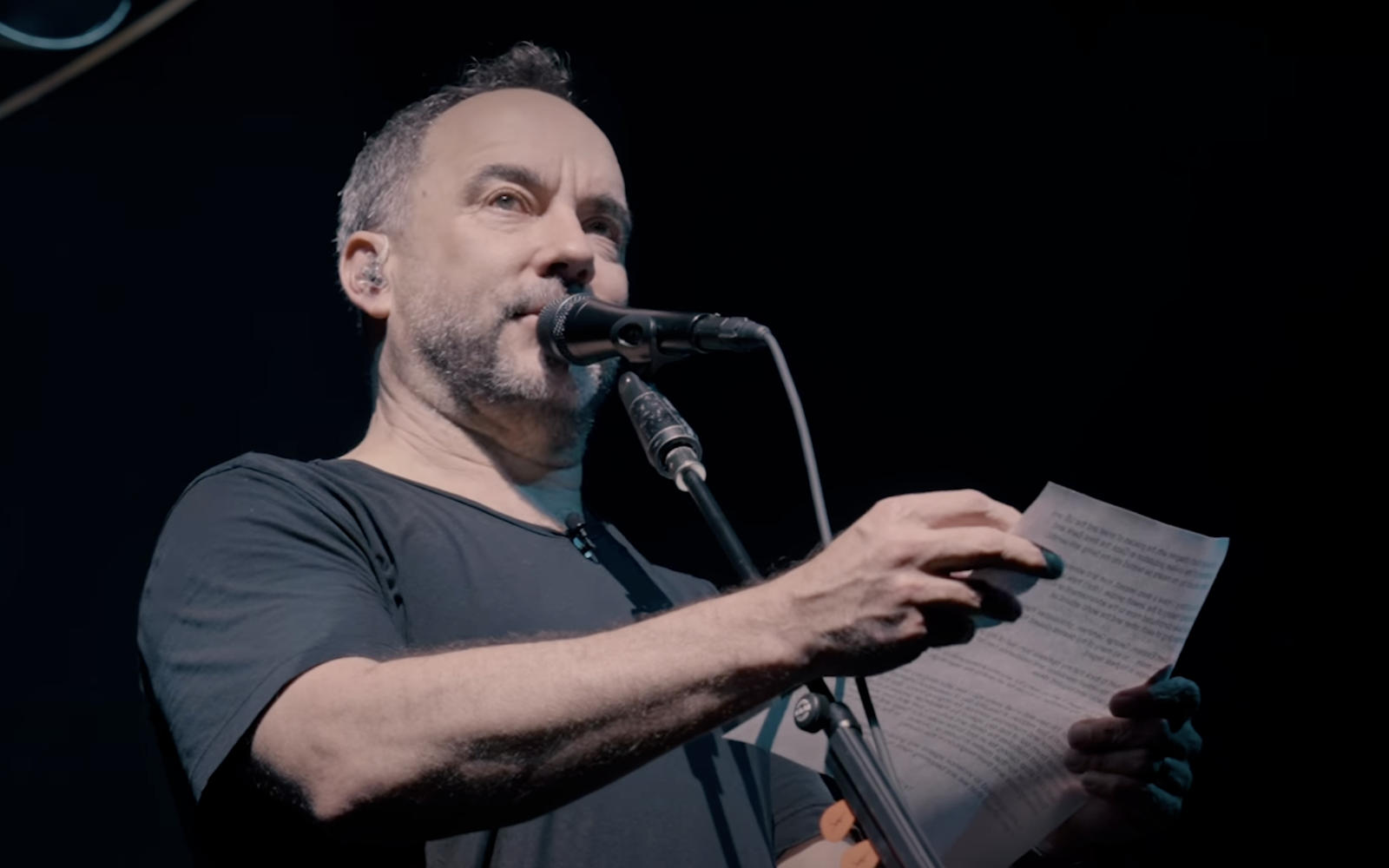
She did not stfu. Her husband had been streaming the Raleigh show and heard it live, and within an hour I was watching a grainy couch-tour video of Dave Matthews standing alone at the microphone, holding a piece of paper — which, if you ask anyone who has followed this band for 30 years, is itself the headline. The man memorizes thousands of songs. He free-associates between them for ten minutes at a stretch. Multiple people in the DMB Jew Crew, fans who have seen him more times than they can count all over the world, said the same thing in the same thread: They have never once seen Dave read from a page on stage.
So either I was in active psychosis, or Dave Matthews had read my blog post — the one about how his West Palm Beach crowd chanted “f*** the Jews, f*** those kikes” while my friend walked his family out of the show — and was now responding to it, in writing, in front of 20,000 people and a livestream. It was, and I mean this clinically, the single most out-of-body experience of my life. It was not on my bingo card.
I have now watched it more times than I’d like to admit. And here is where I’ve landed.
First, the thing I actually mean: Thank you
I want to start with gratitude, because I’m afraid it’s going to get lost in everything that follows, and it shouldn’t.
Dave Matthews did not have to do this. There was no press conference forcing his hand, no sponsor threatening to walk. A blog post by a civil rights attorney in Florida made its way into his orbit, and instead of ignoring it — the safe, easy, defensible move — he sat with it, was bothered by it, and felt compelled enough to write something down and say it out loud to a stadium. That is not nothing. In a culture where the default response to criticism is to lawyer up or log off, a famous person who listens and then answers in public is so rare that half the internet assumed it had to be fake.
He got real things right, too. He drew the distinction — that disagreeing with Israeli policy should never be twisted into license for bigotry against Jews. He said he was sorry for any pain he caused. He named October 7 directly and called it a horror, and he disclosed something genuinely disarming: that he spent that morning at his best friend’s son’s bar mitzvah, watching a Jewish kid become a man, when the news from across the world broke in.
If you had told me a month ago that this is where we’d be, I would have taken it. I’ll take it now.
And now, the harder part: What he got wrong
I am not going to pretend the speech was the speech I would have written for him, because the whole point of being honest is that you don’t stop being honest once someone does something nice.
A couples therapist in the DMB Jew Crew put it better than I could: this was a statement, not an apology. “Sorry for any misunderstanding or pain I might have caused” is the grammar of a man apologizing for your reaction, not his words. It is conditional. It keeps the problem in our ears instead of his mouth.
Then there was the part where he established his credentials by listing famous Jews — Einstein, Gershwin, Hannah Arendt, Anne Frank — and “so many of my closest dearest friends.” I’ll be honest, I laughed. I have a vivid picture of the writers’ room: How do I let the Jews know I’m relatable? What do Jews like? Name-drop Einstein and Anne Frank, mention a bar mitzvah, that’ll do it.
The Israeli singer Rami Feinstein nailed why it lands so badly — imagine, he wrote, an artist trying to prove he’s not racist by saying some of my best friends are Black, I’ve seen a lot of Denzel movies, also Creed one, two, and three, and I was literally eating fried chicken at my friend’s house when George Floyd was killed. You would recognize that instantly as a man reaching for a costume. Reciting a people’s geniuses is not the same as understanding them.
And then, the reflex that undoes the whole thing: Within one breath of naming October 7’s horror, he pivoted to “but the violence against the Palestinian people is no less horrific and multiplies.” Many in the crowd were waiting to see if he’d finally go somewhere new. Instead he went exactly where he always goes. The “yes, but” arrived right on schedule.
The thing he still hasn’t done
Here is what was missing, and it’s the only thing I really wanted.
He defended himself against the charge of being an antisemite. But nobody serious accused him of being one. My piece didn’t. What I wrote — what my friend’s brother lived through in West Palm Beach — is that his rhetoric, delivered from a stage to 20,000 people, created a room where some of those people felt licensed to scream a slur. The question was never “Dave, are you a bigot?” The question was “Dave, do your words give cover to the bigots in your own crowd?”
He answered the wrong question. He still hasn’t said the sentence that would actually fix this. Another fan in the Jew Crew wrote the script for him, and I’d frame it for his dressing room mirror: “Apparently my words against the Israeli government made some people feel it was okay to shout ‘f*** the Jews.’ That is despicable. And if that was you — you are no longer welcome at my shows.”
That’s it. That’s the whole thing. Use the stage that caused the problem to denounce what it produced. The fact that he hasn’t yet doesn’t make this hopeless. It makes it the obvious next step.
Who are the critics, exactly?
Now I have to talk about everyone else, because the reaction to the speech told me more than the speech did.
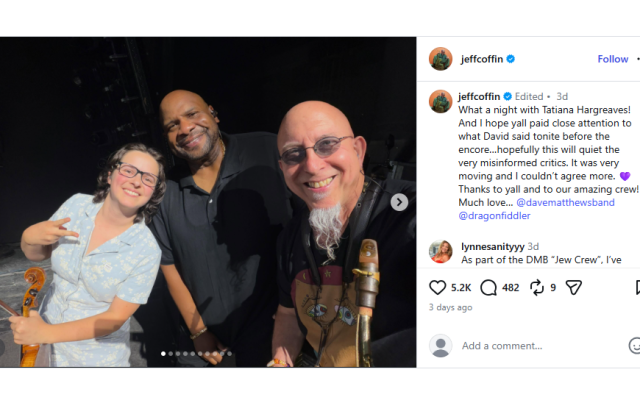
The band’s saxophonist, Jeff Coffin, posted that he hoped Dave’s words would “quiet the very misinformed critics.” And there it is — the speech, barely cold, immediately repurposed as a tool to silence the people who got hurt. My friend’s brother (the one who was the subject of my original post) asked the only question that matters back: Who are the critics? The ones who yelled “f*** the kikes,” or the ones who heard it?
Because watch what the deniers did. They didn’t engage with whether a fan screamed a slur at a concert. They went straight at me. There’s no evidence, it’s hearsay.
“I heard it bro,” one commenter wrote, with total confidence, “Guarantee that slur wasn’t used” — and then, in the very next breath, “if the people of Israel want respect maybe they should stop doing things that lose my respect.” First it didn’t happen. Then we deserved it. Pick one.
I want you to sit with how differently this would go for literally any other group. If a Black concertgoer said they’d heard the N-word shouted in a crowd, no one — no one — would demand a notarized affidavit. The other fans standing there would have turned around and told those people to shut the hell up. That’s the part that should chill you. It’s not just that the slur was shouted. It’s that when we said so, a chunk of the fandom’s instinct was to interrogate the witness instead of the offender. That reflex is the entire subject of everything I write.
And to my own side: Put the pitchforks down
But I’m not letting my own people off the hook either, because plenty of them are failing this moment from the opposite direction.
The scorched-earth crowd showed up immediately. This was not an apology. It’s PR because ticket sales are down. Too late. He’s a “but I have Jewish friends” guy. Don’t believe a word. (For the record, a longtime fan in the group pointed out the “sales are down” theory is just false; tickets are at an all-time high. So that’s not it.)
But I have an honest question for the pitchfork brigade. What do we think we’re actually doing here? When I write one of these pieces, the goal isn’t to win — it’s to get one person to stop, reconsider, and change course. That’s the entire bet activism makes: that people can grow. So if we only ever judge people by their worst moment and refuse to acknowledge it when they take a step in the right direction, we aren’t holding the line. We’re just guaranteeing that no one ever moves — and quietly sentencing ourselves to a life with all the joy cut out of it.
If you demand change and then sneer at the first imperfect attempt at it, you are not actually asking for change. You’re asking for a villain you get to keep. And I understand the temptation — it feels righteous, it feels safe, it costs you nothing. But a movement that cannot recognize forward motion when it happens is a movement that guarantees no one ever moves.
Nobody is asking you to buy a ticket. I’m certainly not rushing to buy one; he doesn’t come back to Florida for a year, and if he picks the signs back up, fine — then we know exactly who he is. But there is a wide canyon between “I’ll keep my money in my pocket and watch what he does next” and “I will personally make sure this man never gets credit for taking a step in the right direction.” Live in the canyon.
What I’m choosing
So here’s where I’ve landed, eyes open.
I think the speech was real and flawed at the same time — somewhere between authentic and performative, like most human things. I think he listened. I think he got the easy half right and dodged the hard half. I think he still owes his Jewish fans the one sentence that would mean the most, and I hope he finds it.
And I think the only way anyone ever changes is if the people demanding the change leave a door open wide enough for them to actually walk through it. The deniers want to pretend nothing happened. The absolutists want to make sure nothing can ever be forgiven. Both of them, from opposite sides, are betting against the possibility that a person can hear something true and grow. I’m not willing to take that bet. The entire reason I sat down and wrote about a concert in the first place was that I believed words could reach somebody and move them.
Last week, one of them reached Dave Matthews, and he stood up in front of twenty thousand people and tried to answer. He didn’t get it all right. But he got up.
Now comes the hard part — for him, and for all of us watching to see if we’re capable of letting it count.