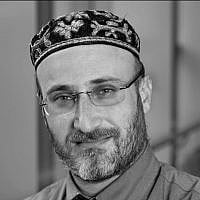
Former Jewish Prison Chaplain / Co-Founder: L’chaim
“Eye for an eye?” A 2026 Shabbat Shof’tim Sermon Against the Death Penalty
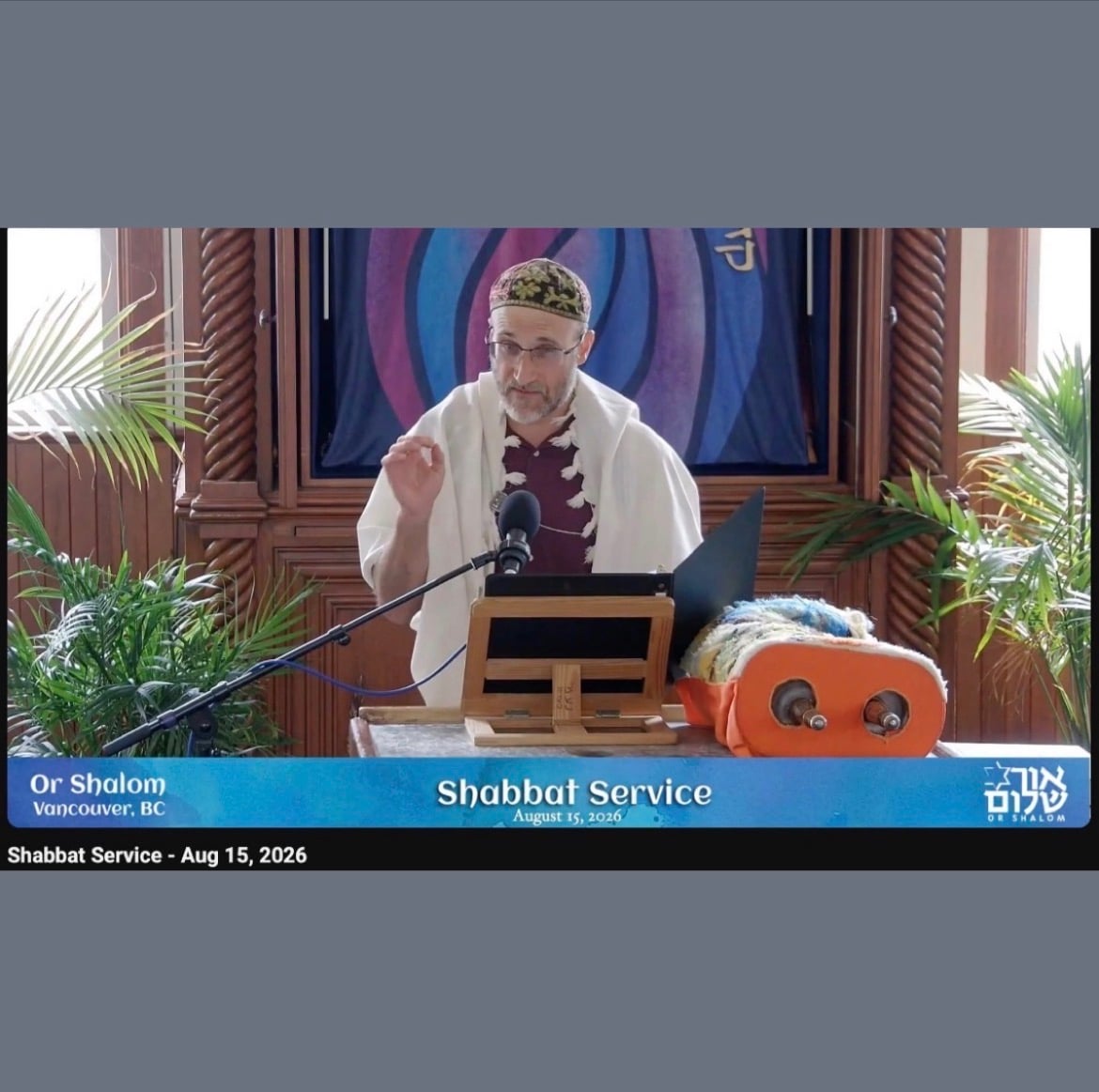
A screenshot of the writer delivering the D’var Torah (Sermon) on Shabbat morning, Aug. 15, 2026 at Or Shalom Synagogue in Vancouver, BC. The author is a former prison chaplain and co-founder of "L'chaim! Jews Against the Death Penalty," a group founded in 2020, with thousands of members in Israel and across the world. (Screenshot by Abraham J. Bonowitz. No copyright.)
The below text is a copy of the sermon that this writer delivered for Shabbat Shof’tim at Or Shalom Synagogue in Vancouver, BC on August 15, 2026. The writer is a former Jewish prison chaplain and co-founder of the group “L’chaim! Jews Against the Death Penalty,” with roughly 5,000 members across Israel and the world. The service was recorded and one can watch the sermon online starting at minute 1:26 here, as well.
___________________________
Shabbat Shalom!
(I dedicate this D’var Torah, this sermon, to my beloved paternal grandfather Jacob Zoosman, Yaakov ben Avraham (1890-1975). These words are delivered on his 51st yahrzeit. Zichrono Livracha – May his memory be an everlasting blessing, and his neshama/his spirit a loving guide for us all…)
Profound gratitude to Or Shalom for offering this bimah – this platform – to share my views on the death penalty – a topic that some might construe as “political,” but that I maintain is a human rights issue. Long before 2020, when I co-founded “L’chaim! Jews Against the Death Penalty” – which now approaches 5000 members – and long before I became involved with its parent organization Death Penalty Action and its Director Abe Bonowitz – I served as Jewish Prison Chaplain for three years for the federal correctional facilities across British Columbia. There, I personally witnessed the devastating impact of retributive justice and the cycle of violence, and just how much any human being can indeed change. That experience helped shape who I am today and my views about the death penalty.
That said, I recognize that not everyone shares my perspective (just as I myself once supported the death penalty.)’. Given the inherently contentious nature of this issue (an issue with which our tradition nonetheless demands we grapple, as we do in this Torah portion), I want to emphasize that the opinions you will hear from me today are just that. They do not reflect any official position of this congregation and community, no matter how much I might desire otherwise in my heart of hearts…As our Talmudic tradition models, we can conclude with: “Teiku” – that is, we can surely agree to disagree l’Sheim Shamayim – for the Sake of Heaven – and that is okay.
I also want to apologize ahead of time for going over my ten-minute limit. I tried my best, but alas, in the end, I failed miserably. I take full responsibility for that and pledge to make proper teshuvah (repentance ) on the approaching Day of Atonement Yom Kippur. I pray that you can forgive me for making us late to the kiddush lunch…
—————————
Two days ago, on Thursday, a veritable mass execution took place in the United States. Three lethal injections occurred all within 24 hours south of the border – in Tennessee, Oklahoma, and Alabama. As at every execution, the members of L’chaim participated in online vigils for each of these, hosted by Death Penalty Action. We offered memorial prayers – Eil Malei Rachamims – and shared about the lives of the victims of the crimes that led to those executions. We also chanted final prayers – including Psalm 23 in Hebrew – for those being led to the slaughter. As executions continue to ramp up in the States, we now do this roughly once a week, and more often of late, twice. Occasionally, but rarely, it’s three times a week. This Thursday was the first time since L’chaim began in 2020 that we had to hold three vigils on the same day…I hope never to have to do so again, but I fear it is only the beginning.
In a horrific synchronicity, this American triple execution day occurred during the very same week that Jews across the world join us here at Or Shalom Synagogue in Vancouver, BC in reading the parsha (portion) of the Torah called Shof’tim (“Judges”) Deuteronomy 16:18 – 21:9. This section of the Hebrew Bible includes the famous lex talionis Torah verse: “ayin tachat ayin” – an eye for an eye (Deut. 19: 21). (The full verse reads: “Nor must you show pity: life for life, eye for eye, tooth for tooth, hand for hand, foot for foot.”) Many rabbis and students of Torah use this opportunity to discuss their interpretation of Judaism’s approaches to the death penalty. The members of “L’chaim! Jews Against the Death Penalty” from across Israel and the world have marked this somber occasion by republishing our past sermons about this Torah portion, including one I delivered at Congregation Beth Israel here in Vancouver three years ago.
One cannot overstate the relevance of the topic of capital punishment for world Jewry in 2026. Just a few months ago, Israel enacted two new highly contentious laws calling for the death penalty. Meanwhile, the government of Iran, Israel’s sworn enemy, is executing its own citizens daily, and at a monstrous pace. In the United States, Robert Bowers, the perpetrator of the 2018 mass murder at Pittsburgh’s Tree of Life Synagogue, received the death penalty in 2023. That same year witnessed the latest execution of one of the many Jewish individuals on American death rows. No longer can anyone claim, as individuals once did, that the death penalty is “not a Jewish issue.”
In the United States, the death penalty will only continue to become increasingly relevant for the Jewish community. Thursday’s mass lethal injection took place on the heels of Florida’s double execution day last month and Texas’ recent celebration of its six hundredth execution of the modern era. States like these, along with the three executing states this week, are all within the American Bible Belt. Their death penalty advocates are often informed by a Christian tradition with undeniable Jewish roots. Many Christians who support the death penalty often quote “eye for an eye,” or “God’s Will” to L’chaim members when seeking to justify their support of capital punishment. Now, more than ever, the world needs a reminder of the many reasons why 21st-century Jews can and should always oppose the death penalty.
Many individuals in non-Jewish circles assume that Judaism embraces capital punishment. They often cite the very same “ayin tachat ayin” – “an eye for an eye” – verse that we read in this parsha. Their perception that “God commands it” trumps the countless human rights, ethical, and moral standards that the death penalty inherently violates. The truth is that Judaism did everything it could to curtail the employment of the death penalty. Before we get to that, though, just what are some of the many reasons for opposing the death penalty in the 21st century?
1) It violates the human right to life.
2) It often results in physical torture, and always is psychological torture for individuals counting down to their execution day. There is no humane way to execute human beings against their will.
3) It invariably is implemented in a racist manner, including in the USA, where cases involving white victims yield the death penalty significantly more than those involving black victims, and other nations whose laws openly target specific ethnicities. We recently saw this in Israel, whose first death penalty law this year targets Palestinian terrorists.
4) It risks executing the innocent. There have been over 200 exonerations of wrongfully convicted death row inmates since the resumption of executions in the USA in 1976. This does not include those before 1976, like Sacco and Vanzetti, who were most likely innocent and executed in Massachusetts 99 years ago this coming week, to name just two. How many more were missed and wrongfully executed? We shall never know…
5) It is an insidious tool for vengeance. In a recent Jerusalem Post op-ed, David S. Levine responded to an essay that I penned on behalf of L’chaim. My JPost op-ed had stated that “the death penalty is vengeance disguised as deterrence.” Mr. Levine’s retort, rather than denying this charge, openly acknowledged that the death penalty is indeed “unapologetically vengeance,” which he then proceeded to justify.
6) Meta-studies have determined time and again that the death penalty is not a deterrent. Deterrence is a fallacious delusion when applied to the death penalty, and “retributive” or “proportional” justice does not bring closure for murder victims’ loved ones.
7) Rather, the death penalty only creates more martyrs. A renowned comment regarding the well-established relationship between the death penalty and the desire for martyrdom comes from the 19th-century writer Eliphas Levi. He demonstrated a keen understanding of these basic human dynamics when he wrote: “Every head that falls upon the scaffold may be honored and praised as the head of a martyr.” History has proven this time and again.
8) It traumatizes executioners and witnesses.
9) From Adolph Hitler to Donald Trump and elsewhere, the death penalty is used as a political tool, particularly for election campaigns.
10) Many execution methods are direct Nazi legacies, including firing squad, gassing, and lethal injection.
Despite all of this and more, death penalty supporters maintain that in our parsha and throughout the Torah “God commands it.”
And yet, informed Jews are well aware that Jewish tradition did all it could to diminish the death penalty. Judaism today does not hold to the more than thirty offenses cited in the Torah that demand capital punishment. One such Biblical capital crime is insulting one’s parents; were this standard in place today, I myself would have been put to death long ago, as would my children, and dare I say so would many of you…
Rabbis and Jewish scholars who are much more well-versed in the Talmud than I have spilled countless volumes of ink on the topic of Judaism and capital punishment. Rabbinic Judaism, while not entirely abolishing the death penalty, provided prodigious safeguards making it nearly impossible to carry out. A main goal of these failsafes was to ensure that no innocent person ever would be put to death. As R. Moses Maimonides (1135-1204) famously said of capital punishment: “It is better to acquit a thousand guilty persons than to put a single innocent one to death.”
For individuals who were decidedly not innocent, many Jewish scholars point to what is perhaps the most oft-quoted Talmudic passage on the death penalty, which comes from the Mishna, Makkot 7a, where we read the following:
“A Sanhedrin [Rabbinic court] that affects an execution once in seven years, is branded a destructive tribunal.” (a la hanging court) Rabbi Eliezer ben Azariah says: once in seventy years. Rabbi Tarfon and Rabbi Akiva say: Were we members of a Sanhedrin, no person would ever be put to death.
Rabbinic law and custom have a great deal to say about the legal requirements necessary to ensure that there is not a “hanging court.” The bar is impossibly high to convict. A death sentence required not only that two people witnessed the actual capital crime, but that they warned the perpetrator just before s/he was about to carry out the criminal action that would warrant the death penalty if they went through with it. I, for one, know of no instance where these standards have been met.
And there is more. In its historical context, lex talionis (“ayin tachat ayin” – “eye for an eye”) was intended to curtail, rather than augment, the collective bloodlust of expansive vengeful massacres that societies practiced in response to killings in ancient times — and still do all too often today. In other words, one eye – and no more than one eye – should be paid for the loss of one eye, lest punishment becomes in excess. Furthermore, and crucially, in rabbinic parlance, the traditional Jewish interpretation of the Biblical “eye for an eye” was as a call for financial compensation for the value of said eyes.
Still, rabbinic texts did leave room for capital punishment. The very next line in the Mishna quoted above is from Rabban Shimon ben Gamliel, who said that if a Sanhedrin only had one execution every seventy years, then that court would serve to “increase murderers among the Jewish people.” In other words, the death penalty according to Rabbi Shimon ben Gamliel would lose its deterrent value, as all potential murderers would know that no one is ever executed. Rabban Shimon ben Gamliel, of blessed memory, who lived thousands of years ago, could not have known of any of the many modern social science studies that have demonstrated that the idea of any deterrence effect of the death penalty is a fallacy. With this false obstacle to the rabbinic view removed, the next logical step in Jewish thought on this matter is full abolition.
And yet: here we are celebrating a triple execution day in 2026.
Since 2020, L’chaim’s members and I have been in touch with all individuals with active execution warrants in the USA, as well as all Jewish men and women on American death rows. This includes my longtime pen pal Jedidiah Murphy, a Jewish man with dissociative identity disorder who had been my pen pal for years, and who the Lone Star state lethally injected on World Day Against the Death Penalty, on October 10th, 2023, for the murder of 79-year-old Bertie Lee Harmon Cunningham, Z’L.
Jedidiah sent me these words before his execution:
“I have spent 8300 days in segregation, and during that time I’ve sought to do the most that I could to help others and, in the end, myself. I sought out Hashem, and he helped me get to where I am today. I have been loved throughout my time, and it is that love that helped me collect back some of the broken pieces I lost long ago. People misunderstand this [dissociative identity] disorder, and I understand why. But it has been the bane I have fought since I was young, and now that I have a grip on it, instead of the opposite, the state wants to kill me. I live to serve, and my wish is to tell my story, as painful and tragic as it is, so that my repentance is not just in the way I walked or talked, but in what I did to lead people away from the places that led me here. To live as an example to those who wish to change and also to show the pain this crime carries to everyone involved. I wake up to my crime daily, and I’ve never gone a day without sincere remorse for the hurt I’ve caused. So I don’t seek LIFE for some out. I seek it to pay back for what I’ve done. It won’t be life as a free man, but as a man in prison… a man who has changed and wishes to show everyone the power of G-d…. Be Blessed..Shalom, Jedidiah Isaac Murphy.”
We all know the horrors that unfolded in Israel on October 7th, 2023, three days before Jedidiah’s execution. In one of his last messages to me, Jedidiah told me that he was praying for Israel, just as he himself was facing death.
Texas indeed murdered Jedidiah on October 10th. To do so, it used the most common American form of execution, which is lethal injection. Lethal injection was first implemented in this world by the Nazis as part of the Aktion T4 protocol used to kill people deemed “unworthy of life.” Dr. Karl Brandt, the personal physician of Adolf Hitler, first devised that protocol. Every use of lethal injection carries on this direct Nazi legacy. This is the method by which the federal government likely also will put to death the Tree of Life shooter, though other killing methods indeed exist. Various states also employ firing squads and gas chambers to put their inmates to death, with Arizona even proposing Zyklon B, as used in Auschwitz.
The members of L’chaim who, like myself, are direct scions of Holocaust survivors know very well that the death penalty is not the same as the unparalleled conflagration that was the Shoah. L’havdil. And yet, members also know, viscerally, the dangers of giving a government the power to kill those it incarcerates. Holocaust survivor and human rights activist Elie Wiesel articulated this prophetically. Weasel, a die-hard abolitionist (pun intended), famously said the following in a 1988 interview with Amnesty International: “With every cell of my being and with every fiber of my memory I oppose the death penalty in all forms…I don’t think it’s human to become an agent of the angel of death.” Later in his life, Wiesel famously stated of capital punishment: “death should never be the answer in a civilized society.”
To this blood-thin-red-line, there are no exceptions. For Martin Buber, Gershom Scholem, Holocaust survivor Nelly Sachs and other Jewish human rights activists in the wake of the Shoah, this included staunch opposition to Nazi mass murderer Adolph Eichmann’s execution, which Buber notably called a “great mistake.” For the thousands of members of L’chaim! who carry this torch, that mistake applies as well to Robert Bowers and to the perpetrators of October 7th.
In his Reflections on the Guillotine, Albert Camus concluded: “But what then is capital punishment but the most premeditated of murders, to which no criminal’s deed, however calculated it may be, can be compared?” From my personal experience over the last six years with L’chaim in communicating daily over email, letters and phone with condemned men and women counting down their final months, weeks, days and hours, I can attest to this psychological torture. The death penalty condemns the society that enacts it infinitely more than the human beings it condemns to death. Canada ended this gruesome cycle of violence decades ago, when it initially abolished the death penalty in 1976 (and fully in 1998). I pray that one day all nations of the world will join Canada, and the more than 70% of world nations who stand united against the consummate human rights violation that is capital punishment. As of just this past week, that list now includes Lebanon, which abolished the death penalty just this past Tuesday after 22 years without an execution. And the only party to go on record opposing that resolution in Lebanon? Hezbollah. Other newcomers to abolition are Ghana (2023), Antigua and Barbuda (2023), Papua New Guinea (2022), Sierra Leone (2021) and Kazakhstan (2021).
“God commands it.” I hear the echoes of that statement in my ears regularly from the voices of individuals who support capital punishment, including many fellow Jews who label me a self-hating Jew, Hamas supporter, and “Kapo” for being a death penalty abolitionist. (One response to a social media post in which I advertised that I would be delivering this sermon, stated: “Your stance is both morally perverse, and evidence of an underlying mental instability.” Another said of Hezbollah’s opposition: “As much as I despise Hezbollah, they are right on this one. Lack of deterrent always results in crime propagation.”
In response, the members of L’chaim join me in invoking another well-known verse from this week’s parsha: the famous call of “Tzedek, tzedek tirdof – “Justice, justice shall you pursue.” (Deut. 16: 20) Our version of that “Justice” is not retributive, but rather restorative justice. It is the kind of justice reflected in the title of Prisoner Justice Day, which was begun in Canada and now is marked internationally every year on August 10. To reflect our version of the pursuit of justice, we instead chant: “Abolition, abolition shall you pursue,” and we conclude of course with the familiar refrain: “L’chaim – To Life!”
Will you join us in that chorus?
Thank you again for your extra time…I owe you all lunch!
Shabbat Shalom.
Cantor Michael J. Zoosman, MSM, BCC
Co-Founder: L’chaim! Jews Against the Death Penalty
Advisory Committee Member: Death Penalty Action
Related Topics
Related Posts