
Introducing Braidzuterol By Mensch Pharmaceuticals
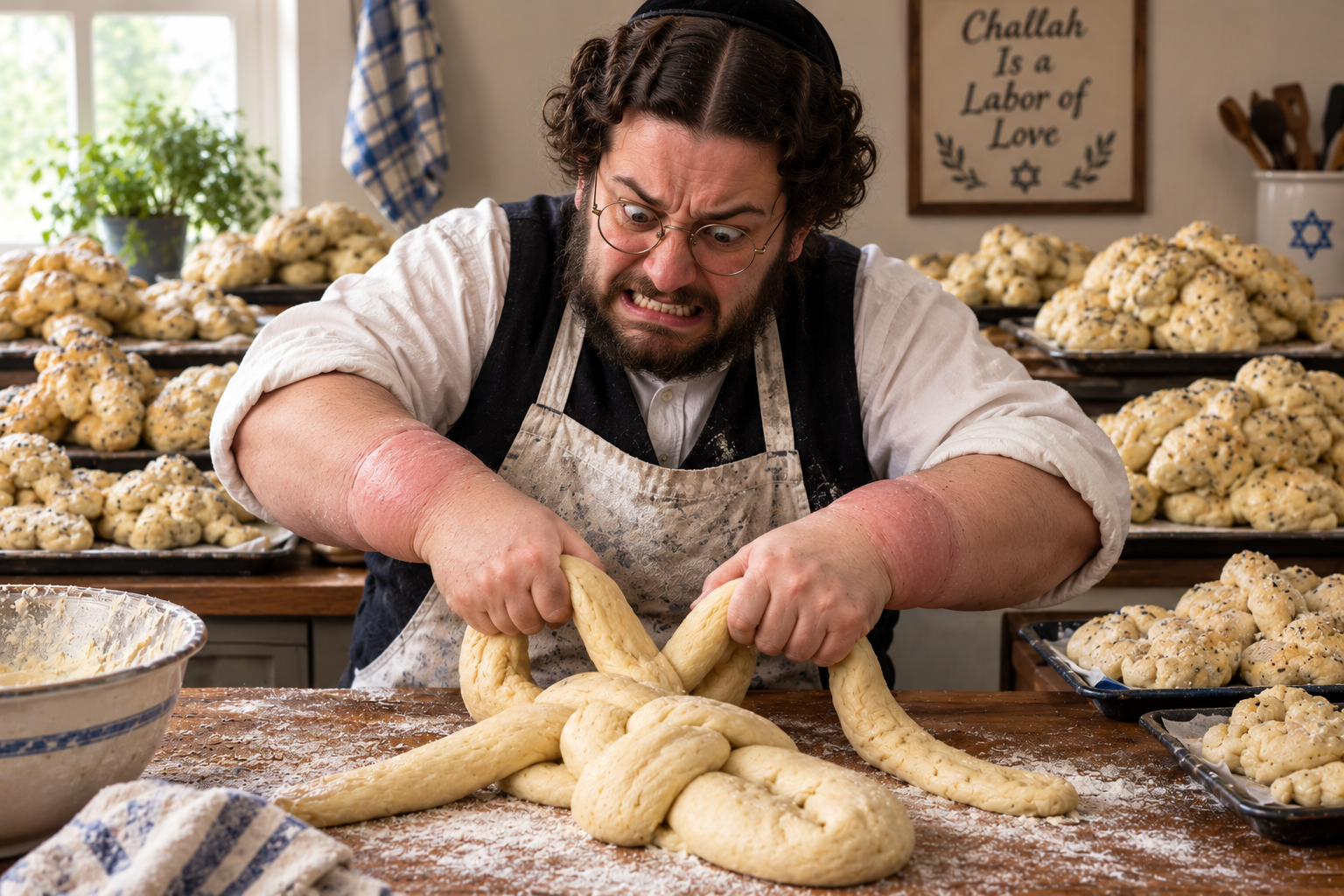
Every week, Jews around the world enjoy the warm, sweet, familiar embrace of freshly baked challah. Those fortunate men and women who can make it can sit back and enjoy the wide eyes and watering mouths of friends and family as they glance upon the intricately woven threads of egg-bathed dough. Sadly, hundreds of thousands of Jews will never know this sense of satisfaction. I am, of course, talking about those of us who suffer from the debilitating disease, Challahtosis.
Good Shabbos. While you may know me as America’s Rebbitzman, purveyor of Jewish absurdity, I am also a lifelong sufferer of Challahtosis. For decades, I have felt the anxiety and physical pain that comes with attempting to braid a challah. It doesn’t matter if it’s a nine, six, or even a three-strand challah; we, with this cruelest of ailments, will never know the pleasure of having a fully baked loaf come out of the oven and look beautiful. No, for us, baking a challah means anxiety, anger, wrist pain, the disdain of hopeful children, in some extreme cases, excommunication, and worst of all, an amalgamation of clumped dough we try to call a challah.
According to a 2023 study by the Cleveland Clinic, a whopping 1 in 8 Jews suffer from Challahtosis. Even more incredible, a shocking number of those infected do not even realize they have it. So if you have ever had Shabbos guests bring a challah that resembles a disfigured mound of paper mache instead of the holiest of carbohydrates, chances are they too have Challahtosis.
Those of us with the disease have had to live a life of silent shame. We are unable to participate in our children’s tot shabbat challah making. We need to have awkward and embarrassing conversations with our b’shert, prior to marriage about getting extra blood tests to ensure that our children are born disease free. We must endure the often hurtful comments of “why don’t you just watch this Youtube video, or “you can braid your daughter’s hair; why can’t you just apply that to dough?” While they mean to be helpful, these people will never know the true impact Challahtosis has.
For years now, I have accepted this to be my reality, but I am here to tell you there is hope. When the good people at Mensch Pharmaceuticals first reached out to me to be the face of Challahtosis, I was skeptical and afraid. Did I really want the world to know my secret? That while I am known in certain circles for my skills with macrame, I couldn’t even fold a challah at a toddler’s level. Then they introduced me to Braidzuterol. Braidzuterol is the world’s first treatment for chronic Challahtosis! After my first full dosage of Bradzuterol, I was able to braid a challah that I wasn’t ashamed of!
The process is easy. All it takes are 3 simple injections in the eyes on Monday, Wednesday, and Thursday, each week leading up to the pre-Shabbos baking day. As long as I start the dough by 6:30 AM, my Challahtosis symptoms disappear for the 15 minutes of required braiding time. By erev Shabbos, the challah is done and beautiful for all to enjoy. Then I simply have to re-inject my eyes the following Monday to be ready for the next Shabbos.
I know what you are thinking: only three injections to the eyes to be able to braid a beautiful challah of any size? That sounds too good to be true. Well, friends, I am here to tell you it is true! The best part is, there are only a couple of minor side effects, which include:
- Temporary blindness at the injection site
- Headaches
- Explosive Stigmata
- Confusion
- Celiac Disease
- Abnormal sensitivity to the color blue
- Spontanious Hagbah
- Dry mouth
Do not take Braidzuterol if you or a family member suffers from fear of heights, are on EIEIO inhibitors, need to operate relatively light weight machinery, know someone who is pregnant or planning to become pregnant, are allergic to Braidzuterol, or if you regularly wear socks. Braidzuterol is not for those who can braid a challah but wish to achieve a superhero-level braiding abilities, as this was tested in the lab and the less we say about that, the better. Do not play Twister while on Braidzuterol, as it creates an unfair advantage in the game. Do not take other eyeball injections while on Braidzuterol. Finally, do not ever stop taking Braidzuterol. Even if you are not planning on baking Challah that week, stopping the injections may result in a newly discovered spinoff disease called Kreplachkinisia.
So, join me, America’s Rebbitzman, and the hundreds of thousands of other Challahtosis sufferers in saying “Thanks Braidzuterol, we can finally twist that dough!”