Jewish Educators: Everyone Deserves to Learn
To protect the anonymity of all professors and teachers in the article, they will be referred to with they/them pronouns and will not be identified by the subject they teach. Their actions, whether good or bad, should serve to educate, rather than to investigate.
Recently, a professor did something that surprised me. In my third semester of college, they went above and beyond what I would even expect an inclusive professor to do, reshaping my expectations of our Jewish educators.
One day in class, a noise was bothering me. I didn’t know what it was, where it was coming from, or how to stop it. It was overstimulating. A few minutes before the end of class I had to step out.
Normally, I would investigate the source of the noise and try to find a way to block it out. I might adjust my earplugs, sit in a different seat, or just try to avoid the problem. But my professor (“Gideon”) did something different. They did not want us to wait. Only 45 minutes after class I received an email. “Gideon” had reached out to SSD and Space Management to switch rooms. Later that night, I received another email. They had spent a good portion of their day emailing and calling through the proper channels to make the switch possible. They were confident it was going to happen.
To reiterate: “Gideon” did this without me requesting it – without me even asking. But in their email to me, they reminded me that what they did was not actually going above and beyond; it was a basic expectation: “It is not acceptable to meet in an environment in which everyone does not have the same opportunity to participate in the learning.”
“Not acceptable.” “Gideon” reframed the conversation. This was not about doing what was nice, or going above and beyond; they were doing what any decent educator would do–what is just right. I could feel through the email that if they received a “no,” that they would not accept it; this was a matter of basic duty to their students.
I thanked the professor, of course. And as I have mentioned in previous blogs, because Binghamton’s Services for Students with Disabilities department is so wonderful, we successfully switched rooms. This reminded me of what educators should do when confronted with an access issue; unfortunately, it reminded me of moments where the opposite has occurred.
In contrast, I’ve had some bad teachers when it came to supporting my needs. Sometimes, my needs were dismissed. I distinctly remember getting an essay assignment I didn’t understand. I asked the teacher (“Jacob”) during class to clarify the vague instructions, explaining that since I am Autistic, I needed more direct guidance. Their response shook me and my classmates.
“Jacob” told me since they had worked in education for over 10 years, including with Autistic students, that they knew more about Autistic learning needs than I did. Compare that with “Gideon”: there was no assumption that they knew better than me. They saw me struggling, they told me they wanted to help, and they acted. They were not dismissive; they were active.
However, sometimes a well-meaning teacher can also be ineffective. Even when it was clear that I was struggling in one teacher’s (“George”) class, I was never challenged to improve. I was falling behind and failing to understand the material. While COVID was partly to blame, the “George”’s focus on talking to me about one of my special interests rather than the course didn’t help either.
When a teacher wants to support a neurodivergent student, they shouldn’t just ensure that the student has the opportunity to learn; they should hold them accountable for learning. Being Autistic and neurodivergent means I learn differently; it’s not a “free pass” for not putting in the effort. This delicate balance — between grace and great expectations — is exactly what I found myself tackling as a Jewish educator this past summer.
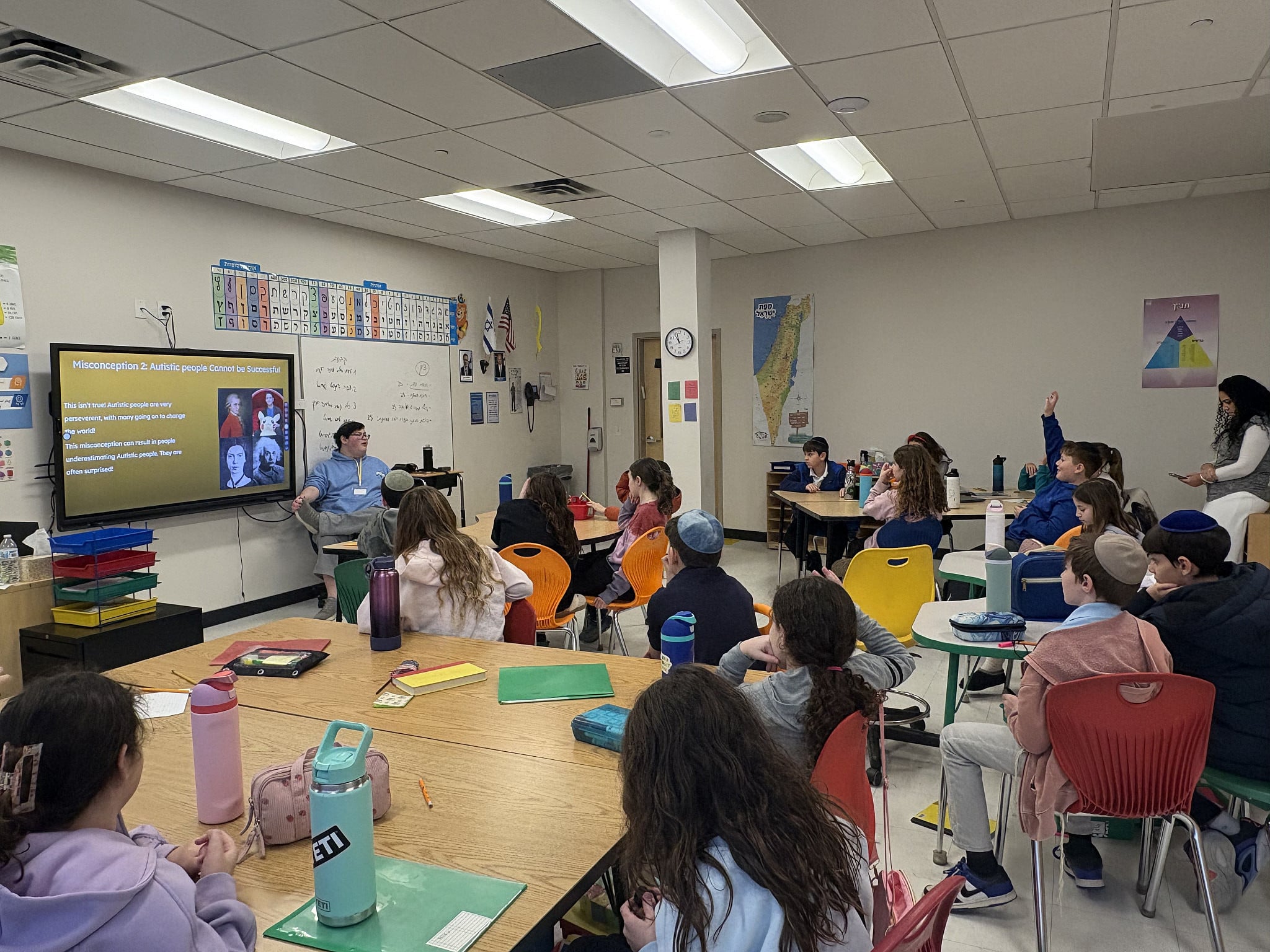
However, I think it is important to understand the other side, which is why working on Ramah Nyack’s education team this past summer was such a valuable experience. What I learned is that inclusion is difficult because of limited resources. The teachers care – but when you have to manage 10-15 sweaty, antsy campers, you have to reevaluate your priorities. I started the summer with an ambitious plan to discuss hard-hitting Jewish subjects with my middle-school aged campers. When I noticed that my curriculum wasn’t working, I needed to pivot. Jewish education needed to reach their needs, not fit my agenda. I wasn’t perfect, though. One difficult moment was having to ask a camper to leave my class because I couldn’t accommodate them. I know if it were one-on-one, I could have figured something out, but I had ten other campers to manage. It was devastating. And that gave me a window into the broader reality of Jewish education.
Now, I need to deliver a hard truth. Jewish education is behind the curve when it comes to neurodiversity access. While some environments thrive, others don’t. Our institutions need to prioritize inclusion more.
The reality is clear to me: most Jewish educators are not ‘bad’. Nor do they go above and beyond like my professor. Instead, most, to varying degrees and success, try their best with the resources available to them to accommodate students while also addressing the many other needs of the class. I fell into this category this past summer.
So, how do we move educators towards what “Gideon” exemplified? It starts with recognizing that inclusion must be a core value. It must be the center of what we do. And that comes with understanding that inclusion doesn’t just impact neurodivergent students, but everyone in the classroom. I got better at prioritizing inclusive learning in my curriculum by the second session. Instead of lecturing about Jews in Hollywood, I put on The LEGO Batman Movie. Rather than talking about the shtetl, we played a Mafia-style Dybbuk game. I focused on experiential learning, because I discovered that in a camp environment, my campers needed more interactive and physical lessons. Part of this also required getting advice from colleagues and other camp staff, just like when “Gideon” worked with SSD and me to address my needs – it takes a joint effort and diverse perspectives to bring inclusion to the classroom.
“Gideon”, like any educator, is not going to be perfect. But I think about what they have done that other Jewish educators can learn from:
- A genuine desire to help every student succeed: I haven’t seen this professor just assist me; they’ve gone out of their way to address other needs in the classroom.
- A focus on conversation and building the classroom around our interests: We are expected to show up having done the work, but it is our thoughts that drive the discussion.
- A friendly and approachable nature: They are still my professor, but they frequently bring up relatable personal anecdotes, play on class jokes, and note particular student interests when asking questions. This makes it easier to have a sensitive conversation about a particular need.
- Lastly, they are open to growth: This is the most important takeaway. When I advised on a recent faculty search, the one question I constantly asked was: what is something you can do better on, and how do you want your fellow professors and your students to help you with this growth? The candidate who was ultimately selected gave an excellent answer. Experience does not mean perfection. Both “Gideon” and “Jacob” had extensive teaching experience, but they utilized it differently. “Gideon” used it to grow; they constantly revise their reading lists, course expectations, and pedagogy in line with genuine student needs; my other teacher used it to dismiss my needs.
As we enter 5787, let’s commit to grow and do the needed work. Let’s continue to celebrate the teachers who prioritize inclusion and ensure that everyone can learn – because we are a people defined by our dedication to learning, where each individual shall be taught “in the way each ought to go” (Proverbs 22:6). So, if we want to live up to that promise, we need to remember that inclusion is our responsibility to each other. When we see something unacceptable, like “Gideon” did, we do something. Through learning, we can truly mimic G-D, by making sure everyone can.