A Moroccan Journalist
Normalization with Israel Should Not Require Missionaries
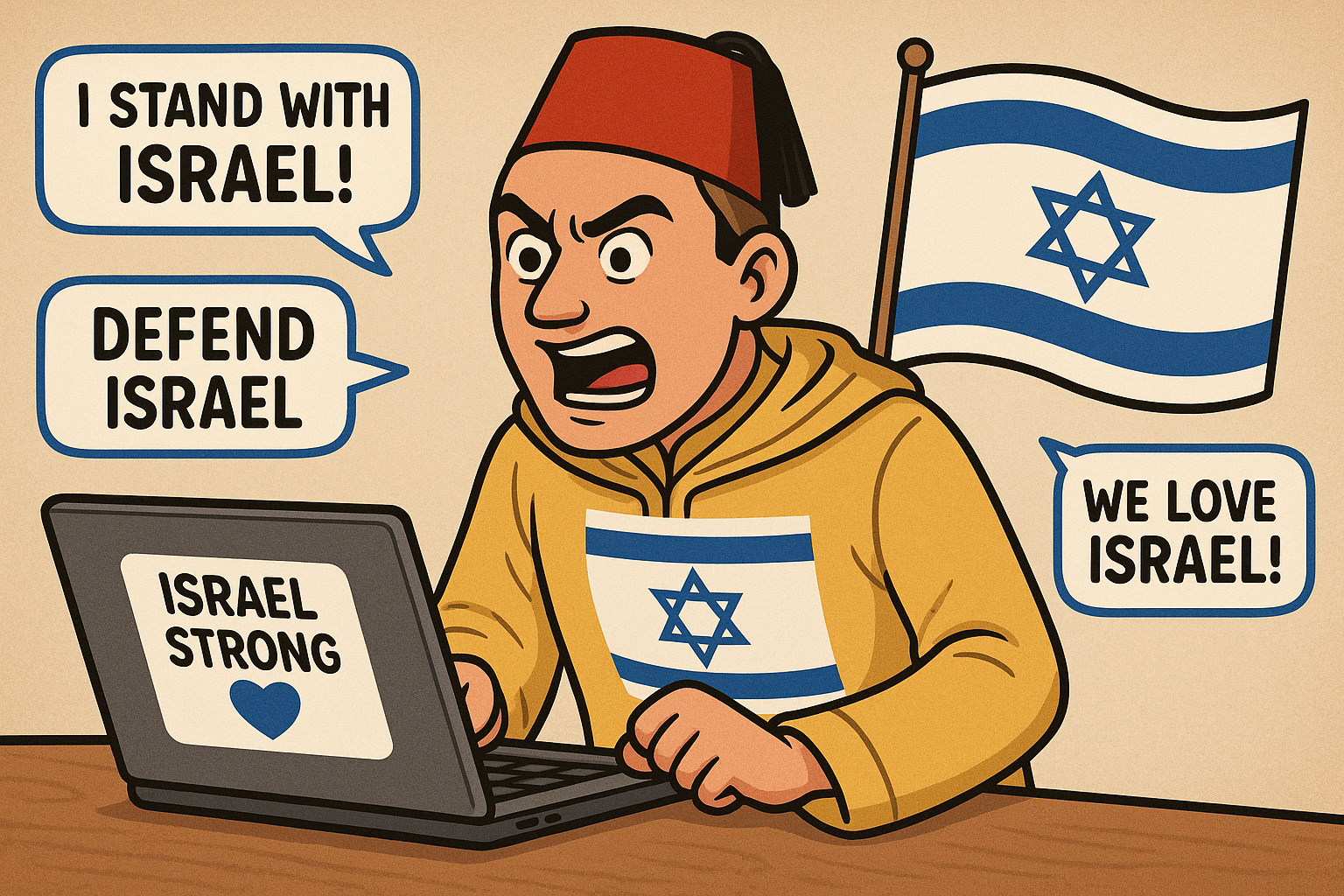
A Moroccan man in traditional attire passionately defending Israel in online debates. (AI generated)
Public opinion in Morocco has remained structurally and emotionally pro-Palestinian for decades, but since October 7, 2023, that position has crystallized into something deeper: a sustained moral economy of solidarity, expressed through weekly nationwide demonstrations, editorial lines across much of the press, and a popular consensus that distinguishes clearly between state-to-state diplomacy and ethical alignment.
This distinction matters. It is precisely within this gap that a peculiar political pathology has emerged: the figure of the Moroccan “pro-Israel missionary.”
These actors are not merely supportive of diplomatic normalization. They do not advocate pragmatic engagement, strategic restraint, or balanced foreign policy realism. Instead, they perform an almost evangelical defense of Israel – loud, obsessive, and conspicuously public – often framing themselves as brave dissenters against an allegedly dominant Arab orthodoxy.
In reality, they are neither dissenters nor strategists. They are opportunists operating within what political theorists would call a symbolic scarcity economy: a space where being “the Arab who supports Israel” is rare, visible, and therefore marketable.
Their calculation is simple. In a global hierarchy where Israel is perceived – rightly or wrongly – as possessing disproportionate symbolic, lobbying, and geopolitical weight in Washington, proximity to Israel is imagined as proximity to American power.
“Loving Israel” thus becomes a speculative investment, a shortcut around institutional merit, professional rigor, or genuine policy expertise. It is a politics of shortcuts, not convictions.
In this climate, some support for Tel Aviv/Jerusalem appears less about principle than about chasing personal gain, knowing full well that only a handful will compete in this race to ingratiate themselves, convinced that “loving Israel” is a shortcut to American favor.
Yet this posture fundamentally misunderstands both power and normalization.
Normalization, by definition, implies routinization. It strips relations of exceptionality and integrates them into the ordinary machinery of foreign policy: interests, limits, disagreements, and mutual respect.
What is normal does not require constant declaration. No Moroccan intellectual dedicates their career to being “pro-Spain.” No one builds an identity around defending Franco-Moroccan relations with missionary zeal. Spain is treated as what it is: a neighboring state with which Morocco has layered, sometimes tense, sometimes cooperative relations. That is normal foreign policy.
By contrast, loudly branding oneself as “pro-Israel” does not normalize relations – it exoticizes them. It turns diplomacy into identity performance. Worse, it re-politicizes normalization by transforming it into a moral allegiance test. In doing so, these missionaries undermine the very logic they claim to defend. A relationship that constantly needs defending is, by definition, not normal.
This is where Foreign Minister Nasser Bourita’s earlier remark – “we should not be more Palestinian than the Palestinians themselves” – remains analytically relevant. He made the statement in early 2020, in the context of parliamentary discussions following the announcement of the US-proposed “Deal of the Century,” stressing that Morocco’s support for Palestine is grounded in respect for Palestinian political agency rather than performative over-identification or rhetorical excess.
It was not a dismissal of Palestine, as critics often caricature it, but a statement of diplomatic realism: Morocco supports Palestinian rights while recognizing that Palestinians themselves are the primary political agents of their cause. Extending that logic symmetrically, one might say: we should not be more Israeli than Israelis themselves.
Israel does not need Moroccan volunteers to fight its narrative battles. It has a state, institutions, allies, media infrastructures, and one of the most sophisticated diplomatic and lobbying ecosystems in the world. When Moroccans take it upon themselves to defend Israel more aggressively than Israeli officials, they cross from diplomacy into servitude. And servitude, in international politics, is never rewarded long-term.
Indeed, Israel’s relationship with such figures is instrumental, not emotional. They are useful as proof-of-concept – tokens deployed to signal that “even Arabs support us.” Once used, they are discarded. Tissue politics: absorb, display, dispose. This is not cynicism; it is how power operates.
Crucially, even the Hebrew state itself regards such figures with quiet suspicion rather than admiration. In the Israeli political imagination, they remain Arabs first and foremost – useful as temporary exhibits, never as equals. They are instrumentalized, not embraced; tolerated, not trusted. Their hyper-visibility does not translate into influence, only into momentary utility.
In the end, they occupy a political no-man’s-land: estranged from Arab publics they openly disdain, yet perpetually peripheral to Israeli society, which neither needs nor truly acknowledges them. Their loyalty performance yields no capital – only isolation.
What makes this phenomenon particularly corrosive is its performative hostility toward Moroccan public sentiment. These missionaries do not merely support Israel; they actively antagonize Morocco’s pro-Palestinian majority, framing it as naïve, emotional, or ideologically trapped.
In doing so, they invert the hierarchy of legitimacy: popular sentiment becomes something to be corrected, not represented.
When examined closely, this posture does not even rise to the level of foreign policy realism. As a matter of fact, it is a posture of aristocratic disdain – a theatrical performance of elitist contempt, an affectation of superiority that cloaks social detachment, moral arrogance, political emptiness, and social alienation in the borrowed language of courage and the self-flattering illusion of intellectual bravery.
From a theoretical perspective, this behavior aligns with what Pierre Bourdieu would describe as the pursuit of symbolic capital in transnational fields. Lacking strong domestic legitimacy, these actors seek validation abroad, converting external recognition into local authority. Yet such capital is inherently unstable. It depends entirely on remaining useful to external power brokers – and usefulness has an expiration date.
Morocco’s foreign policy, by contrast, has been remarkably consistent: principled pragmatism. Support for Palestine is articulated clearly and repeatedly at the highest levels of the state, including repeated affirmations that Morocco supports the Palestinian cause in accordance with the choices and priorities determined by the legitimate Palestinian authority, endorsing what Palestinians deem viable while refraining from interference in their internal political calculations.
At the same time, Morocco defines its national priority unambiguously: territorial integrity. This hierarchy is neither immoral nor unique; it is how sovereign states operate.
The danger, then, is not normalization itself. The danger is its distortion into spectacle, ideology, and personal branding. When individuals turn bilateral relations into identity crusades, they hollow out diplomacy and replace it with theatrics. They mistake alignment for relevance and noise for influence.
In this sense, ritualized militancy and doctrinal fanaticism – whether draped in unconditional devotion to Israel or in absolutist, performative claims to “own” the Palestinian cause – produces the same analytical failure: it replaces strategy with identity and foreign policy with moral exhibitionism.
Normalization should be boring. Quiet. Institutional. Managed by professionals, debated rationally, adjusted when necessary. The moment it becomes a cause to which individuals dedicate their lives – declaring loyalty, denouncing skeptics, seeking applause abroad – it ceases to be normal and becomes something else entirely: a symptom of insecurity, not strength.
Morocco does not need missionaries. It needs diplomats.
Related Topics
Related Posts