A Moroccan Journalist
Morocco First. Period.
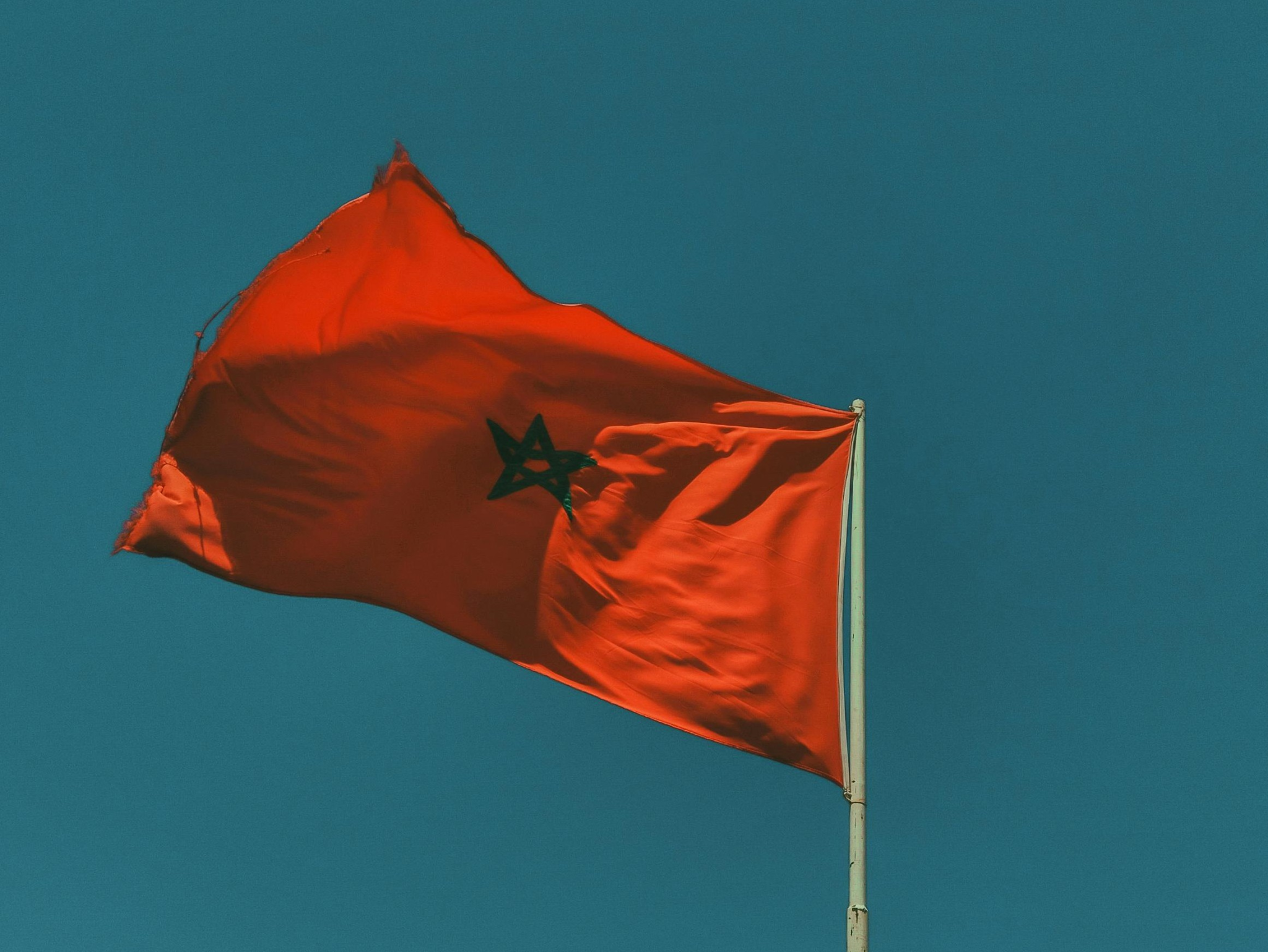
Morocco’s flag. (Pexels/free to use)
Sometimes, international politics feels like one of those “Piccadilly plays” – the British dramas packed with deceit, backroom deals, and a cast that hides daggers behind polite smiles. But the play we have just witnessed on Morocco’s Western Sahara stage could make even the most tragic widow laugh. It is that absurd, that revealing, and that deeply ironic.
The recent developments have once again underscored that although the Cold War era – once framed as a binary contest between East and West – has formally ended, its underlying logic of bloc politics remains deeply alive. Today, the world is not divided by ideology in the same rigid vocabulary, yet every state, whether it declares it or not, whether it wishes it or not, inevitably gravitates toward one of two broad strategic constellations.
On one side stands what is often called the Axis of Resistance, represented by Iran, Qatar, and Palestine-aligned groups, projecting a narrative of defiance against Western-backed regional orders. On the other side stands the Normalization or Strategic Partnership Bloc, where states such as Morocco, the UAE, and Israel align their security, diplomacy, and development trajectories with US-anchored frameworks. The Western Sahara question has simply revealed, once more, that global alignments never truly disappear – they transform.
Indeed, when the question of the Sahara arises, the Palestinian voice goes silent – or when it does speak, it does so with a detachment so chilling it borders on indifference. Those who speak endlessly of Arab unity, Islamic brotherhood, shared destiny, and the sacredness of land suddenly find no vocabulary, no fire, and no loyalty when the map points west. They become distant, calculating, stripped of the emotional intensity they expect from us when the cause is theirs.
Indeed, when the Sahara comes up, one notices a silence as revealing as any explicit stance: a tone deliberately drained of warmth, as though acknowledging Morocco’s right to its own territory might disturb some unexamined narrative they cling to. And so we must repeat what we have long said, and it bears repeating again: Morocco is not obligated to serve as a vessel for the ideological or sentimental projections of others, and Morocco owes no one its silence.
We are not tools in anyone’s grand project, not pawns on someone else’s chessboard. Our first and only commitment is to Morocco – to its sovereignty, its security, its stability, its people. No slogan, no cry of the ummah, no rehearsed rhetoric of liberation can supersede the moral and historical imperative of defending the unity of the Moroccan homeland.
And why not? Many Palestinians – shaped by decades of anti-imperialist discourse – read the Sahara question through the same prism they apply to their own struggle: Israel as “neo-colonialism,” Morocco as a supposed parallel, the Sahrawis and Palestinians folded into one imagined narrative of self-determination crafted in the 1970s and kept alive mostly by the remnants of a left that still believes it is saving the world while doing the opposite.
Even the flag of the self-styled “Sahrawi Arab Democratic Republic” gives the game away: a Palestinian flag with an added Algerian crescent and star – an aesthetic Frankenstein that reveals who stitched the narrative together and for what purpose.
The true ally is the one who stands plainly beside us when our essential interests are at stake. The one who hesitates, who prefers ambiguity, who chooses convenient silence or the comfort of “neutrality” while our territorial integrity is challenged, is neither ally nor friend, no matter how loud his sympathies elsewhere or how theatrically he demands emotional solidarity from us. And as clarity finally settles across global diplomacy – Madrid forced to swallow historical fact, Paris recalculating the cost of hedging, Washington and London aligning interests with strategic realism, Riyadh and Abu Dhabi closing the chapter of ideological adventurism, and Tel Aviv recognizing the geopolitical grammar of North Africa – it becomes ever more obvious that Morocco’s problem was never with distance, but with proximity. Not with the foreigner, but with the familiar who wears the mask of fraternity while harboring the intent of the stranger.
And there is no need to belabor the obvious role of the United States, the penholder that championed and steered Resolution 2797 through the Security Council – the landmark text that recognizes Morocco’s autonomy plan as the sole basis for a negotiated solution. The point is made more clearly in an unlikely but revealing gesture: Prime Minister Benjamin Netanyahu publicly congratulated King Mohammed VI for the resolution’s adoption, praising it as “a triumph for long-lasting, determined Moroccan diplomacy.”
At a moment when anti-Israel sentiment had reached its peak in Morocco – boycotts, protests, nonstop campaigning – Israel’s leadership was among the first to salute Morocco’s strategic victory. A paradox? Hardly. It simply proves what the ideologues refuse to accept: Morocco’s diplomacy wins on its own terms, guided neither by applause nor by outrage, neither by ideological sentiment nor political intimidation.
And that, perhaps, is the ultimate irony. Those who shout the loudest about Palestine cannot muster a whisper for Morocco. Those who demand that we bleed for their cause cannot find a heartbeat for ours. Those who speak to us of unity shrink when unity requires them to stand with Morocco, not merely extract from it. But Morocco has outgrown these theatrics. It has learned to read the regional script for what it is: a hall of mirrors where faces smile in front and sharpen daggers behind. And while others rehearse old slogans, Morocco does what states do – it advances, it consolidates, it wins. With or without their approval.
It is here that Qatar appears as a nearly perfect symbol of this duplicity: the chameleon emirate that smiles in daylight and whispers sabotage once lights dim. A polished diplomatic grin at the surface, while beneath, a soft warfare of narratives recycles the same tired myths of the Sahara conflict – old ideological dust repackaged as moral truth.
Media organs positioning themselves as guardians of conscience while in fact perpetuating uncertainty, preserving the wound, ensuring that nothing truly resolves, for resolution would diminish their cherished role as eternal mediator. It is the old Arab game of mirrors: a face blessing your steps, another sharpening symbolic knives just behind your shoulder. What they do not realize is that the audience has changed. The region sees. The Moroccan public especially sees.
Yet perhaps the most startling hypocrisy is not abroad but at home. Years ago, Morocco’s Ministry of Foreign Affairs issued a firm directive barring holders of diplomatic and service passports from entering the Spanish-occupied cities of Ceuta and Melilla via the Spanish gate. Few recalled that years earlier, some “scholars” insisted that entering “occupied Palestine” was forbidden because stamping one’s passport amounted to recognition of “occupation.” Those same preachers, so eager to moralize Morocco and prove their credentials in defending causes that do not concern them directly, never extended the same principle to Moroccan land under foreign control.
Worse still, many of those who speak loudest in the name of Palestine cross Ceuta and Melilla routinely for residency, benefits, status, passports, or simply convenience. They carry the Palestinian flag in one hand, and walk upon the Moroccan flag with their feet without even noticing. It is not solidarity – it is psychological migration toward the East, a need to belong to the story of someone else, because they have abandoned the story of their own land.
This same crowd then tries to reduce Morocco’s diplomatic success in the Sahara to normalization with Israel. It is a claim that does not belong to political analysis but to the amateurism of social media adolescence – the ideology of the meme disguised as intellectual critique.
If normalization was the magic key, why did it not force Algeria to vote for the Security Council resolution? Why did Russia, China, or Pakistan not vote in favor of Morocco? Why did states that openly challenge Israeli policy endorse, recognize, or move toward recognition of Moroccan sovereignty? Why, if Washington and Tel Aviv could simply “purchase” consensus, have they failed to stop dozens of states from recognizing Palestine even in moments of maximum military escalation? The answer is simple: Morocco’s victory in the Sahara is the culmination of decades of disciplined diplomacy under the leadership of King Mohammed VI, built through patience, strategy, historical legitimacy, and the quiet strength of a state that acts, not reacts.
This truth is unbearable for those whose political identity depends on the fantasy of overthrowing the state. To acknowledge the success of Moroccan diplomacy is to acknowledge the competence and legitimacy of the very institutions they dream of dismantling. So they reject reality not because they believe in their own arguments, but because the collapse of illusion would also collapse their revolutionary mythology. They must pretend Morocco’s achievements are accidents, purchases, or conspiracies – anything but the result of Moroccan statecraft.
Yet throughout all of this, Morocco has never abandoned the Palestinian cause, never ceased to denounce the “occupation,” never withheld support. The chairmanship of the Al-Quds Committee under King Mohammed VI has been acknowledged and welcomed by Palestinian leadership and civil society alike.
Moroccans have marched, spoken, and acted for Palestine not because someone instructed them to, but because the cause resonates with a deep moral instinct. But supporting Palestine never required losing ourselves. Loyalty to one cause does not necessitate the betrayal of another. The Moroccan position is not confused. It is simply sovereign.
Morocco stands with Palestine. But Morocco stands for Morocco first. And perhaps that is the lesson that some still find too difficult to accept: that true solidarity begins with clarity, and that the defense of one’s own land is not nationalism in excess – it is dignity in its purest form.
Related Topics
Related Posts