
Russian-American-Israeli Palestinian. Palestine is Israel.
Palestina, Zoe, and the Greek Art of Translating Meaning
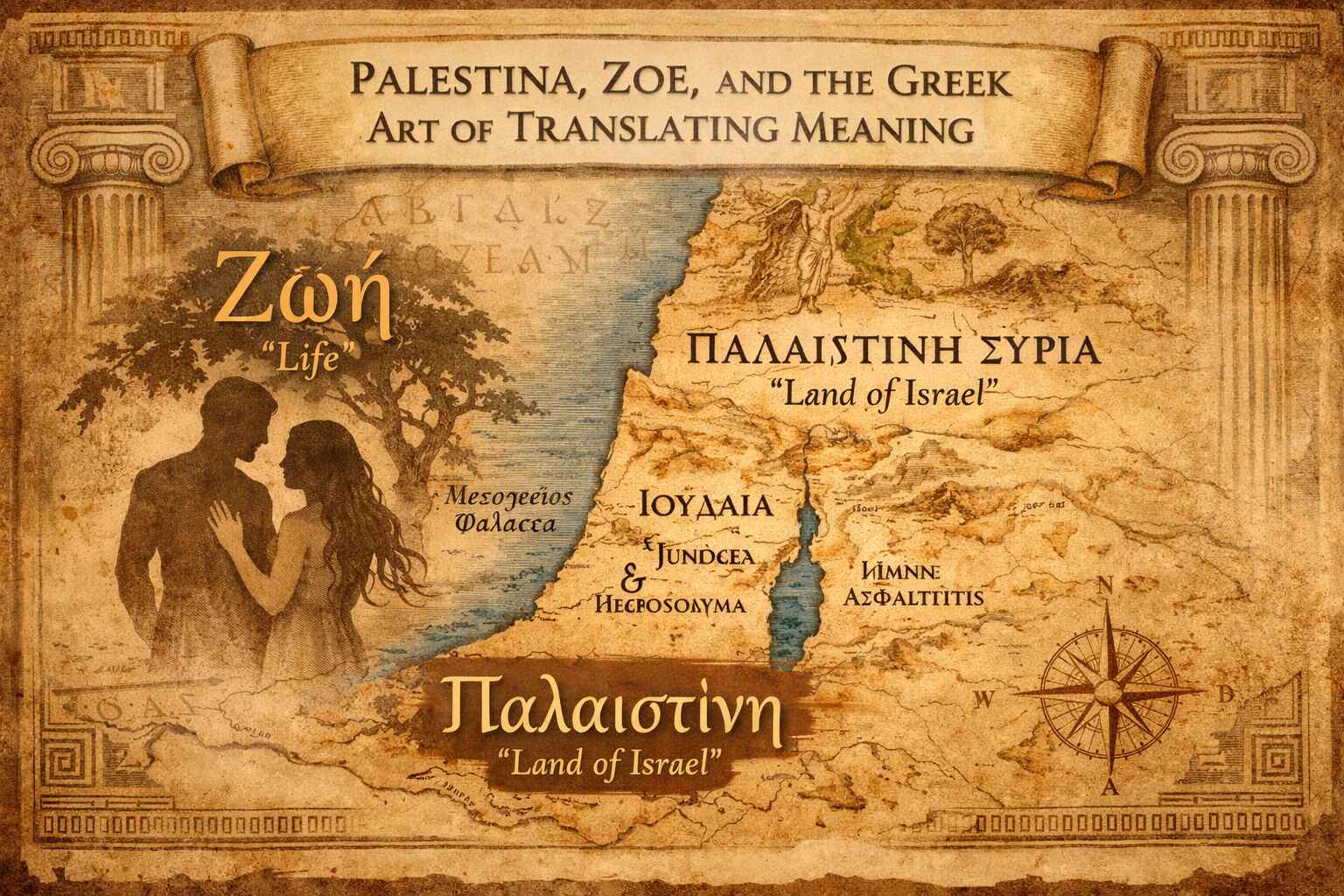
Just as Zoe did not replace Eve but revealed her, Palestina did not erase Israel — it named it in Greek. Image © Ivan Bassov, 2025. Licensed under CC BY 4.0.
Why Greek Names Followed Meaning — and How Palestina Fits the Pattern
One of the quiet assumptions behind modern debates about Palestine is that ancient names were rigid, literal, and politically weaponized from birth. This assumption is false. It projects modern anxieties backward onto ancient linguistic practice and distorts how Greeks actually named the world.
Greek was not merely a language of sounds. It was a language of meaning.
Once that is understood, the name Palestina stops looking like an anomaly — and starts looking entirely ordinary.
Several scholars and writers — including the present author — have noted that Palestina can be understood as a Greek rendering of the Land of Israel, without requiring a derivation from the Philistines or a theory of punitive renaming. That argument has been explored elsewhere and does not need to be fully rehearsed here. What matters for this discussion is not which etymology one prefers, but the linguistic fact that Greek regularly translated foreign names by meaning rather than by sound.
Greek Was a Semantic Language
When Greeks encountered foreign names — especially those carrying symbolic or theological weight — they did not mechanically transliterate them. They often translated their meaning.
This is not speculation. It is documented practice.
In the Septuagint, the Greek translation of the Hebrew Bible, Adam’s wife is called not Eva but Ζωή (Zoe) — Life. The translators explain why: “because she was the mother of all living.” The sound of the name was secondary; the meaning was decisive.
This was not an isolated case.
Hebrew Sheol, the realm of the dead, became Hades — not because the words sounded alike, but because they fulfilled the same conceptual function. Likewise, Abaddon (“destruction”) became Apóleia (“destruction”).
Place names followed the same principle: the peak known in Hebrew as Har HaTzofim (Mount Scopus) was called in Greek Skopos — “lookout,” preserving the original sense rather than the sound, a name that endures to this day.
Greek translators did not treat names as inert labels.
They treated them as statements.
Once this is understood, a critical shift occurs: Palestina must be evaluated not as a phonetic accident or political insult, but as a semantic choice within a known translation culture.
How Greeks Translated Meaning, Not Just Sound
Greek translators did not follow a single rule. They employed several distinct strategies, all united by one principle: names were expected to carry meaning.
1. Semantic Substitution
When meaning mattered more than sound
In some cases, Greek replaced a foreign name entirely with a Greek word expressing its meaning.
The clearest example is Eve. The Hebrew Chavah (“life”) becomes Zoe — Life. The original sound disappears. What survives is the idea.
Greek was willing to replace names altogether when meaning was central. Names were not untouchable phonetic artifacts. They were semantic claims.
Once this is accepted, the insistence that Palestina must preserve Hebrew phonetics to be legitimate collapses.
2. Functional Equivalence
When a Greek concept fulfilled the same role
Sometimes Greek did not translate a name word-for-word but substituted a Greek term occupying the same conceptual space.
Sheol became Hades. There is no phonetic resemblance. The choice was functional: both referred to the underworld.
This shows that Greek prioritized conceptual intelligibility over etymological precision. If a Hebrew cosmological concept could be rendered through a Greek one, a Greek rendering of Israel’s land-identity does not require a literal Hebrew source to be meaningful.
3. Semantic Explanation
When sound was preserved but meaning was made explicit
Greek sometimes retained the foreign name but refused to leave it opaque.
Immanuel is transliterated, but immediately explained: “God with us.” The reader is not expected to carry an uninterpreted name. Meaning is foregrounded.
Whether Palestina originated as translation, adaptation, or interpretation, it belongs to the same semantic environment.
4. Meaning-Preserving Adaptation
When form changed but identity traveled
The name Joshua (Yehoshuaʿ, “YHWH saves”) entered Greek as Ἰησοῦς (Iēsous). This is not a lexical translation. The Hebrew words are not rendered into Greek equivalents.
Yet the semantic identity is preserved. The same Greek name designates Joshua son of Nun and Jesus of Nazareth. The continuity is intentional.
Greek adaptation was not careless. It was meaning-aware.
5. Semantic Transformation
When meaning overtook geography
Finally, some names ceased to function primarily as locations and became concepts.
The Valley of Hinnom (Gehinnom) became Gehenna. A physical place was transformed into a term of judgment. Geography was absorbed into meaning.
This is one of the closest parallels to Palestina: a place name, mediated through Greek, later burdened with moral and political significance. Crucially, later connotations do not define original usage.
Semantic drift is not evidence of hostile origin.
Why This Matters for Palestina
Once these strategies are recognized — substitution, equivalence, explanation, adaptation, and transformation — a simple conclusion follows:
Greek did not require names to be literal, phonetic, or politically motivated.
Within this linguistic culture, Palestina does not need to derive from the Philistines, nor does it require a Roman agenda of erasure to make sense. It fits comfortably within established Greek habits of meaning-based naming.
The controversy surrounding the name is not ancient.
It is modern.
What began as an ordinary Greek way of naming a land became, over time, a contested symbol — not because of its origin, but because of who later claimed authority over it.
Seen in this light, Palestina is not an anomaly.
It is Zoe all over again.
Palestina Is a Greek Name — Not a Roman Invention
The historical fact is straightforward: Greeks used the term Palestina centuries before the Romans.
Herodotus, writing in the fifth century BCE, refers to the region as Palaistinē Syria (Παλαιστίνη Συρίη). This predates the destruction of Jerusalem, the Bar Kokhba revolt, and any alleged punitive renaming by nearly six centuries.
In Greek usage, Syria was a broad geographic label for the Levant, roughly stretching from Anatolia to Egypt. Palaistinē Syria simply situates Palestina within that larger regional frame, without ethnic or political implication.
All later imperial, administrative, and ecclesiastical uses of the name descend from this Greek geographic tradition.
Rome did not invent Palestina.
Rome inherited Greek geographic language, as it routinely did across the empire.
Everything beyond that is interpretation — and interpretation must be judged by plausibility, not ideology.
Competing Etymologies — and Why None Are Fatal
Three main etymological explanations are commonly proposed.
The Greek semantic derivation situates Palestina within a well-established Greek habit of rendering foreign names by meaning rather than by sound. Greek translators routinely adapted names to convey function, concept, or symbolic sense, even when phonetic preservation was possible. While semantic intent cannot be proven in any single case, the practice itself is extensively documented and requires no exceptional assumptions.
The Philistine derivation is a phonetic theory linking Palestina to Peleshet, the territory associated with the Philistines. While the Philistines themselves are well attested in earlier sources, no pre-Greek text applies a cognate of Palestina as a regional name. The theory rests on resemblance of sound rather than documented geographic usage.
The Roman punitive-renaming theory claims that the name was imposed after the Jewish revolts in order to erase Israel. This interpretation projects modern political logic backward without contemporary evidence and overlooks the fact that Rome inherited the name from an already long-standing Greek geographic vocabulary.
Modern polemics often demand that one of these explanations must “win.” That expectation is misguided. The earliest attested usage of the name is Greek, serving as the historical anchor for all later references. Ancient place names frequently accumulated additional meanings, associations, and reinterpretations over time. The coexistence of multiple plausible explanations does not weaken the case; it demonstrates that the name was never semantically fixed, while its Greek origin provides a solid linguistic and historical foundation.
What matters is this: none of these explanations requires an anti-Jewish origin. The Greek explanation reflects ordinary linguistic practice; the Philistine theory lacks documentary support as a regional name; and the Roman-erasure claim lacks historical evidence. Together, they situate Palestina within the normal dynamics of ancient naming, not as an act of negation or erasure.
Wrestling, Israel, and Greek Semantic Logic
The Hebrew name Israel is explicitly defined in Genesis: “for you have wrestled with God.” Wrestling is not incidental; it is the name’s meaning.
Greek possesses an exact semantic field for this concept: palaistra, palaistēs — struggle, wrestling, contest. A Greek rendering that captured this idea would not be unusual. It would be expected.
Does this prove that Greeks consciously translated Israel as Palestina because of Jacob’s wrestling? No. And it does not need to.
What it proves is far more important: Greek had no difficulty translating identity through meaning rather than sound. The semantic pathway exists, is culturally normal, and requires no hostility to function.
In other words, Palestina does not need Philistines, insults, or erasure narratives to make sense.
Semantic Drift Is Not Original Sin
Even if — at some later point — the name Palestina became associated polemically with Philistines, or was exploited rhetorically by hostile powers, that tells us nothing about its origin.
Words change. Meanings drift. Neutral terms become insults. This is linguistic history, not conspiracy.
The word “Jew” itself comes from Yehudi — a name rooted in gratitude and thanksgiving. Yet antisemites can wield it as a slur. Similarly, Zion and Zionism remain expressions of Jewish identity and homeland, but they are often used pejoratively by Ziophobes. Corruption does not erase origin; it exposes the failure to defend it.
Names are not lost by force alone. They are lost when their owners stop asserting their meaning.
Who Were the “Palestinians” in Antiquity?
In Greek and Roman usage, “Palestinian” was a geographic demonym, referring to the inhabitants of the region so named. It did not denote a separate ethnic or national identity. In antiquity, the majority of those inhabitants were Jews, and Palestina functioned as a Greek geographic designation for the land known in Jewish sources as Israel and Judea.
There was no separate Arab “Palestinian” nation in the ancient world. That identity was politically constructed in the late 1960s, when the name Palestine was appropriated by the clientele — ironically, without awareness of its original meaning. In antiquity, the term described geography, not ethnicity, and certainly not opposition to Israel.
The idea that “Palestine” and “Israel” represent mutually exclusive identities is therefore not ancient. It is a modern political construct, shaped in the mid–twentieth century and later amplified through international ideological campaigns.
Thus, to say that Palestina meant Israel is not to erase anyone. It is to restore historical proportion.
Reclaiming Meaning Is Not Revisionism
The insistence that Palestina must be hostile, punitive, or anti-Jewish is itself a modern narrative — one that grants enemies exclusive authority over language.
Greek semantic translation tells a different story: one of interpretation, adaptation, and continuity. Palestina fits naturally into that story.
Not as an insult.
Not as an erasure.
But as a name — one whose meaning Jews once inhabited and later abandoned.
Reclaiming that meaning is not an act of revision. It is an act of memory.
Just as Zoe did not replace Eve, but revealed her,
Palestina did not erase Israel — it named it in Greek.
And names, once understood, can be taken back.
Further Reading
For readers interested in detailed etymological arguments connecting Palestina to the Land of Israel in Greek sources, see James Cooper, “Is Palestine the Ancient Greek Name for the Children of Israel?” and Micah Ben David Naziri, “The Name ‘Palestine’ Literally Just Means ‘Land of Israel’ in Greek,” both published in the Times of Israel. The present essay approaches the question from a different angle: Greek semantic translation as a cultural norm.
—
See Also
Related Topics
Related Posts