Russian-American-Israeli Palestinian. Palestine is Israel.
The Enemy Is Ziophobia
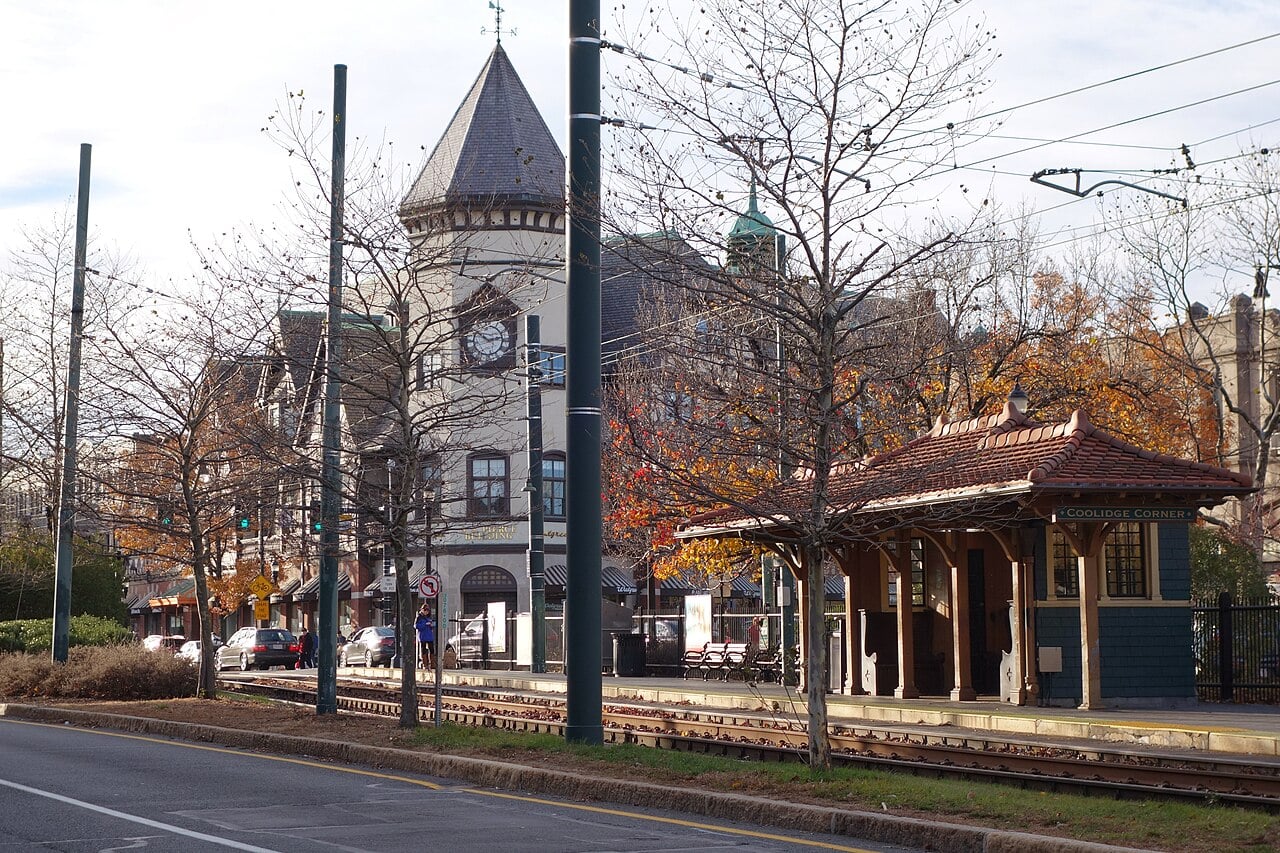
Outbound platform at Coolidge Corner, Brookline, MA. Image © bdamon, 2013. Licensed under CC BY 2.0. Source: Flickr via Wikimedia Commons.
When Home No Longer Feels Like Home
When I moved to Brookline, Massachusetts, nearly two decades ago, it was widely known as one of America’s most Jewish and pro-Israel towns.
Today, it feels different.
I see visibly more Muslims. More women wearing hijabs. More public debates against Israel. More reports of Jewish businesses being vandalized. More Jews saying they no longer feel entirely at home in the very communities they chose because they once felt safe there.
Brookline is not unique.
People point to Sharon, Massachusetts, once widely known as a Jewish town with a strong Jewish community identity, where the Islamic Center of New England now serves a growing Muslim community.
They point to Boca Raton, Florida, another city long associated with a strong Jewish identity, which today is also home to the Islamic Center of Boca Raton.
They point to New York City, where the Muslim population has grown substantially over the past several decades and where ziophobic rhetoric has become increasingly prominent in local politics, universities, and public life.
They point to neighborhoods in Brooklyn, including Brighton Beach and nearby areas, where new immigrant communities—predominantly Muslims from Central Asia—have become ever more visible, replacing older Jewish and Russian-speaking populations.
They point to the ziophobic mayor Zohran Mamdani, the growing prominence of an anti-Israel agenda in New York politics, and incidents of antisemitic vandalism and intimidation that have left many Jews questioning whether communities they once regarded as unquestionably welcoming still feel the same.
Is this coordination?
None of these examples, by themselves, prove coordination.
Cities evolve. Immigration reshapes neighborhoods. Housing markets change. Yet many Jewish residents notice what they perceive as a recurring pattern: communities that once felt overwhelmingly Jewish gradually become visibly Muslim and centers of anti-Israel activism.
Is this merely the natural consequence of demographic change? Or do ideological activists deliberately seek influence in communities with significant Jewish populations because those communities carry symbolic or political importance?
These questions are becoming harder to ignore.
Why was the Islamic Center of New England established in Sharon, a town with a significant Jewish population?
Why was another Islamic center established in Boca Raton, another community with a large Jewish presence?
Why move to Jewish communities and promote an anti-Israel agenda there rather than choose neighborhoods with a cultural or political outlook more similar to your own?
I do not claim to have the answers. I only observe that these questions are being asked with increasing frequency—and that dismissing them outright prevents an honest discussion.
The Real Divide Is Not Religion
Let me be absolutely clear: I have nothing against Muslims.
I do not divide human beings by race, ethnicity, religion, ancestry, or national origin.
As I wrote in Why Israel Is Treated Differently:
I divide people into only two categories: those who love Israel and those who hate it. Zionists and Ziophobes. Everything else is secondary. And I have far more in common with Arabs who love Israel than with Jews who obsessively demonize it.
After receiving fair criticism that extremes such as “love” and “hate” are rare and that most of us live in the comfortably nuanced middle, I softened this statement in Zionistish and Ziophobish: Why the World Needs a Spectrum:
I divide people into only two categories: those who support Israel and those who oppose it. Zionistish and Ziophobish. Everything else is secondary. And I have far more in common with Arabs who support Israel than with Jews who oppose it.
If tomorrow Brookline became home to thousands of Muslims who respect and support Israel, I would have no problem whatsoever.
Likewise, I would feel uncomfortable living among Jews whose identity revolves around demonizing Israel.
Religion is not the issue.
Hatred is.
The Housing Paradox
American law prohibits discrimination based on religion, race, national origin, and many other protected characteristics.
Those laws exist for good reason.
History demonstrates what happens when people are denied opportunities because of who they are.
At the same time, American law generally allows private organizations to define themselves around shared ideas and values.
A Zionist organization may require its members to support Israel.
An anti-Zionist organization may require its members to oppose it.
A chess club may exclude people who have no interest in chess.
A vegan association may require its members to support veganism.
The dividing line in these cases is ideology rather than religion or ethnicity.
Housing, however, is different.
Imagine two housing cooperatives.
The first announces:
Membership is open only to Zionists.
The second announces:
Membership is open only to anti-Zionists.
Neither rule discriminates on the basis of religion.
A Muslim Zionist may join the first.
A Jewish anti-Zionist may join the second.
The distinction is ideological rather than religious.
Yet housing law largely prevents either thought experiment from being implemented in practice.
Why?
Because housing is treated differently from an ordinary private club.
The law protects people from discrimination in housing far more aggressively than it regulates membership in voluntary organizations.
At first glance, this seems entirely reasonable.
But now consider the practical consequences.
Suppose a Jewish family wants to spend the rest of its life surrounded by people who support Israel or at least do not express hostility toward Zionists.
What legal mechanism exists to preserve such a community?
Virtually none.
The law strongly protects the right of newcomers to move into a neighborhood.
It does not protect the existing community’s ability to preserve its ideological character.
Liberal society protects mobility.
It does not preserve communities.
The Unintended Consequence
I suspect this is one of those situations where good laws produce unintended consequences.
Every law creates incentives.
Every protection creates trade-offs.
The law prevents religious discrimination.
It also makes it almost impossible for people who share a common worldview to preserve that environment over time if the community is fundamentally residential rather than voluntary.
A synagogue can decide its members.
A political organization can decide its members.
A book club can decide its members.
A neighborhood cannot decide its neighbors.
Is this the right balance?
Is there a better alternative?
At the very least, we should acknowledge the trade-off instead of pretending it does not exist.
It Happened Before
History shows that communities can change dramatically within a single generation.
Dorchester—along with neighboring Roxbury and Mattapan—was once one of the vibrant centers of Jewish life in Greater Boston. From the 1930s through the 1950s, these neighborhoods were home to kosher groceries, Yiddish theaters, dozens of synagogues, and major Jewish institutions.
Over the following decades, as the demographics of these neighborhoods changed, Dorchester lost virtually all of its Jewish population, much of which relocated to suburbs such as Brookline and Newton. Today, only faint traces of that once-thriving Jewish presence remain.
Yesterday’s Brookline was Dorchester.
Today, Dorchester, Roxbury, and Mattapan are predominantly Black neighborhoods. They are also widely associated with extremely high crime rates and are often compared to Harlem in New York City.
I see similar shifts happening now, and today’s Jewish communities are once again undergoing profound demographic and social change, on the verge of being pushed out again, this time by ziophobia.
Ownership Is an Illusion
This realization has fundamentally changed how I think about home ownership.
For years I believed buying a home meant buying stability.
I no longer think that is true.
Owning a house does not determine who buys the house next door.
It does not determine who joins the school committee.
It does not determine the values that shape local government.
It does not determine what your town will look like twenty years from now.
In my article Money, Markets, and the Illusion of Ownership, I argued that ownership itself ultimately depends on the sovereign.
Property rights exist only because governments enforce them.
The same is true of neighborhoods.
Owning property never meant owning the future.
If the surrounding community changes in ways that make you unhappy, ownership may become a trap rather than a source of security.
Renting, by contrast, offers something ownership does not.
Freedom.
If the character of a community changes dramatically, a renter can simply leave.
An owner must first sell in most cases.
That may take months, and sometimes even years.
Selling has enormous transaction costs. These include realtor commissions (often around 6% in the U.S.), taxes, legal fees, paperwork, and the uncertainty and time involved in finding a buyer and completing the transaction.
Sometimes, political changes themselves reduce the value of the property you own.
Recent debates over rent regulation, taxation, and housing policy in New York have reminded many owners that governments can dramatically change the economics of real estate after people have already invested their savings.
Perhaps residential property is not the safe investment many people imagine.
Perhaps it is wiser to invest financial capital in diversified markets while keeping one’s residence flexible.
There May Be No Solution
I wish I had a legal solution.
I do not.
I understand why fair housing laws exist.
I do not advocate religious discrimination.
Nor do I advocate excluding people because of their ethnicity or ancestry.
At the same time, I also understand why many people increasingly wonder whether they can preserve communities where support for Israel remains part of the local culture.
American law has a clear answer.
You cannot.
Communities change.
People move.
Politics changes.
Schools change.
Neighborhoods change.
Perhaps that is the unavoidable price of balancing competing freedoms in a free society: the freedom to choose where people live versus the freedom of communities to preserve their character.
Or perhaps it is one of the unintended consequences we have not yet learned how to discuss honestly.
Or perhaps ziophobia, including the denial of Israel’s right to exist, should be a criminal offense and treated under the law like any other form of hatred.
Either way, it has changed how I think about where I live.
And whether I should ever buy another home.
—
See Also
Related Topics
Related Posts