
A Moroccan Journalist
When Hassan II Rejected the Illusion That Guns Create States [3/3]
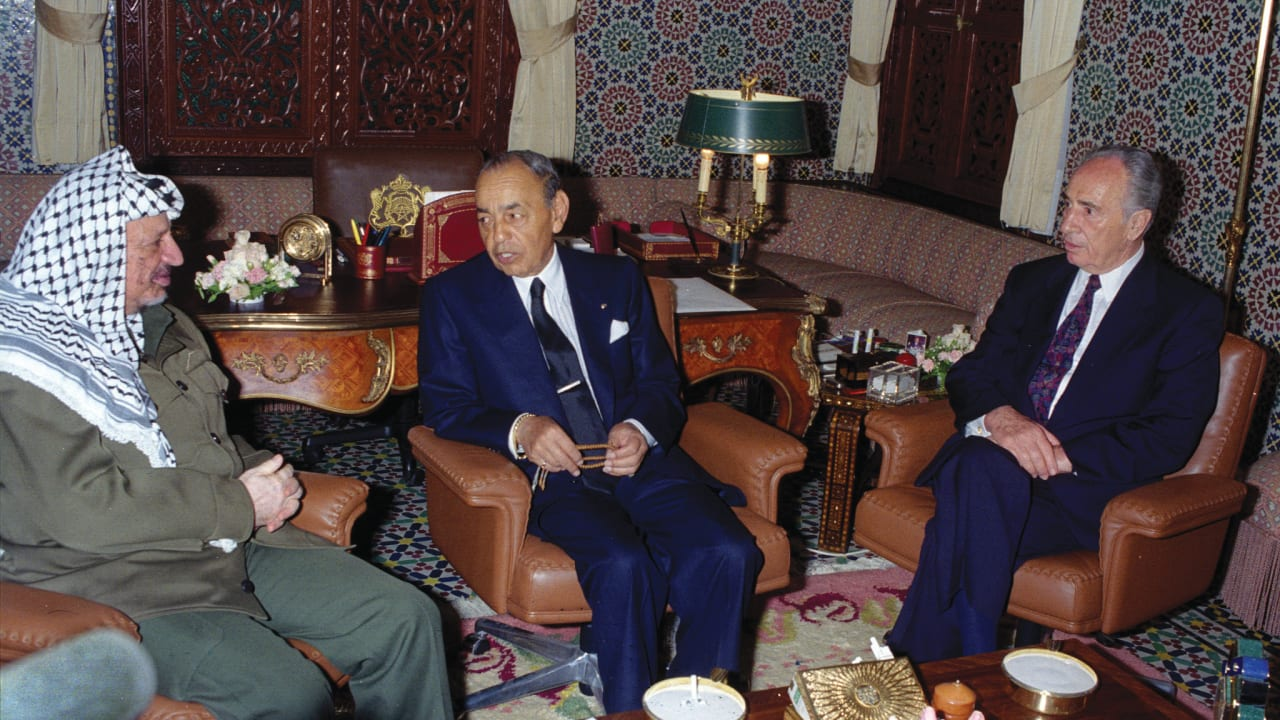
Morocco’s King Hassan II (center) speaks with PLO leader Yasser Arafat and Israeli foreign minister Shimon Peres in the King’s Palace in Rabat, Morocco, 1995.
Credit: REUTERS
This is the third and final chapter in a three-part series on King Hassan II’s views on Israel. To read the first chapter, click here. To read the second chapter, click here.
1973: The victory that opened the door to negotiation
If 1967 was the war the Arabs lost before it began, 1973 was the war they won – and still lost. King Hassan II’s reflections on the October War reveal one of the most nuanced, unsentimental, and strategically mature readings ever offered by an Arab statesman. He recognized the symbolic triumph, the restored pride, the Egyptian breakthrough across the Suez Canal — but he also understood, long before anyone admitted it, that the war rested on illusions as dangerous as those that preceded 1967.
The king admired Anwar al-Sadat profoundly. He considered him one of the few Arab leaders capable of breaking with slogans and pursuing a genuine strategy: “Sadat was my interlocutor since 1955. When he spoke, silence fell. Even if one did not always understand him, he acted with intelligence and dignity.”
He recalls how Sadat could recover from errors instantly – even in moments of public tension. In the 1969 Islamic Conference, after clashing with the Shah of Iran, Sadat realized he had gone too far and immediately transformed his speech, praising Iran and quoting two verses “in Persian.” The Shah later admitted to Hassan II with amused disbelief: “Either I am Persian and did not recognize my own language, or that was not Persian at all.”
But this ability to adapt, improvise, and restore equilibrium prepared Sadat for 1973. Hassan II saw the October War not merely as a military act, but as a psychological and diplomatic maneuver designed to break the deadlock created by 1967.
And yet, despite the courage and sophistication of the campaign, Hassan II never succumbed to mythology. His realism remained intact. He believed the war succeeded precisely because it avoided the rhetorical madness of earlier decades. There were no threats of “throwing the Jews into the sea,” no apocalyptic speeches, no intoxicating promises of total destruction. As he put it elsewhere: “The Palestinian issue already existed, but it was, let us say, both cacophonous and mercenary. The language of its leaders was not a responsible language. It had far more to do with commerce than with negotiation.”
Sadat broke with that tradition. He knew Egypt could not destroy Israel, and he did not pretend otherwise. For Hassan II, this honesty made 1973 what one might call a “war of honor” – a war fought to restore dignity, not to chase fantasies. The king’s reading of events was analytical, not emotional: the war was inevitable because the Arabs needed to “show they could hurt Israel,” but he did not believe it would turn decisive.
But the king also understood the deeper illusion: that the war could be converted into a permanent strategic advantage. It could not. It was a symbolic victory, a necessary victory, but a temporary one. Sadat’s real achievement, in Hassan II’s eyes, was not the crossing of the Suez Canal but the political courage to transform the victory into peace.
Hassan II saw this clearly: “Never has there been a liberation movement, a resistance, that won by arms alone. The Palestinians knew this. Sadat knew this. Only diplomacy could complete what the war had begun.”
And yet, the Arab world misunderstood the meaning of 1973. Many celebrated it as the new 1948 – a turning point, a reversal of fate. Hassan II disagreed. For him, it was not the beginning of a new era of Arab military strength. It was the end of an era – the realization that military confrontation had reached its limits. The time for negotiation, realism, and coexistence had arrived.
He saw the illusion creeping back: the belief that one symbolic victory could erase decades of political failure. In this sense, 1973 was both triumph and trap. As he put it when speaking about Arab political behavior more broadly: “Pragmatism is acquired only with time and with knowledge of the other.” The Arab world, in his view, had not yet acquired that knowledge.
But one leader had – Sadat. This is why Hassan II respected him more than almost any other Arab leader of his era. He understood that Sadat’s trip to Jerusalem was not betrayal but culmination: the logical conclusion of the 1973 breakthrough. It was the moment when the “war of honor” transitioned into the diplomacy of survival.
For Hassan II, Sadat’s peace with Israel was not an aberration but the opening chapter of what the entire Arab world would eventually one day have to face. His conviction was forged in moments like his 1967-1968 meeting with the new Palestinian leadership in Agadir, where he told them bluntly:
“I am willing to work with you, but you will never destroy Israel. Do not live in illusions; terrorism has never conquered land – especially when carried out from outside that land. One day you will have to negotiate, and refusing to accept this will only waste the time of Arab leaders.” They agreed entirely with his analysis.
To Hassan II, the 1973 war was therefore the final demonstration – a war that showed what could be done, and what could never be done again. It restored dignity. But it also exposed illusions. It proved Arab soldiers could fight. But it also proved Arab politicians could not continue lying to their people. It was the last war fought with honor – and the first war that made peace possible.
Morocco as the secret bridge: Bringing Dayan and the Egyptians together
If the 1960s revealed Hassan II’s realism and the 1973 war confirmed his strategic instincts, the late 1970s unveiled his most consequential diplomatic role of all: Morocco as a clandestine bridge between Israel and the Arab world. This chapter of The Memory of a King is among the book’s most electrifying revelations – not least because it shows how an Arab monarch facilitated meetings that helped make possible one of the most dramatic diplomatic gestures of the 20th century: Anwar Sadat’s visit to Jerusalem.
For decades, the story circulated as rumor. In Hassan II’s memoir, it becomes history.
Hassan II reveals that Morocco hosted secret, decisive encounters between Moshe Dayan, Israel’s foreign minister and legendary military figure and Hassan Tohami, Egypt’s presidential adviser and Sadat’s most trusted envoy.
These meetings took place in Ifrane and Rabat – far from cameras, journalists, and even the Arab League’s most powerful intelligence services. These clandestine talks prepared the ground for Sadat’s unprecedented 1977 announcement that he was ready to go to Jerusalem.
Hassan II recounts the moment Dayan arrived and the very first question he posed: “General, what do you think of the Golan?” Dayan replied calmly: “The Golan is Syrian.” Hassan II writes: “Good. Now we can speak.” He adds that if Dayan had said the Golan belonged to Israel, he would have ended the meeting immediately.
The atmosphere between the Egyptians and Israelis was tense – a room vibrating with suspicion, unspoken anger, and decades of war. He writes: “At first they were tense… each expected unacceptable demands. Then they began speaking of past battles… When I saw the meeting take this turn, I left them alone.”
It was a small but monumental moment: two enemies discovering that they could speak – not as abstractions, not as slogans, but as men who understood the costs of war.
Sadat’s visit to Jerusalem: The king who supported the impossible
Many believe Sadat’s decision to go to Jerusalem was coordinated, discussed, and tested among allies. Not according to Hassan II. He insists, with a touch of astonishment: “Sadat informed no one of his decision… If he had told me, I might have asked him to postpone it.”
Sadat’s courage lay in going alone. When the Egyptian president made his historic walk into the Knesset, Hassan II recognized it instantly – not as betrayal, but as the culmination of a new Arab political maturity. He writes: “I believe I was the only one to support him publicly.”
The king also diagnoses the imbalance that weakened the immediate negotiations that followed: “Sadat had months to prepare; he had rewritten his speech. Begin had twenty-four hours. Israel was struck in the liver.” In other words, Sadat arrived as a statesman with a vision; Begin arrived as a tactician responding to an earthquake.
The Fes Plan and the Arab world’s closest moment to recognizing Israel
Hassan II’s most gripping diplomatic revelation comes from the 1982 Fes Summit, where the Arab world came closer than ever to adopting a peace framework implicitly recognizing Israel’s right to exist – decades before normalization would become fashionable.
It is here where Hassan II’s leadership shines. He describes a moment almost erased from the collective memory of the Middle East: a moment when nearly the entire Arab world agreed to a plan that accepted the logic of coexistence.
Crown Prince Fahd of Saudi Arabia presented the plan. To the king’s astonishment, it received universal support: “When the plan was presented, there was not the slightest false note. Everyone subscribed to it… even Iraq,” which had never previously endorsed Resolutions 242 and 338. Even more astonishing was the position of Hafez al-Assad – the most uncompromising Arab leader of the era: “I am skeptical, but I will not stand apart. I am with you.”
These sentences reverberate with the gravity of a moment that should have changed history – the closest the Arab world came to collectively acknowledging Israel, long before peace treaties, long before the Gulf normalization wave, long before anyone imagined that Saudi Arabia might one day consider diplomatic ties with Jerusalem.
But the opportunity vanished. The Arab world fell back into familiar divisions, rivalries, and maximalist postures. What could have been a regional breakthrough became another footnote in the archives of unrealized possibilities.
Hassan II’s sobriety turns melancholic here. He reminds readers that Jews had lived for centuries in Fez, Tetouan, Marrakech, and Essaouira; that Arab Jews understood the region’s languages, codes, and psychology better than many modern politicians; and that the conflict could have been resolved “with much less acuteness” had realism prevailed earlier.
The king who thought like a historian
In one chapter, when Éric Laurent asked him, “If you had not been king, what profession would you have chosen?”, Hassan II replied simply: “Historian.” Indeed, Hassan II’s memoir reveals a man who consistently prioritized reason over rhetoric, feasibility over fantasy, and long-term strategy over emotional outbursts. His statements demonstrate a clarity rare among leaders of his era.
The three episodes – the secret meetings in Ifrane, Sadat’s solo journey to Jerusalem, and the Fes Plan – reveal a consistent truth: King Hassan II saw the Arab-Israeli conflict not through ideology, but through history and reason.
At a time when normalization was inconceivable, when the Abraham Accords would have sounded like fiction, when Arab diplomacy refused to think pragmatically, Morocco acted as a discreet axis of dialogue – a place where Israelis and Arabs could meet without theatrics, without slogans, and without illusions.
In The Memory of a King, he delivers verdicts with the clarity of someone who had lived every chapter of the story. Everything else – the summits, the speeches, the wars – were only preludes. Morocco had already laid the first stones on the road to the future.
He criticized Arab mistakes, recognized Israeli realities, warned against illusions, supported courageous initiatives, and believed that Arabs and Jews were not destined enemies but intertwined civilizations. In many ways, the region is only now catching up to the worldview he articulated privately in the 1950s and publicly in the 1970s and 1980s.
He was, simply, a king who could see beyond his century.
Related Topics
Related Posts