
Time for Positive Change...
Where Israel’s Parties Stand on CIS Civil Separation
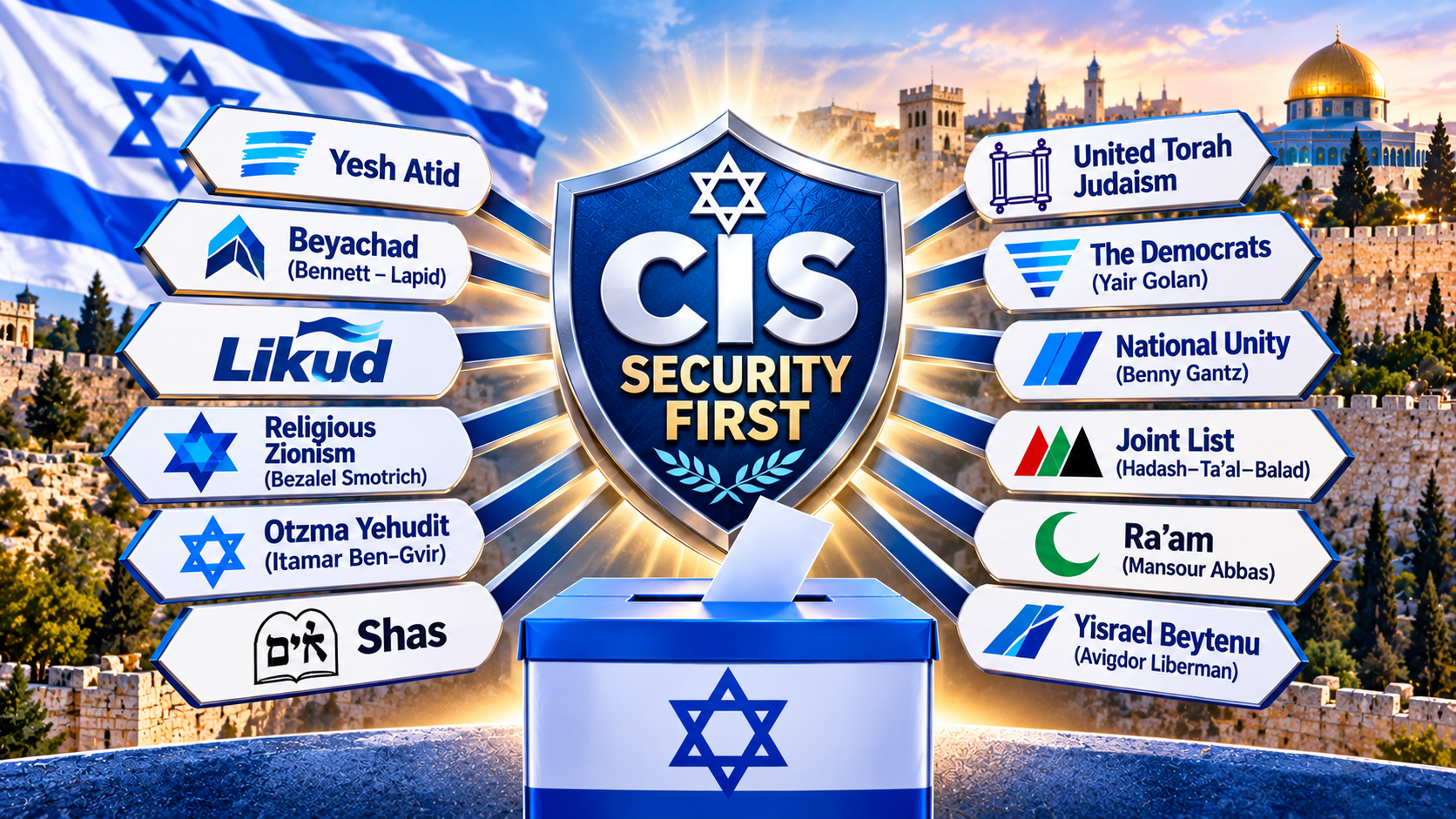
Image created by ChatGPT
This pivotal election will have profound impacts on Israel’s security. How do parties align with Commanders for Israel’s Security on its approach, particularly in the West Bank?
Why Commanders for Israel’s Security (CIS)?
CIS is an organization representing more than 550 former senior officials from the IDF, Mossad, Shin Bet, police and diplomatic services. Besides their combined experience and expertise, being retired, they are independent of government. Their pragmatic approach makes sense.
CIS and the Institute for National Security Studies (INSS), a leading Israeli security research institute, have repeatedly warned that West Bank annexation and continued expansion of settlements and outposts could seriously undermine Israel’s national security. CIS’s recommendations provide a framework for examining the parties’ policies.
What does CIS propose?
CIS advocates a security-first policy of Civil Separation between Israelis and Palestinians.
Its approach includes maintaining Israeli military security control until reliable alternative arrangements exist, completing the security barrier, reducing friction between populations, strengthening Palestinian civil governance and security coordination, and opposing annexation.
It supports preserving the possibility of a negotiated two-state agreement, without requiring Israel to establish a Palestinian state before the necessary security conditions exist.
Its central argument is that Israel’s security requires more than military superiority. It also depends on avoiding unnecessary conflict, maintaining regional partnerships and preserving international support.
Further reading:
• CIS: Governing Principles and its Security-First Plan
• Commanders for Israel’s Security: Why Its Voice Deserves Serious Consideration
• INSS: Drifting into a One-State Reality: Active Accelerators and Possible Halts
Netanyahu and his coalition partners
Benjamin Netanyahu’s Likud and his principal right-wing coalition partners have pursued policies substantially different from the CIS approach.
Netanyahu opposes Palestinian statehood, while his government has expanded settlements and advanced administrative measures that CIS considers steps toward annexation.
Finance Minister Bezalel Smotrich’s Religious Zionism party explicitly advocates Israeli sovereignty over the West Bank and has called for dismantling the Palestinian Authority.
Itamar Ben-Gvir’s Otzma Yehudit likewise supports expanded Israeli control and settlement.
While Netanyahu has sometimes resisted or delayed formal annexation, reflecting diplomatic and security considerations, his government’s settlement and administrative policies conflict with key security elements of CIS’s recommendations.
The ultra-Orthodox parties
Shas and United Torah Judaism focus primarily on religious and domestic interests and have helped sustain Netanyahu-led governments. Shas opposes Palestinian statehood and supports settlement expansion, while United Torah Judaism is divided on territorial policy. Neither explicitly supports CIS civil separation, although their positions do not necessarily exclude it.
However, supporting settlement-expanding governments risks contributing to creeping annexation and undermining civil separation.
Smotrich: Israel must ‘go to war’ in West Bank, ‘do there what we did in Gaza’
Gadi Eisenkot and Yashar
Former IDF chief of staff Gadi Eisenkot, leader of Yashar, has articulated several positions consistent with CIS’s immediate security recommendations.
He opposes settlement activity that undermines Israeli security interests, has criticized the E1 expansion project, supports restoring effective military and police authority in the West Bank, and wants the Palestinian Authority to continue governing Palestinian population centers.
In an October 6 interview with The Times of Israel, Eisenkot proposed dismantling the administrative arrangements established under Smotrich, restoring effective enforcement against violent settlers and improving Palestinian living conditions.
However, Eisenkot explicitly rejects a conventional two-state solution in the foreseeable future. He instead envisions Palestinian autonomy or a state-minus arrangement under overriding Israeli security control.
Nevertheless, his proposals concerning Palestinian governance, security coordination, settler violence and avoiding direct Israeli administration of millions of Palestinians overlap with major elements of CIS’s immediate security approach.
Further reading:
• Eisenkot’s Prime Ministerial Mission
• Eisenkot says two-state solution ‘delusional’, but E1 settlement plan a ‘mistake’
Naftali Bennett and Yair Lapid: Beyachad
Former prime ministers Naftali Bennett and Yair Lapid have joined forces under the Beyachad (Together) electoral alliance.
Bennett opposes Palestinian statehood and supports continued Israeli security control and legal settlement construction in Area C.
However, he has also called for dismantling illegal settlement outposts and opposed construction on privately owned Palestinian land or in Areas A and B.
Lapid historically supported a negotiated two-state settlement, but has stated that Palestinian statehood is not a realistic prospect in the coming decade.
Both emphasize military security, regional cooperation and maintaining Israel’s ability to act against threats.
The question is whether Beyachad’s approach to Palestinian autonomy, settlement expansion and future territorial arrangements would preserve the conditions for eventual civil separation.
Its joint electoral platform has not fully resolved those questions.
Bennett calls to dismantle illegal settlement outposts, draws right-wing leaders’ ire
Yair Golan and the Democrats
The Democrats, led by former IDF deputy chief of staff Yair Golan, have articulated policies addressing several central CIS concerns.
The party opposes West Bank annexation, seeks to curb settler violence, supports ending government assistance to illegal outposts and advocates restoring military authority over the West Bank’s civil administration arrangements.
It also favors diplomatic initiatives and preserving the possibility of future Israeli-Palestinian separation.
Some senior party figures, including Gilad Kariv, support an eventual demilitarized Palestinian state within a regional agreement.
However, the party’s approach to Palestinian sovereignty and the conditions for a final agreement is not identical to the immediate security arrangements proposed by CIS.
What does Yair Golan’s Democrats party stand for?
Benny Gantz and Blue and White
Benny Gantz has long advocated security-focused arrangements with the Palestinians and has supported separation while protecting Israel’s military interests.
In 2020, Gantz advocated annexing the Jordan Valley in coordination with the international community. That position differs from CIS’s opposition to annexation.
His current electoral campaign concentrates heavily on national unity and bridging Israel’s political divisions.
Gantz’s previous support for separation should therefore not be confused with an explicit commitment to implement the current CIS civil separation program.
Gantz vows to annex Jordan Valley ‘in coordination with international community’
Avigdor Liberman and Yisrael Beytenu
Avigdor Liberman supports maintaining strong Israeli military control while seeking to avoid direct Israeli responsibility for governing Palestinian population centers.
In September, he proposed transferring responsibility for Areas A and B of the West Bank to Jordan while maintaining Israeli control over Area C.
This shares CIS’s concern about Israel becoming responsible for administering millions of Palestinians.
However, Liberman also advocates dismantling the Palestinian Authority, directly contradicting CIS’s argument that Palestinian governance and security coordination are essential to Israeli security.
His proposal also faces the substantial obstacle of Jordan’s opposition to assuming responsibility for the West Bank.
The differences illustrate that agreement on the desirability of separation does not necessarily imply agreement on how to achieve it.
Liberman proposes Jordan control parts of West Bank, drawing right-wing rebuke
The Arab parties
Ra’am, led by Mansour Abbas, and the Joint List, comprising Hadash, Ta’al and Balad, support Palestinian self-determination and oppose settlement expansion.
Ra’am emphasizes practical cooperation with Jewish-led parties and has previously participated in an Israeli governing coalition.
The Joint List places greater emphasis on Palestinian national rights and political equality.
These parties share concerns about annexation and Palestinian civil rights, but their support for Palestinian sovereignty goes beyond CIS’s interim framework of continued Israeli military security control.
Their positions nevertheless matter to any discussion about sustainable governance and relations between Jewish and Arab communities.
2026 Election Blocs Explained The Israel Policy Forum: This begins with the religious parties, it then covers all the other party blocs, providing an excellent, succinct yet comprehensive overview.
Why these differences matter for Israel’s security
The consequences extend well beyond the West Bank.
In September 2026, CIS published a detailed warning examining how current policies could affect Israel at three interconnected levels.
First, internal security.
- CIS warns that weakening or collapsing the Palestinian Authority could create a security vacuum.
- Israel might then face an expanded Palestinian insurgency, greater Hamas influence and the need to redeploy substantial IDF forces to administer and secure Palestinian population centers.
- This would divert military personnel and resources from other threats.
- Conversely, preserving Palestinian governance while maintaining effective Israeli security capabilities could reduce these additional commitments.
These are projected consequences, not certainties. Much would depend on Palestinian political developments and the effectiveness of security cooperation.
Second, regional security.
- Jordan and Egypt are not simply diplomatic partners. Their security cooperation contributes directly to Israel’s defense.
- CIS warns that annexation and escalating West Bank instability could undermine these relationships.
- Jordan is particularly sensitive to developments that could destabilize its Palestinian population or create pressure for Palestinians to move into its territory.
- Egypt also has serious concerns about instability in Gaza and the possibility of population displacement.
- Further deterioration could weaken established peace arrangements and make regional security cooperation more difficult.
- It could also complicate Saudi normalization and efforts to build a broader regional coalition capable of countering Iran and its proxies.
Third, international security.
- CIS warns that continued annexation measures and settlement expansion could accelerate Israel’s diplomatic isolation.
- The consequences could extend beyond criticism to include sanctions, restrictions on security cooperation, and declining support from Israel’s traditional international partners.
- The United States remains Israel’s most important strategic ally. CIS is particularly concerned about declining bipartisan American support and the potential long-term consequences for that relationship.
These risks interact.
A deterioration in the West Bank could increase Israel’s military commitments while simultaneously weakening regional cooperation and international support.
This cumulative effect is central to the CIS security assessment.
Further reading: CIS Security Warning: Government Annexation Policy Endangers Israel’s Security – September 2026
The election is not simply about supporting or rejecting a Palestinian state
One important conclusion emerges from examining these different political positions.
Support for civil separation does not necessarily mean support for the immediate establishment of a Palestinian state.
Nor does opposition to Palestinian statehood necessarily require annexation or direct Israeli administration of Palestinian population centers.
These distinctions are particularly important following October 7, when Israeli concerns about the security consequences of Palestinian sovereignty remain substantial.
Different parties propose different combinations of military control, Palestinian governance, settlement policies and eventual political arrangements.
The practical questions concern what those policies would actually produce over time.
- Would they reduce the likelihood of another major conflict?
- Would they reduce or increase the demands placed on the IDF?
- Would they strengthen or weaken Palestinian security cooperation?
- Would they preserve Israel’s regional partnerships and international support?
- And would they leave future governments with workable options for a negotiated political settlement?
A security question Israel cannot afford to ignore
The October 27 election provides an opportunity to examine these questions more closely.
CIS does not represent all former Israeli security officials, and its recommendations merit the same critical scrutiny as any other strategic proposal.
Nevertheless, its warnings come from people with extensive experience in confronting Israel’s security threats.
The organization has identified specific dangers, explained how they might develop and proposed measures intended to reduce them.
Israel’s political parties differ considerably in how they address those dangers.
The important test is not whether a party agrees with every CIS recommendation.
The key question is whether that party has a credible security strategy that accounts for the risks CIS has identified, including the potential long-term consequences for Israel’s security, regional partnerships, and international standing.
Israel’s military superiority remains a critical national asset. However, lasting security also depends on regional alliances, social cohesion, economic resilience, and preserving Israel’s liberal, democratic and Jewish character.
––––––––––––––––––––––––––––-
See also my related article: Netanyahu’s Unanswered Security Questions
Related Topics