
Russian-American-Israeli Palestinian. Palestine is Israel.
Who Moved the Boundary?
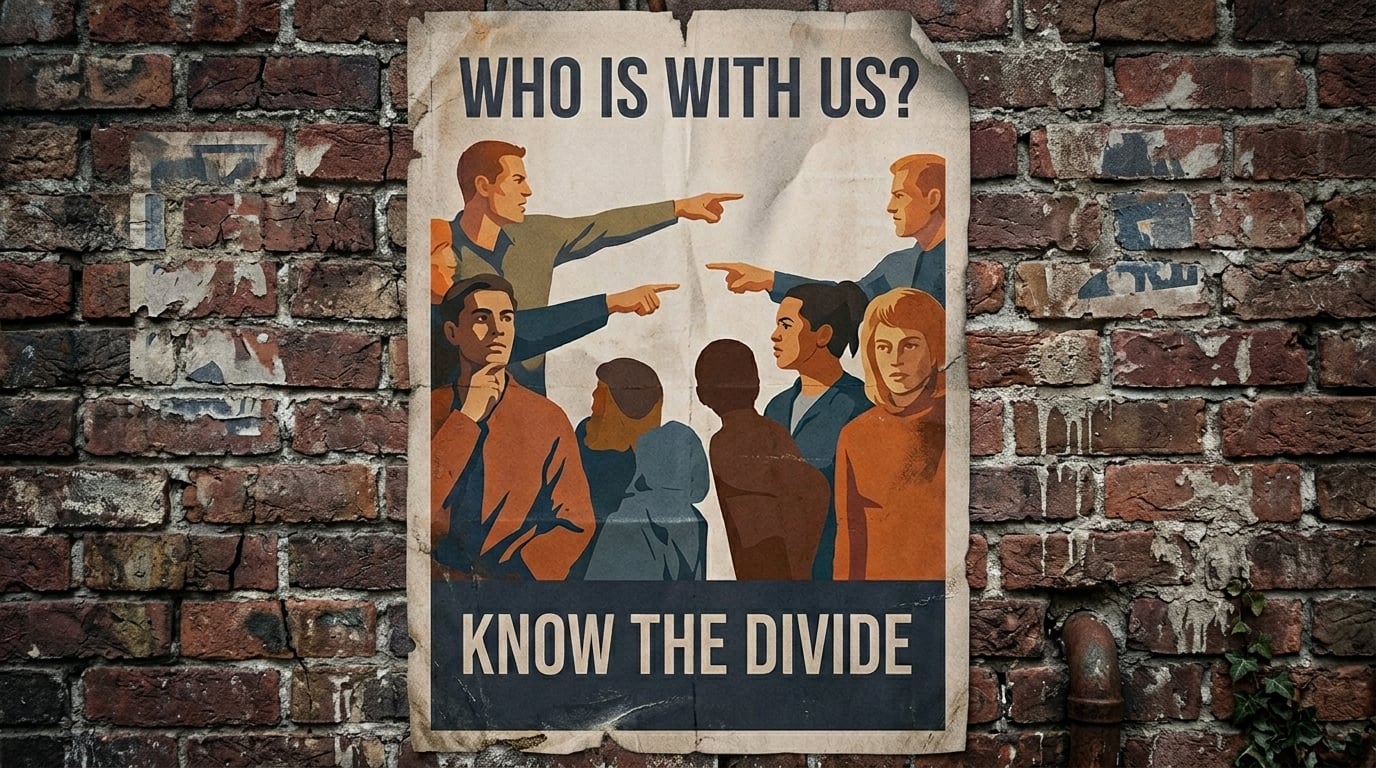
How Propaganda Turns Neighbors Into Enemies. Image © Ivan Bassov, 2026. Licensed under CC BY 4.0.
How Propaganda Turns Neighbors Into Enemies
Human beings divide the world into “us” and “them” in countless ways: family and outsiders, friends and strangers, neighbors and foreigners, people we trust and people we fear.
Some boundaries are obvious. Others are invisible until something happens that makes them suddenly important.
But there is something more unsettling than the existence of boundaries:
The boundary can move.
And when it does, people who were yesterday part of “us” can become “them” without changing their language, ancestry, religion, appearance, or even their relationships with us.
One of the most powerful mechanisms for moving that boundary is propaganda.
The Boundary Can Move
What happens when people who were clearly part of our “us”—friends, colleagues, neighbors, even family members—suddenly appear to be on the other side of a moral or political boundary?
Were those relationships artificial?
Was the previous sense of belonging merely a pretense?
Not necessarily.
The relationships may have been completely genuine. What changed may not have been the people.
What changed was the boundary.
This is one of the central questions explored in my Us vs. Them series:
- Part I: The Psychology of Belonging
- Part II: When Belonging Becomes a Boundary
- Part III: Living With “Them”
The series asks how we create “us” and “them,” how boundaries of belonging become social and political institutions, and how we can live together despite our tendency to divide the world into groups.
But there is an important complication: every person belongs to multiple groups simultaneously.
A person can be Jewish and American. Muslim and French. Russian and Christian. Secular and Israeli. A colleague, a neighbor, a friend, a parent.
These identities coexist. Yet in any given situation, one identity can become more important than the others.
Who decides which one matters?
That is where propaganda becomes powerful.
It can determine which difference matters—and therefore which boundary becomes relevant.
Pavlik Morozov
The Soviet story of Pavlik Morozov provides a particularly disturbing illustration.
Pavlik was presented to generations of Soviet children as a heroic boy who denounced his father to the authorities. The official narrative transformed an act of family betrayal into an act of political virtue: loyalty to the Soviet state was placed above loyalty to one’s family.
The historical reality was far more complicated than the Soviet legend. But that almost makes the example more useful.
The important thing was not what actually happened to Pavlik.
It was what the story taught.
It taught children that the relevant boundary was not:
family vs. stranger.
It was:
loyal citizen vs. ideological enemy.
The father could remain the child’s biological father while simultaneously being classified as an enemy.
The family relationship had not disappeared.
Its political meaning had changed.
The story therefore did something more profound than simply glorifying one boy.
It taught people that political loyalty could override a natural boundary of belonging.
Civil War
Revolutions and civil wars demonstrate the same mechanism on a much larger scale.
The terrifying feature of civil war is not simply that two armies fight each other.
It is that the people on opposite sides may have been neighbors yesterday.
They may speak the same language.
Share the same religion.
Have the same ancestry and culture.
They may have attended the same schools, worked in the same factories, or married into the same families.
Sometimes they are brothers.
Sometimes parents and children.
What changes?
Not necessarily the underlying differences between the people.
What changes is which difference becomes politically decisive.
A neighbor becomes a revolutionary or a counterrevolutionary.
A colleague becomes a loyalist or a traitor.
A relative becomes a member of the wrong class.
A friend becomes a collaborator.
The relevant boundary moves through an existing community.
And once it does, behavior that would previously have been unthinkable can become permissible—or even virtuous.
The Pattern Repeats
The historical pattern is therefore disturbingly familiar.
The Czarist regime did not need to convince every Russian that every Jew was personally dangerous.
Nazi Germany did not need every German to become personally acquainted with every Jew before persecuting them.
Modern Ziophobic propaganda does not need every Western student to personally know an Israeli before teaching that Israel represents an existential moral evil.
The mechanism is simpler.
Define the enemy.
Identify the group.
Make the group responsible for the actions of its supposed representatives.
Repeat the association until the category becomes intuitive.
Then the boundary does the rest.
Once someone is placed on the other side of the boundary, facts are interpreted differently. Their intentions are interpreted differently. Their suffering is interpreted differently. Their right to defend themselves is interpreted differently.
Eventually, even their mere presence can become politically provocative.
That is how propaganda transforms social relationships.
It does not have to make strangers hate one another.
It can make people stop seeing one another as individuals.
And that may be the most dangerous step of all.
Because once a person becomes merely a member of “them,” the moral restraints that normally govern relationships between individuals become much easier to discard.
The face disappears.
The category remains.
Propaganda Does Not Need To Invent
This is where our understanding of propaganda often becomes too simplistic.
We imagine propaganda as inventing differences that do not exist.
Sometimes it does.
But it doesn’t have to.
A much more powerful form of propaganda can take a real difference and change its importance.
Two people may differ in religion while sharing almost everything else.
For years, that religious difference may be irrelevant.
They work together.
Their children attend the same school.
They help each other.
They consider each other friends.
Then a political movement begins telling them that religion is not merely a personal difference.
It is the defining difference.
Suddenly the same characteristic acquires an entirely different meaning.
The difference existed before.
The boundary did not—or at least it did not have the same significance.
This is why propaganda can work without inventing a single fact.
It can simply decide which facts deserve to matter.
The Boundary Moves Through Us
This also explains why propaganda can divide people who appear to belong to the same group.
A revolution does not necessarily divide Christians from Muslims or Russians from Germans.
It can divide Russians from Russians.
Muslims from Muslims.
Christians from Christians.
Jews from Jews.
Americans from Americans.
The boundary is not necessarily between ethnicities.
It can run through an ethnicity.
It does not necessarily run between religions.
It can run through a religion.
It does not necessarily run between families.
It can run through families.
This is why asking whether people are “really different from us” can sometimes miss the point.
The more important question is:
Which boundary are we being taught to see?
Who Defines “Us”?
Propaganda is often understood as an attempt to make people believe something false.
But that is only part of the story.
A more sophisticated form of propaganda tells people:
Who you are.
Who belongs to your group.
Who threatens your group.
Whose suffering matters.
Whose suffering can be ignored.
Whom you should trust.
Whom you should fear.
And ultimately:
Who is one of “us” and who is one of “them.”
Once those categories are established, facts are interpreted accordingly.
The same act committed by “our side” can become self-defense.
Committed by “their side,” it becomes aggression.
The same person can be called a freedom fighter or a terrorist depending on which boundary the observer has accepted.
The same civilian can be seen as an innocent human being—or as merely a member of the enemy population.
The facts may not have changed.
The category changed first.
Even “Us” Can Be Redefined
There is another uncomfortable aspect of this process.
Propaganda does not have to be accepted only by outsiders.
People can internalize narratives that place their own group on the wrong side of a newly constructed boundary.
This is one reason ideological movements can become so destructive.
Once a political or religious ideology defines the legitimate “us,” members of the group may begin judging one another according to that ideology.
Some become sufficiently loyal.
Others become suspect.
Then insufficiently loyal.
Then collaborators.
Then enemies.
The boundary can move again.
And again.
Eventually, the people who were originally supposed to be protected by the movement may discover that they themselves have crossed the newly redrawn line.
The Real Battle
This brings us back to the central question of Us vs. Them.
Do differences create boundaries?
Or do we establish boundaries first and then decide which differences matter?
The answer may be both.
Sometimes a genuine difference becomes the basis for a boundary.
But sometimes a boundary is established first, and differences are subsequently recruited to justify it.
Propaganda is one of the mechanisms that makes this possible.
It can take an ordinary difference and turn it into a dividing line.
It can take a previously irrelevant identity and make it politically decisive.
It can take a neighbor and turn him into a representative of an enemy population.
It can take a family and turn it into a battlefield.
And it can take people who genuinely belonged to the same “us” yesterday and persuade them that they belong to different worlds today.
Who Moved The Boundary?
This may be a more useful question than simply asking:
“What is different about them?”
Ask instead:
Why has this particular difference suddenly become important?
Who decided that this was the relevant distinction?
What other identities have been pushed into the background?
Which relationships are being reclassified?
Who benefits from making the boundary more important?
And, ultimately:
Who moved the boundary?
Because once we understand that boundaries can move, we see something both reassuring and frightening.
They are not inevitable.
But neither are they permanent.
The same mechanism that can turn “us” into “them” can sometimes work in the opposite direction.
A broader identity can make yesterday’s opponent part of today’s “us.”
The boundary can move again.
Which means that the deepest struggle is not always over the differences between people.
Sometimes the deeper struggle is over where the boundary of belonging will be drawn.
And whoever controls that boundary has enormous power over who we trust, who we fear, whom we defend—and whom we are willing to abandon.
—
See Also
Related Topics
Related Posts