
Why Bangladesh’s BNP May Have to Join the Makkah Pact to Survive
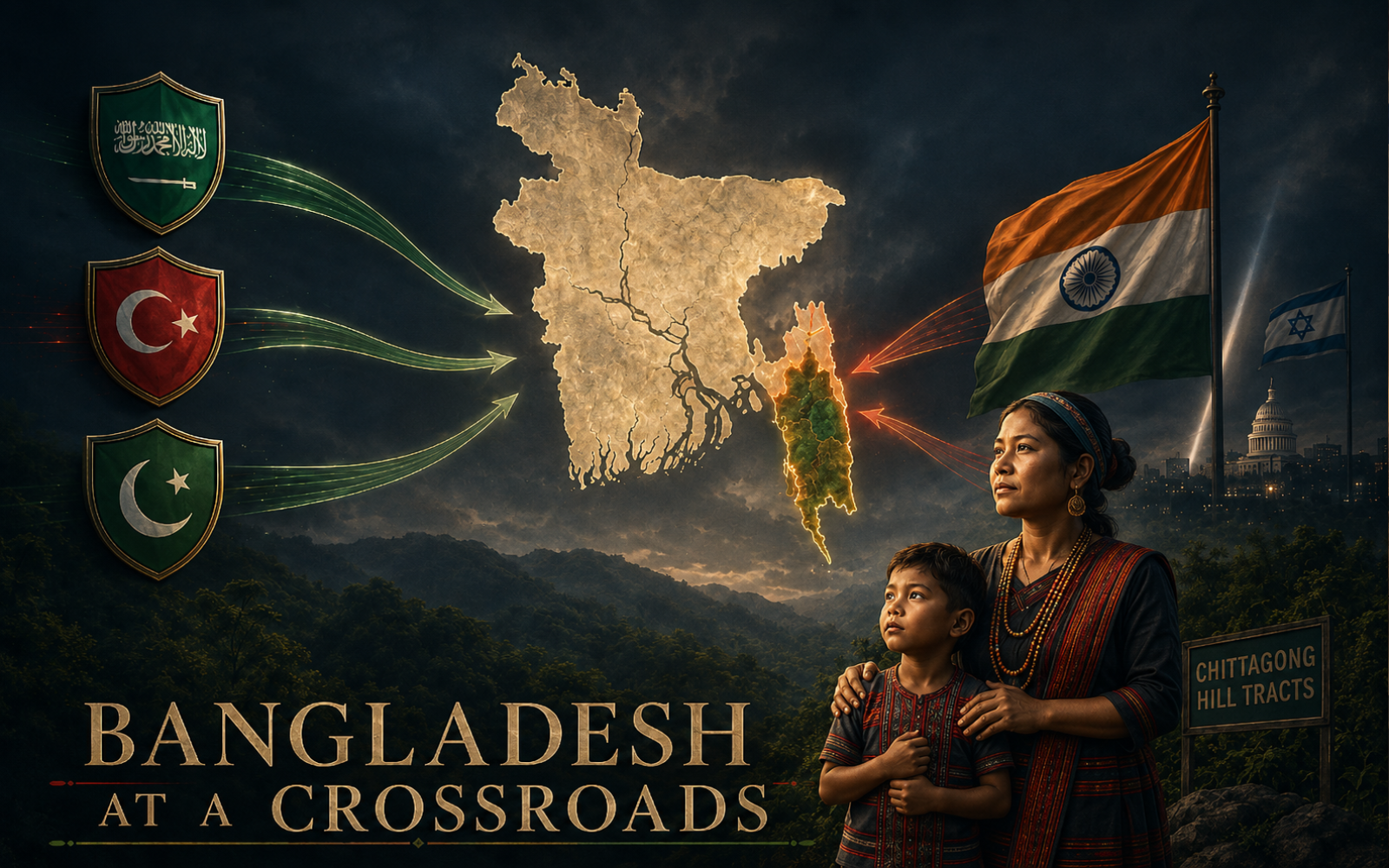
Bangladesh has been invited to join the Makkah Defence Pact formed by Saudi Arabia, Turkey and Pakistan. Dhaka has not accepted yet, but the BNP government says it is considering the invitation positively.
For Prime Minister Tarique Rahman, this may look like a foreign policy choice, but it could become a question of political survival. As an Indigenous Bangladeshi who supports Israel, I may not welcome this direction, yet domestic politics may leave the BNP government little room to say no.
The Political Cost of Saying ‘No’
Bangladesh is overwhelmingly Muslim, and Saudi Arabia has a special place in the hearts of millions because Makkah and Madinah are Islam’s two holiest cities. A defence pact involving Saudi Arabia, Turkey and Pakistan can therefore carry political and emotional meaning beyond its military terms.
Public attitudes also matter. Pew found in 2026 that 54 percent of Bangladeshis viewed Pakistan favorably, while 51 percent viewed India unfavorably. Favorable views of India have also fallen sharply since 2024.
Most voters will never study the pact’s military clauses. Many may see one simple picture: Saudi Arabia, Turkey and Pakistan are together. Will Muslim-majority Bangladesh join them, or stay outside?
If the BNP says no, its opponents will have an easy message: “Why did the BNP refuse? Is the government pro-India, or is it afraid of India?” That question could be more powerful on the streets than a long diplomatic explanation.
The Hasina Warning
The BNP should remember the political lesson of Sheikh Hasina. Her government fell for many reasons, but for years opponents also portrayed her as too dependent on India. The “India Out” campaign and calls to boycott Indian products showed how politically powerful that feeling had become.
Claims that New Delhi had too much influence over Dhaka became an effective political weapon. Now the same weapon can be turned against the BNP: “Hasina was accused of following India and lost power. Is the BNP now following the same path?”
The BNP spent years attacking the Awami League for being too close to India. Rejecting a pact involving Saudi Arabia, Turkey and Pakistan could now expose the BNP itself to the same “pro-India” label.
Why India Will Be Watching
India has reason to worry because Bangladesh shares most of its land border with India and lies beside its sensitive northeastern states. Pakistan, meanwhile, remains India’s long-time military rival.
I previously examined the wider India–Bangladesh security risks of the Makkah Pact, including what deeper Pakistani military influence in Bangladesh could mean for India’s eastern flank.
This is where the fear of a strategic Trojan horse comes from. Pakistan normally confronts India from the west, but if pact membership ever led to Pakistani troops, advisers, drones or intelligence facilities in Bangladesh, India would also have to think about pressure from the east.
Bangladesh lies beside India’s northeast and close to the narrow Siliguri Corridor, which connects much of that region with the rest of India. A Pakistan-linked military presence in Bangladesh would therefore create a very different security problem for New Delhi.
But this remains a possible future risk, not an automatic result of membership. Bangladesh could join the pact while refusing permanent foreign bases and assuring India that its territory would not be used for military operations against India.
Why Israel Should Watch
Israel should also pay attention to Bangladesh’s political direction. Bangladesh does not recognize Israel, and Pew found that 79 percent of Bangladeshis had an unfavorable view of Israel in 2026.
The policy is visible even in the passport. Bangladesh has ordered the phrase “This passport is valid for all countries of the world except Israel” restored to newly issued passports.
This matters even more while Israel remains in a wider regional conflict. Fighting in and around Gaza continues despite the ceasefire framework, and Israel has also been directly involved in the broader confrontation with Iran. In that environment, any new defence alignment involving Pakistan, Turkey and a strongly anti-Israel Bangladeshi public deserves closer attention in Jerusalem.
As an Indigenous Bangladeshi who supports Israel, I would rather see greater openness toward the Jewish state. The Makkah Pact is not formally an anti-Israel alliance, but Bangladesh moving closer to a defence framework that includes Pakistan and Turkey deserves attention in Jerusalem.
There is another concern that is personal to me. Bangladesh may be a democracy, but the Chittagong Hill Tracts have remained heavily militarized for decades. Indigenous communities have lived with military camps, land disputes, displacement and allegations of serious human-rights abuses.
I have written before about the decades of militarization, displacement and loss of freedom faced by Indigenous peoples in the Chittagong Hill Tracts. Even after the 1997 CHT Accord, the region has not fully escaped a security-first approach.
If joining another military framework strengthens that mindset in Dhaka, Indigenous people may reasonably fear that the space for demilitarization and a political settlement could become even smaller.
For me, the pact is therefore not only about India, Pakistan or Israel. It also raises a difficult question about what deeper militarization could mean for Bangladesh’s own Indigenous peoples.
The BNP’s Real Choice
For the BNP, the immediate political calculation is still simple. If Bangladesh joins the Makkah Pact, the government may have to manage India. If it refuses, it may have to manage its own streets.
The first problem may still be handled through diplomacy and security guarantees. The second could quickly become a campaign built around religion, nationalism and the accusation that the BNP has become another India-friendly government.
I am not arguing that joining the pact is necessarily good for Bangladesh, India, Israel or Indigenous communities. I am arguing that, from the BNP’s narrow political-survival perspective, refusing may be even more dangerous.
Joining could create a difficult diplomatic problem abroad. Refusing could revive the same pro-India accusation that became so damaging under Sheikh Hasina. For a government determined to complete its five-year term, joining may become the safer political gamble.
August 26, 2026
Tokyo, Japan