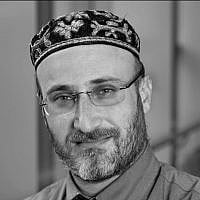
Former Jewish Prison Chaplain / Co-Founder: L’chaim
A society that condemns a human being to death condemns itself infinitely more.
Image: The official logo of “L’chaim! Jews Against the Death Penalty,” a group with thousands of members across Israel, the United States, and worldwide that has been mobilizing the Jewish world since 2020 against capital punishment without exception.
(Note: An original version of this article appeared here in Evolve on October 6, 2025.)
We, the thousands of members of the group “L’chaim! Jews Against the Death Penalty,” from across Israel, the United States, and the world, firmly believe that Judaism in the 21st century must unconditionally reject the death penalty. Various moral, ethical, and cultural considerations motivate our feelings. They all underscore a singular point that Judaism, along with all of civilized humanity, realizes: a society that condemns a human being to death condemns itself infinitely more. Far from any so-called “deterrence,” the death penalty is nothing more than veiled vengeance par excellence. It is an abject abomination that only perpetuates the cycle of violence and killing that has plagued humanity since time immemorial. Well over seventy percent of world nations have abolished the death penalty in law or practice. Below are some reasons modern Jewish civilization must follow suit.
Innocence:
First, and arguably foremost, there is rightfully no tolerance for the execution of an individual who is innocent of an alleged capital crime. The reputable Death Penalty Information Center (DPIC) writes that, given the fallibility of human judgment, there has always been the danger that an execution could result in the killing of an innocent person. Since 1973, over 200 death-row prisoners have been exonerated of the charges related to the wrongful convictions that had put them on death row. DPIC adds the following grim statistics about these human beings, which speak for themselves:
“These individuals have collectively spent 2,621 years in harsh prison conditions for crimes they did not commit. On average, death row exonerees spent 13 years under the sentence of death before their exonerations, with some individuals spending more than 40 years fighting to prove their innocence. 65% of exonerees are people of color, and of them, 54% are Black, highlighting systemic racial disparities. Florida has the highest number of death row exonerations of any state (30), followed by Illinois (22) and Texas (18).”
How many more innocent individuals must be released before society recognizes the fallibility of any human-crafted system of justice and stops the possibility of executing an innocent human being?
Jewish tradition, to be sure, forbids the execution of someone where there is any level of doubt about guilt or fairness. It is for this very reason that rabbinic tradition placed prodigious safeguards to ensure that no innocent person was put to death. Arguably, the most famous comment comes from one of the most renowned Jewish sages: the Rambam, Rabbi Moses ben Maimon (1135-1204). Maimonides, as he is often called, was a Sephardic Jewish physician and philosopher who became one of the most prolific and influential Torah scholars of the Middle Ages. As he famously wrote of capital punishment in Sefer HaMitzvot, Prohibition 290:
“It is better to acquit a thousand guilty persons than to put a single innocent one to death.”
Maimonides’s charge for protection of the innocent calls to mind another famous Jewish aphorism, one that is echoed as well in other traditions: “Whoever destroys a life, it is considered as if he destroyed an entire world. And whoever saves a life, it is considered as if he saved an entire world.” (Talmud, Mishnah Sanhedrin 4:5).
Per Maimonides, the highest level of repentance occurs when the offending party (after sincerely apologizing and making restitution through restorative justice practices) is presented with the opportunity to commit the same sin again and does not. Until the United States of America recognizes that it continues to put to death the innocent through a broken “justice system,” apologizes for its mistakes, and abolishes the death penalty so that the killing of innocents becomes an impossibility, America’s collective teshuvah/repentance will continue to fall short, with lethal consequences.
Jewish Tradition Renders the Death Penalty Virtuallyl Impossible to Employ
Regarding the many individuals who truthfully are guilty of heinous murder, let there be no doubt: traditional Jewish law does indeed allow for capital punishment, albeit with prodigious safeguards that effectively render the punishment obsolete. Many of the most powerful and brilliant rabbinic voices reflect this reality.
Let us recall the words of some of the loftiest figures among them: Rabbi Eliezer ben Azariah, Rabbi Tarfon, and Rabbi Akiva, as found in the Talmud:
“A Sanhedrin [Rabbinic court] that affects an execution once in seven years is branded a destructive tribunal. Rabbi Eliezer ben Azariah says: once in 70 years. Rabbi Tarfon and Rabbi Akiva say: Were we members of a Sanhedrin, no person would ever be put to death. [Thereupon] Rabban Simeon ben Gamaliel remarked, they would also multiply shedders of blood in Israel!” (Mishnah, Makkot 7a)
Indeed, there were dissenters — like Rabban Simeon ben Gamaliel above — who were pro-death, citing similar deterrence factors and other now antiquated notions of “justice.” Posterity can forgive their views, which reflected the understanding of their time, including their view of deterrence. They were not privy to recent meta-studies that have concluded that when it comes to deterrence, there is no demonstrable link between the presence or absence of the death penalty and murder rates.
For this reason alone, most traditional Jewish arguments for the death penalty no longer apply in our world. Rabbi Mordecai Kaplan famously taught that Jewish tradition should get a vote, not a veto. The United States and Israel’s continued antiquated invocation of deterrence to justify killing those who are safely incarcerated and no longer a danger to the public underscores the ongoing relevance of Kaplan’s suggested veto power for the sake of evolving social science.
Rabbinic law and custom say a great deal about the legal requirements needed to ensure there is not a “hanging court.” The bar for conviction is impossibly high. A death sentence required not only that two people witnessed the actual capital crime, but that they warned the perpetrator just before s/he was about to carry out the criminal action that would warrant the death penalty if they went through with it. I, for one, know of no instance where these standards have been met.
And there is more. In its historical context, lex talionis (“ayin tachat ayin” – “eye for an eye”) was intended to curtail, rather than augment, the collective bloodlust of expansive, vengeful massacres that societies practiced in ancient times—and still do all too often today. In other words, one eye – and no more than one eye – should be paid for the loss of one eye, lest punishment become excessive. Furthermore, and crucially, in rabbinic parlance, the traditional Jewish interpretation of the Biblical “eye for an eye” was as a call for financial compensation for the value of said eyes.
Some Other Traditional Death Penalty Abolitionist Arguments
In addition to the above, L’Chaim has outlined ad nauseam many of the other countless reasons why the death penalty is indeed nothing short of an abject abomination now in the twenty-first century. Here are but a few for review:
1) It violates the human right to life.
2) It often results in physical torture, and always is psychological torture for individuals counting down to their execution day. There is no humane way to execute human beings against their will. Last week’s torture and botched execution of Christa Pike disgustingly proved this point once again.
3) It invariably is implemented in a racist manner, including in the USA, where cases involving white victims yield the death penalty significantly more than those involving black victims, and in other nations whose laws openly target specific ethnicities. We recently saw this in Israel, whose first death penalty law this year targets Palestinian terrorists.
4) It traumatizes executioners and witnesses.
5) From Adolph Hitler to Donald Trump and elsewhere, the death penalty is used as a political tool, particularly for election campaigns, as Ben Gvir’s disgusting, sadistic comments praising a death viewing chamber recently demonstrated yet again.
6) Meta-studies have determined time and again that the death penalty is not a deterrent. Deterrence is a fallacious delusion when applied to the death penalty, and “retributive” or “proportional” justice does not bring closure for murder victims’ loved ones.
7) Rather, the death penalty only creates more martyrs. A renowned comment regarding the well-established relationship between the death penalty and the desire for martyrdom comes from the 19th-century writer Eliphas Levi. He demonstrated a keen understanding of these basic human dynamics when he wrote: “Every head that falls upon the scaffold may be honored and praised as the head of a martyr.” History has proven this time and again. Critics of the recent proposal to live-stream a U.S. military firing squad execution recently cited this argument directly.
8) Regarding Israel’s death penalty laws, antisemitic extremists will assuredly blame all Jews for the execution of their enemies. They will conveniently fold the sadistic death wish of individuals like Minister of National Security Itamar Ben-Gvir into the narrative into which they have lumped those who advocate for capital punishment in Israel. It will neatly fit into a warped view of Israel – and, by extension, Judaism – as a so-called “Death Cult.” Just as advocating for death in this case and across Israel jeopardizes the safety and security of Jews across the globe in this way, it also threatens to permanently mar what remains of Israel’s moral standing among the vast majority of nations that have abolished the death penalty in law and practice. In the highly volatile political climate that now imperils the rule of law in Israel, this issue further normalizes the invocation of state violence. It widens the gap between modern-day Israel and the central Jewish value of life’s inviolability.
The Nazi Legacies of Various Execution Methods
Even beyond the above, there is more that the Jewish world in particular must consider in the wake of the Holocaust and the events of the 20th century. Many of the members of “L’chaim! Jews Against the Death Penalty,” like this author and L’chaim co-founder, are direct descendants of Holocaust victims and survivors. More than most people, we know that one cannot conflate capital punishment with the Shoah. And yet, for many L’chaim members, the shadow of the Holocaust is inextricably linked to our firm rejection of the death penalty in all cases, including for convicted Hamas terrorists, as well as the Washington, D.C., Israeli Embassy and the Pittsburgh Tree of Life shooters.
The most common form of execution that the U.S. federal government and multiple states employ is lethal injection. One cannot overstate how lethal injection is a direct Nazi legacy, first implemented in human history by the Third Reich as part of their infamous Aktion T4 protocol used to kill people deemed “unworthy of life.” Dr. Karl Brandt, Adolf Hitler’s personal physician, devised that program. It is most likely this very method that would be used to kill the Tree of Life shooter. If this were not enough, across the USA, more and more states are erecting gas chambers, including one in Arizona that uses Zyklon B, the same lethal gas used in Auschwitz. The increasingly popular use of firing squads in the United States and hangings in Israel also evoke horrific Holocaust memories and amount to nothing short of torture.
No Jewish argument about the death penalty in the 21st century should ignore these facts, against which the members of L’chaim! firmly chant “NEVER AGAIN to state-sponsored murder!” For these reasons, L’chaim! members view the death penalty as one of the worst kinds of institutionalized evil that stains the United States, Israel, or any other nation that employs it.
Modern Jewish Voices Against the Death Penalty
Indeed, many in the Jewish community did not object to Israel’s 1962 execution of Nazi perpetrator Adolf Eichmann. However, a notable core of Jewish leaders vociferously protested. These included renowned Hebrew University philosophers Samuel Hugo Bergmann and Nathan Rotenstreich; Kabbalah scholar Gershom Scholem; and Jewish theologian and philosopher Martin Buber, who called the execution a great “mistake.” Other Holocaust survivors themselves, such as Nobel-prize-winning author Nelly Sachs, voiced their strident opposition to Eichmann’s execution.
More than anyone, 20th-century Jewish human rights icon and Nobel Peace Laureate Elie Wiesel encapsulated the members of L’chaim!’s stance. When asked about capital punishment, Wiesel resolutely stated, “Death is not the answer.” By the end of his life, Wiesel publicly said that he made no exception to this rule. His comment came as part of a death penalty abolitionist video that Amnesty International produced entitled “Lighting the Torch of Conscience,” in which he stated:
“With every cell of my being and with every fiber of my memory, I oppose the death penalty in all forms. I do not believe any civilized society should be at the service of death. I don’t think it’s human to become an agent of the angel of death.”
Driven by Wiesel’s prophetic call, L’chaim members, together with our partners at Death Penalty Action, ensure there is a vocal Jewish presence at every execution vigil in the United States. We also correspond with all Americans in line for state-sponsored murder, letting them know that L’chaim! joins civilized humanity in standing with them on the side of life. L’chaim! also makes daily calls to all actively executing governors, signs daily petitions, drafts op-eds and articles like this one, delivers synagogue programs, engages in regular television, radio, and podcast interviews, and advocates vociferously against the increasing calls for executions in Israel.
In the wake of the Holocaust and the unparalleled horrors of the 20th century, more than 70% of the nations of the world have recognized the inviolability of the human right to life and have abolished the death penalty in law or practice. Twenty-first-century Judaism, directly targeted by that unparalleled conflagration, must reflect this evolution and become a Tree of Life whose branches extend as a model across our world.
And so, without exception for both the innocent and the guilty – including convicted Hamas terrorists – we shall continue to chant, firmly, L’chaim: To Life!
Cantor Michael J. Zoosman, MSM, BCC
Jewish Prison Chaplain
Co-Founder: L’chaim! Jews Against the Death Penalty
Advisory Committee Member: Death Penalty Action
Related Topics