
Founder & Principal, Line of State
Altalena Was the Moment Israel Chose to Become a State
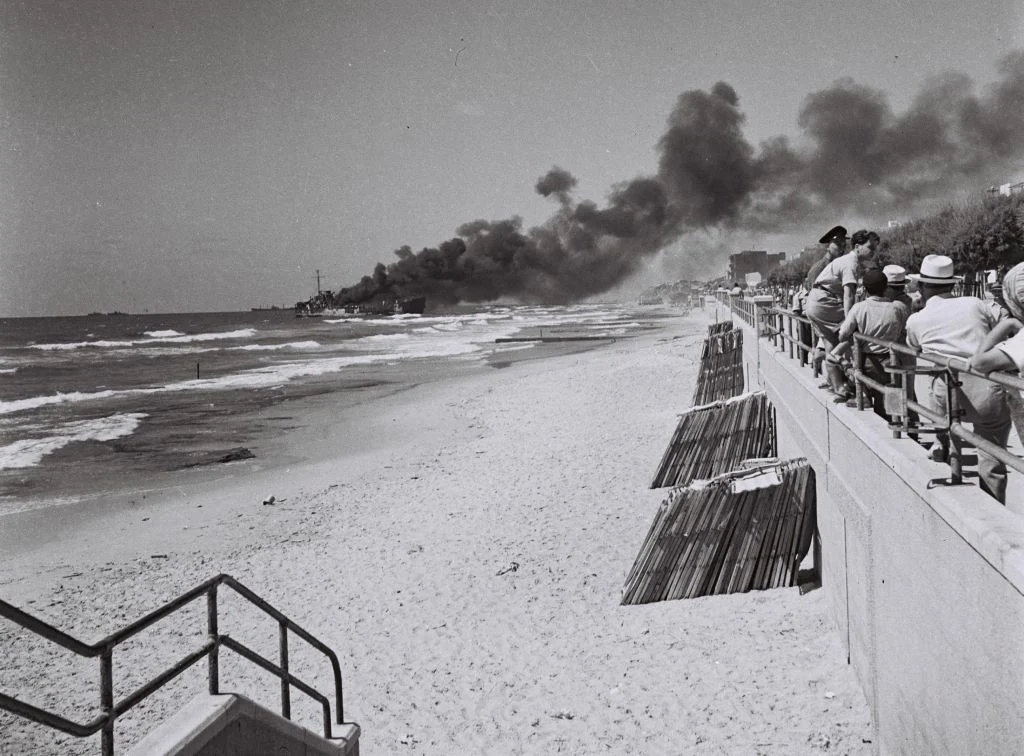
Tel Aviv, June 1948: civilians watch the Altalena burn offshore. The smoke passed; the boundary between political allegiance and state authority was supposed to remain. Hans Pinn / Government Press Office
A state rarely loses sovereignty in one dramatic act. It loses it by granting exceptions: to armed factions it sympathizes with, civilians it trusts, institutions a government mistakes for its own, and private initiatives born of good intentions. Altalena’s enduring lesson is that sovereignty survives only when no camp, cause or elected authority is allowed to own a piece of the state.
This week, 78 years after the Irgun arms ship Altalena burned off Tel Aviv, its wreck was found on the seabed, bringing back to the surface the lesson partisan memory would rather keep there.[1]
On June 1, 1948, the Irgun, Menachem Begin’s pre-state underground organization, agreed to integrate into the newly created Israel Defense Forces. When Altalena arrived laden with arms, Irgun leaders sought to direct some to their forces in Jerusalem, which remained outside the June 1 integration arrangement, and some to IDF units composed of former Irgun fighters. The state had one question: who decides? The confrontation killed sixteen Irgun members and three IDF soldiers.[1]
Begin’s last-minute call to avert civil war is no absolution for the insistence that brought the state to the brink over its sovereign authority to allocate arms after Israel had already established one national army.
Once there is a state, it no longer matters who acquired the weapons, paid for them or brought them ashore. A party, underground movement, commander or fighting force does not choose their destination. The state decides who receives them, who carries them, against whom they are used and who commands those who wield them.
Good intentions are no basis for sovereignty. If the Irgun may decide where the arms it brought go, then tomorrow the Palmach, Lehi or any other armed formation inherited from the pre-state era can claim the same right. The monopoly on force is not a privilege of those in power; it is the condition for having a state rather than armed camps.
Had Ben-Gurion blinked, the concession would have become precedent, leaving Israel with separate armed loyalties instead of one national army.
There is no army within an army. There is no bargaining over who is sovereign.
Sovereignty Cannot Be Subcontracted
Other republics have faced the same test. In 1794, armed resistance to federal law in western Pennsylvania forced George Washington to mobilize a federalized militia and travel west with it: the young American republic would not allow local armed resistance to nullify federal law.[2] In 1961, four French generals seized control in Algiers to block Charles de Gaulle’s policy of Algerian self-determination. De Gaulle ordered French soldiers not to obey them; the putsch collapsed within four days as conscripts refused the rebel command.[3] The circumstances differed; the constitutional rule did not: arms confer no veto over lawful authority.
The danger begins when a state applies that rule selectively — when some armed actors are confronted as a challenge to sovereignty while others are indulged because their cause, identity or politics are familiar.
That is the line Israel is eroding in the West Bank. Armed settlers use violence while IDF forces secure the space around them and enforcement remains weak.[4] The state’s army is not the private guard of a political camp. A weapon in civilian hands confers no shred of sovereignty.
An armed civilian force is an instrument of the state only when the state commands it and enforces its laws upon it. When the state ceases to impose its authority on armed people within it, it begins to share sovereignty with them. No flag, uniform or headquarters is required; it is enough for force, enforcement and protection to be distributed according to political identity.
The slippery slope does not begin with an arms ship off Tel Aviv. It begins every time the state says: this time, we’ll let it slide.
The Israel Police is not the police force of the minister responsible for it. A political camp does not become the state merely because it governs.
After October 7, the same erosion appeared in the most innocent place. Parents of active-duty and reserve soldiers raised money, bought equipment and solicited donors to equip their children’s units. A state army does not allow body armor, helmets or operational equipment to reach a unit because one father found a donor or one mother opened a WhatsApp group. Parental wealth, connections and fundraising capacity are not a military allocation system.[5]
Israel is not a poor state whose army should depend on charity. Procurement and allocation belong to the state, and protecting its soldiers is its duty.
Government Commands. The State Commands Loyalty.
The IDF, the police and the security services are subordinate to the government; their loyalty is to the state, the law and the public. Elected officials have authority over the instruments of force, not ownership of them. They are empowered to give orders, not entitled to demand loyalty.
Even loyalty to whichever government is elected is not loyalty to the state. It merely transfers the object of loyalty from the state to the government of the day.[6]
Replacing “subordination” with “loyalty” turns constitutional authority into political allegiance. Anyone who does so knowingly subverts nonpartisan state service; anyone who does not understand the distinction is unfit for the office.
Altalena was the moment Israel decided that sovereignty cannot be divided among political camps, and that a state unwilling to pay the price of its sovereignty will pay the price of surrendering it.
–
Originally published in Hebrew in Maariv on August 30, 2026, under the title “טיבוע האלטלנה היה הרגע שבו ישראל בחרה להיות מדינה” (“The Sinking of the Altalena Was the Moment Israel Chose to Become a State”). English version translated, adapted and expanded by the author.
–
Related by the same author:
- “With Law, Without Illusions – Rabin, Leadership and Responsibility”, The Times of Israel, November 3, 2025.
- “No Hands on Soldiers”, The Times of Israel, November 16, 2025.
- “Aiding the Enemy in Wartime from Within”, The Times of Israel, April 23, 2026.
- “An Armed Fringe Is Not Defending Israel. It Is Hijacking the State”, The Times of Israel, July 26, 2026.
–
[1] The Knesset’s account describes the Irgun’s integration into the IDF, the continued independence of its Jerusalem units and the demand that 20 percent of Altalena’s arms be allocated to them. The IDF account details the dispute and the sixteen Irgun and three IDF fatalities. The Times of Israel reported the wreck’s discovery on August 24, 2026. Knesset: Menachem Begin — 1948 · IDF: The Sinking of Altalena · The Times of Israel: Wreckage found of Altalena arms ship
[2] The Whiskey Rebellion became an early test of whether armed local resistance could nullify federal law. Washington mobilized militia forces and travelled with them toward western Pennsylvania. U.S. National Archives: The Whiskey Rebellion as a test of federal power · Founders Online: Washington and the Whiskey Insurrection
[3] In April 1961, four French generals attempted a military coup in Algiers against de Gaulle’s Algeria policy. De Gaulle called on soldiers to reject the insurgent command, and the putsch collapsed four days later. INA: Le Putsch des généraux à Alger · INA: Charles de Gaulle during the generals’ putsch
[4] Recent Times of Israel reporting has documented armed settlers acting alongside or in the presence of IDF troops, soldiers standing by or assisting during settler violence and property seizures, and cases in which the IDF itself acknowledged improper conduct. The Times of Israel: Armed settler backed by IDF troops · The Times of Israel: IDF soldiers accused of aiding settler violence and theft
[5] After October 7, privately supplied military equipment flowed to Israeli units on a large scale. In July 2024, the IDF said it would halt direct equipment donations to soldiers, including donations from parents, citing military values, safety and operational concerns. The Times of Israel: IDF vows to halt gear donations — even from parents
[6] Section 4 of Israel’s General Security Service Law places the Shin Bet under government authority while requiring it to operate in a stately and nonpartisan manner. In July 2026, Shin Bet chief David Zini publicly described his qualification for the post in terms of loyalty to the “elected leadership,” regardless of its political outlook. Knesset: General Security Service Law · The Times of Israel: Shin Bet chief on loyalty to elected leadership
Related Topics
Related Posts