A Moroccan Journalist
Ceuta is occupied, but Morocco’s keffiyists don’t care
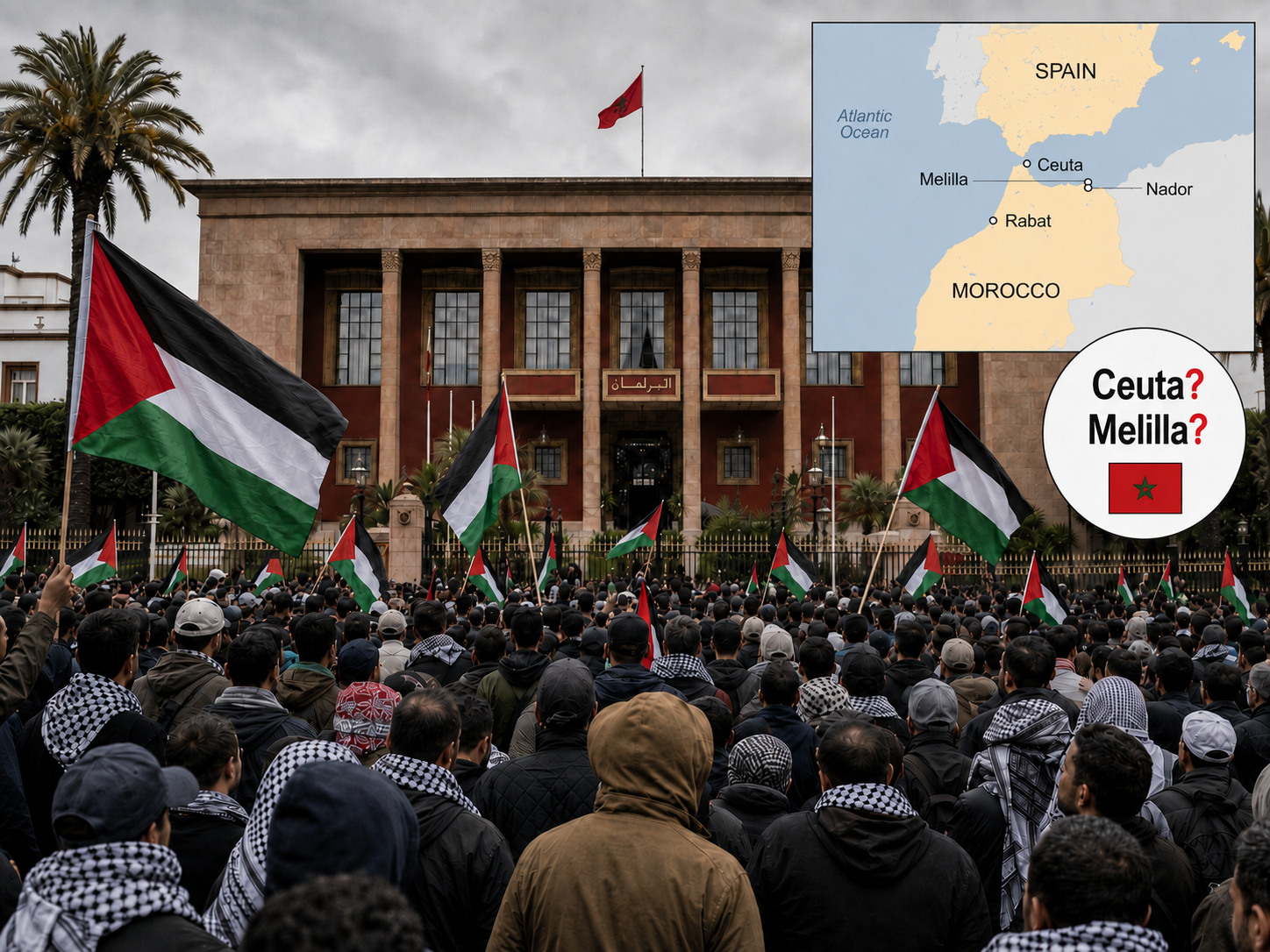
Morocco’s keffiyists will march for every occupied land on earth, except their own. (AI-generated).
There is a species of political activism – performative, selective, and exquisitely comfortable – that flourishes in Morocco’s cities every time a crisis erupts thousands of kilometers away, and that vanishes into absolute silence the moment the crisis sits on Morocco’s own doorstep.
You have seen it in Rabat and Casablanca and Tangier: the marches, the chants, the keffiyehs draped with cinematic precision, the banners denouncing occupation and colonialism and imperial violence with a passion that would be admirable if it were not so ruthlessly discriminating – discriminating in geography, discriminating in outrage, discriminating in memory, discriminating in whom it permits to be colonized and whom it permits to count as a colonizer. It is a moral vocabulary deployed with surgical prejudice: thunderous when the occupier fits the ideological script, suddenly aphasic when the map, the patron, or political convenience points somewhere less useful.
These are Morocco’s keffiyists – the radical left, the Brotherhood’s loyal foot soldiers, the ideological imports who have memorized every UN resolution on Palestine but cannot name the date Ceuta was seized by Portugal, who will fill a boulevard for Gaza on a Friday afternoon and walk past the Spanish consulate on the way home without a flicker of recognition that the colonialism they just spent three hours denouncing is practiced, visibly, materially, on Moroccan soil, by the very country whose flag they have learned to associate with progressive solidarity.
The Ceuta events of late July did not create this hypocrisy. They merely made it impossible to ignore.
When 70,000 Moroccans crossed into Ceuta – a city conquered by Iberian forces in 1415 and held under European sovereignty ever since, the last colonial possession on the African mainland alongside Melilla, seized in 1497 – Spain responded with military deployments, diplomatic fury, and a wall of national consensus so total that it dissolved every internal political distinction the country pretends to maintain.
Left and right, socialist and nationalist, secular left and conservative Christian, Pedro Sánchez’s progressives and Vox’s ultranationalists – virtually every faction of Spanish politics, from the irreligious metropolitan left to the Catholic and religious right, converged on a single proposition: Ceuta is Spanish, Morocco is the aggressor, and any questioning of this arrangement constitutes an assault on sovereignty.
Not a single Spanish politician, from any party, in any region, broke ranks. The consensus was absolute, and it was instructive, because it demonstrated something that Morocco’s own political class has never managed to replicate: in Spain, the nation comes first, and ideology bends to accommodate it. In Morocco, for certain factions, ideology comes first, and the nation bends until it breaks.
There is an irony here too: Spanish authorities in Ceuta reportedly barred a 2M crew (Morocco’s public television channel) from entering, searched its journalists, seized its vehicle and filming equipment, and curtailed its ability to report – precisely the sort of obstruction of press access that Madrid and its ideological fellow-travelers routinely invoke when condemning Israel’s restrictions on journalists covering Gaza.
What followed in the Arab and Islamist media was not merely disappointing – it was a betrayal delivered with the casual indifference of people who have never considered Morocco’s territorial integrity a cause worth defending. Al Jazeera – Doha’s geopolitical loudspeaker and megaphone, fluent in the liturgy of anti-imperialism until Qatari patronage redraws the map of permissible outrage – framed the crisis as Israeli exploitation and European far-right opportunism, casting Morocco not as a nation with a legitimate sovereignty claim but as a pawn in someone else’s geopolitical chess game. Much of the pan-Arab coverage carried an unmistakable insinuation: that Sánchez was being punished for his positions on Palestine, and that Morocco had somehow enlisted itself in a Zionist-engineered choreography of retaliation.
The chauvinism is breathtaking in its consistency: this is the same network whose Brotherhood-aligned commentariat mobilized every platform it owned to legitimize Türkiye’s decision to open its borders with Greece in 2020, flooding the EU with migrants as a pressure tactic, and to champion Ankara’s right to reclaim its islands and extend its maritime sovereignty.
Yet when Morocco is alleged to be deploying a comparable logic of migratory pressure against a comparable European territorial holdover, the network pivots 180 degrees and becomes Madrid’s unofficial spokesman, weeping for the security of the colonizer and accusing the colonized of blackmail. The double standard does not require decoding. When Türkiye pressures Greece, it is national assertion. When Morocco reportedly pressures Spain – although no evidence establishes that this was what occurred in this case – it is destabilization. The only variable is whose side the Brotherhood’s funders are on.
A Palestinian political analyst writing in the same outlet described the events as “how Israel and the European far right tried to exploit Ceuta” – as though the 70,000 Moroccans who crossed into their own city were instruments of Tel Aviv rather than citizens of a country that has claimed that land for as long as it has existed.
Arab broadcasters referred to Ceuta and Melilla, with breathtaking nonchalance, as “Spanish cities” – the same broadcasters who will spend 45 minutes in a panel discussion lamenting the loss of Al-Andalus as though it were a wound inflicted on the entire Arab nation, and who will invoke Córdoba and Granada and Seville as symbols of civilizational glory, but who cannot bring themselves to acknowledge that the same Iberian power that expelled Muslims and Jews from Andalusia still occupies two cities on African soil that are geographically, historically, and culturally Moroccan.
The Brotherhood faction – Morocco’s Islamist networks and their transnational extensions – performed their role with predictable cowardice. These are organizations that, together with parts of the Arab left, inherited the old Cold War lexicon of anti-imperialism, liberation, revolutionary solidarity, and Third World struggle, building entire media ecosystems around causes from Palestine, Iraq, and Syria to places as distant as East Timor and Venezuela.
The alliance has always been an uneasy one: Islamists and leftists march together when a common enemy can be named, only for the partnership to curdle once power is within reach – a pattern whose most brutal historical warning remains Iran, where revolutionary leftists helped bring down the Shah before the Islamic Republic systematically crushed many of the very forces that had helped make the revolution possible.
Yet, with an almost doctrinal discipline, they lapse into near-paralyzed muteness the moment Ceuta and Melilla enter the conversation, because conceding the colonial character of Spain’s presence on Moroccan soil would mean confronting a European state that has positioned itself as Palestine’s champion, and confrontation with a pro-Palestinian ally is a price the Brotherhood’s ideological balance sheet cannot absorb.
Occupation, it turns out, is forbidden when Israel practices it and entirely tolerable when Spain does – provided Spain waves the right flag and mouths the right slogans about Palestinian statehood. The double standard is not subtle. It is architectural. It is the foundation upon which the entire edifice of transnational Islamist solidarity rests: Morocco’s sovereignty is negotiable; everyone else’s is sacred.
The moral deformity of that dispensation becomes harder to ignore when one remembers how much Morocco has actually done for Palestine, for Palestinian institutions, and for Arab-Israeli peace through diplomacy, mediation, humanitarian assistance, and channels of dialogue that many of its most vociferous detractors have never possessed, much less used. Yet none of this purchases Morocco even a fraction of the ideological solicitude routinely extended to foreign actors whose politics otherwise stand in almost ontological opposition to everything these movements profess to defend.
Sánchez is an especially instructive specimen of the contradiction. His government represents a European political tradition that is unapologetically secular, socially liberal, strongly supportive of LGBTQ+ rights, and profoundly alien to the Brotherhood’s own moral and social universe. None of that seems to matter. So long as Sánchez confronts Israel, recognizes Palestine, and speaks the required anti-Israel vocabulary, every other ideological contradiction becomes negotiable. The supposed civilizational struggle dissolves overnight; the Western secularist becomes an ally, while Morocco – Muslim, Arab-Amazigh, historically invested in Palestine, and territorially confronted by Spain itself – is expected to remain silent about its own claims.
And then came the most revealing moment of all – voices aligned with the Palestinian cause, some from Gaza itself, publicly praising Spain’s “support for Palestine” while dismissing Morocco’s claim to its own occupied territories, as though gratitude for diplomatic recognition entitled a foreign country to hold another Muslim nation’s cities under permanent European rule.
The logic, if one can call it that, runs as follows: Spain recognized Palestine, therefore Spain’s colonialism in Africa is exempt from criticism, and any Moroccan who objects is guilty of prioritizing territorial vanity over solidarity with the oppressed. It is a formulation so intellectually bankrupt that it collapses under the weight of its own contradictions – and yet it circulated, was amplified, was endorsed, because in the hierarchy of causes that the transnational activist left has constructed, Morocco’s occupied cities rank somewhere below irrelevant.
This is the great sickness, and it must be named plainly: a significant current within Morocco’s own political landscape, and within the broader Arab media ecosystem, has internalized a framework in which Morocco’s national interests are permanently subordinate to imported ideological commitments – commitments that demand Moroccan blood, Moroccan money, Moroccan solidarity, and Moroccan silence, all at once.
The keffiyist who marches in Tangier for a land 4,000 kilometers away while the Spanish flag flies over a Moroccan city visible from the hills above Fnideq is not practicing solidarity. He is practicing submission – ideological submission to a worldview and apparatus that has always wanted from Morocco not solidarity but servitude: a country that bleeds on command for causes designed in Cairo, Doha, and Istanbul, that offers its streets as staging grounds and its citizens as headcount for marches serving someone else’s fundraising cycle, reducing Morocco to a recruitment pool and a political ATM while consuming its energy and credibility in the service of other people’s wars and other people’s causes.
And in return, Morocco receives nothing: not a single statement from a Brotherhood-aligned scholar or channel acknowledging Ceuta and Melilla as occupied Moroccan territory, not a single Friday sermon from the so-called Union of Muslim Scholars naming Spain as a colonial power, not a single calorie of the vast moral energy these networks generate directed toward Moroccan territorial integrity.
I challenge them – every last one of them – to step onto a single street and say, plainly, that Ceuta is occupied Moroccan land. They will not. They cannot. Because the checks that sustain their platforms and the political alignments that shape their editorial lines do not permit it, and because in the hierarchy of loyalties that governs their politics, the movement comes first, the patron comes second, and Morocco – the country whose institutions sheltered them, whose democratic openings let them govern for a decade, whose freedoms they exploited to build the very networks they now deploy against its interests – comes dead last.
Morocco’s Brotherhood domestics – the commentators, the social media preachers, the party operatives who built careers on Moroccan soil while taking their instructions from movement headquarters abroad – are intellectual slaves performing as free men, kindling in other people’s wars: useful so long as they can be burned for someone else’s cause, their inevitable fate is to be discarded the moment their utility expires, and tossed into the dustbin of history while the nation they repeatedly refused to defend endures, as it always has, without them.
Spain, whatever else one may say about it, understands something that Morocco’s keffiyists do not: that a nation which does not defend its own territory has no business lecturing anyone else about occupation. Every Spanish party, left and right, stood behind Ceuta without hesitation. Morocco deserves the same from its own. And those who cannot offer it – who close their eyes to the colonial flag on their own coast while weeping for flags that fly thousands of kilometers away – are not activists and are not dissidents. They are, in the most precise and unforgiving sense of the word, collaborators with the colonialism they claim to oppose.
The occupation is not only in Palestine. It is in Ceuta. It is in Melilla. It is in the Chafarinas. It is in Peñón de Vélez de la Gomera. And the silence of those who should be screaming is the loudest sound in the room.
Related Topics