
Middle East Analyst
Normalization from the Saudi Perspective: Part III
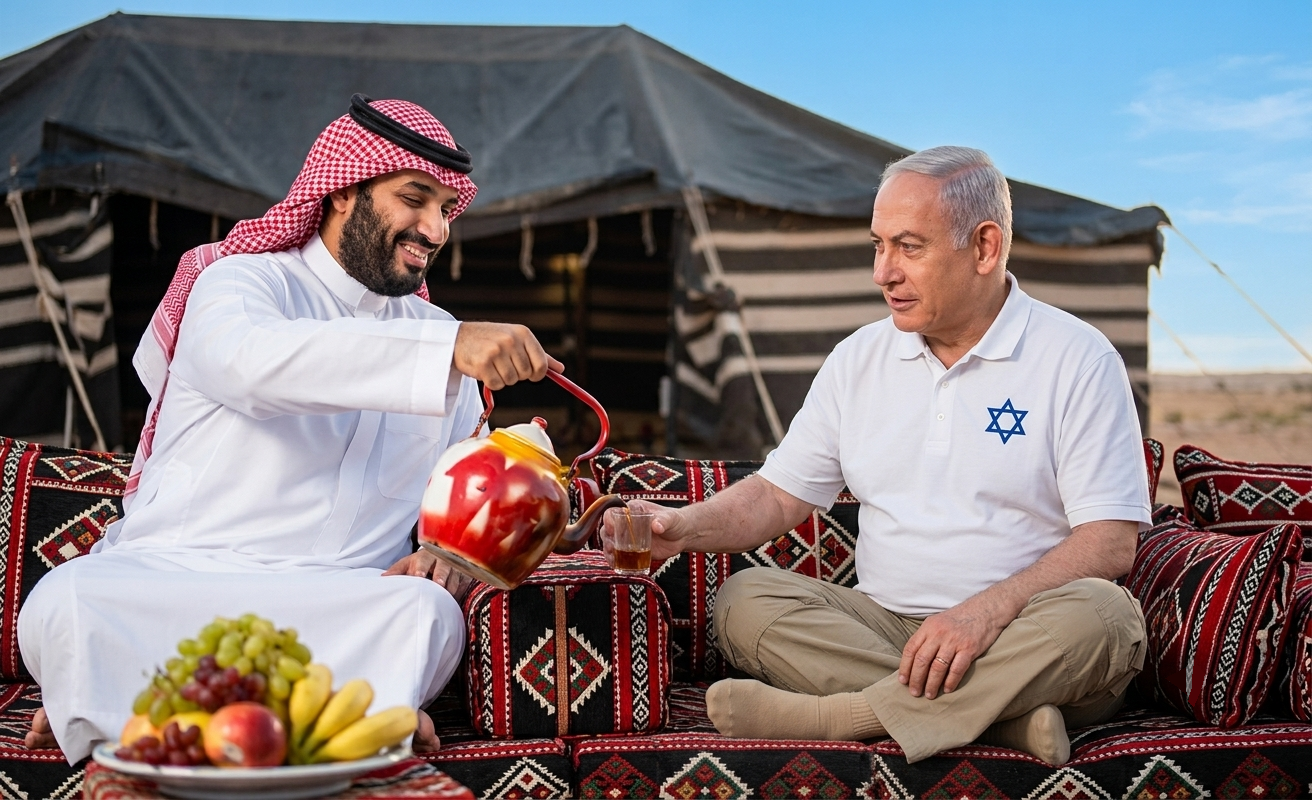
by author (AI)
Learning the Grammar of Regional Legitimacy One Cup of Tea at a Time
Memory in the Middle East is not archived in digital databases or bureaucratic files; it is encoded slowly, deliberately, one cup of tea at a time. Long before I analyzed regional dynamics for NATO or the Pentagon, my understanding of the true grammar of trust was forged on the ground, through deeply personal, everyday human interactions that no political science textbook could ever replicate.
I will never forget the day a Saudi colleague named Khalid Otaibi walked into the breakroom, quietly poured me a fresh cup of tea, and looked at me with a look that perfectly balanced genuine warmth with terrifying pragmatism. “Bill,” he said calmly, taking a sip from his glass, “please don’t park your car next to mine anymore. My car hasn’t been paid off yet, and I don’t want it to get damaged when they blow your car up.”
It was a line delivered with a pitch-black sense of humor, but it carried the absolute weight of reality. At that moment, the macro-level geopolitical frictions of the Middle East—the anti-American fury sweeping the region, the structural instability caused by Western interventions, and the constant threat of asymmetrical violence—ceased to be abstract concepts discussed with Henry Kissinger over hors d’oeuvres. They were physical, immediate realities that haunted you every time you started your car.
Otaibi’s warning provides the vital, ground-level counterweight to the structural blindness that has plagued Western diplomacy for half a century. Practitioners of realpolitik like Kissinger operate under a top-down paradigm: they assume that as long as the ruling elites of absolute monarchies or centralized states agree on a piece of paper, the “street” can be effectively managed, policed, or ignored. They treat the general population as a passive variable.
The Saudi Public Is a Silent Partner
But my nine years living and working inside the Kingdom, chronicled in my memoir Arabia: Nine Years in the Kingdom, proved the exact opposite. While Saudi Arabia is an absolute monarchy with immense centralized power, its leadership does not govern in a total vacuum. The House of Saud do not maintain their authority purely through coercion or financial patronage; their survival rests on their deep fluency within an honor-based social register and their preservation of internal domestic legitimacy. The then Saudi Ambassador to the U.S. once observed that the monarchy was very concerned by what Americans thought about them, but they were far more concerned about what the Saudi people thought about the monarchy.
As I argued in my recent Times of Israel Blogs analysis, “Gaza Phase II – The Grammar of Trust,” societies under stress inevitably revert to their deepest, most durable trust grammars. In the Arab world, that grammar is intensely relational, personal, and reputation-driven. A contract is merely a piece of paper; a true guarantee is an armed actor or a leader whose name, lineage, and family honor are actively on the line.
This reality completely upends the contemporary Western and Israeli strategy regarding normalization. The current political establishment in Jerusalem behaves as if Crown Prince Mohammed bin Salman can simply issue a royal decree, sign the Abraham Accords, and permanently alter the geopolitical alignment of the Islamic world by royal fiat. They assume that because MBS has centralized power and curbed the traditional religious police, he has a blank check from his population to execute any transactional deal that benefits the kingdom’s macroeconomic portfolio.
This is a catastrophic misunderstanding of the Saudi domestic substrate. The opening of Riyadh to concerts and Western tourism does not mean the population has evacuated its core honor-based and religious registers. For the average Saudi citizen, and for the vast segmentary networks of kinship and tribal allegiances that form the bedrock of the state, the ongoing, televised suffering of Palestinians in Gaza and the West Bank is not a distant political event. It is an intense, daily assault on their collective sense of Arab dignity and Islamic solidarity.
Normalization Can’t Be Forced on an Unwilling Public
MbS is acutely aware of this ground-level reality. He knows that his ambitious domestic transformation plan, Vision 2030, requires absolute social stability. If the ruling family forces normalization down the throats of a population intensely sensitized to regional violence, they will create an explosive vacuum of domestic legitimacy. They would hand a lethal recruiting tool to underground extremist networks, resurrecting the exact era of domestic radicalization, insider threats, and car bombs that Khalid Otaibi and I lived through.
This is why Prince Turki al-Faisal’s recent insistence that Israel must first behave like a “normal country” by accepting international law is so vital. The Al Saud are not playing a stubborn game of diplomatic brinkmanship; they are practicing raw regime survival. They know that if they accept a transactional peace while Israel continues to expand West Bank settlements and deny Palestinian statehood, the Saudi leadership will look completely bankrupt in the eyes of their own people and the wider Muslim world. They would be exposed as leaders who traded the well-being of Palestinians and the sacred geography of Jerusalem for Western technology and corporate defense contracts.
The primary logjam to regional peace is not Saudi reluctance; it is Israel’s inability to speak the grammar of trust. The current Israeli leadership wants the ultimate prize of Saudi normalization—the spiritual and economic crown jewel of the Middle East—without paying the necessary price of admission: the recognition of Palestinian sovereignty. They want an urban (ḥaḍar) contract of trade and tech integration while completely ignoring the Bedouin (badū) requirements of reputational honor, regional protection, and moral legitimacy.
As long as Western and Israeli policymakers ignore the ground-level lessons encoded over those slow cups of tea, they will continue to stumble blindly through the maze of Middle Eastern alliances. True stability cannot be engineered through a technocratic, transactional deal that ignores the moral substrate of the region. Until Israel alters its behavior on the ground and begins acting like a normal neighbor within the boundaries of international law, the prospect of a Saudi-Israeli normalization will remain a dangerous mirage—and the cars parked in the alleyways of the Middle East will remain under a very long, very dark shadow.