
Geopolitical Analyst: Bridging Somaliland & Israel to the world
Somaliland: The US recognition window has opened
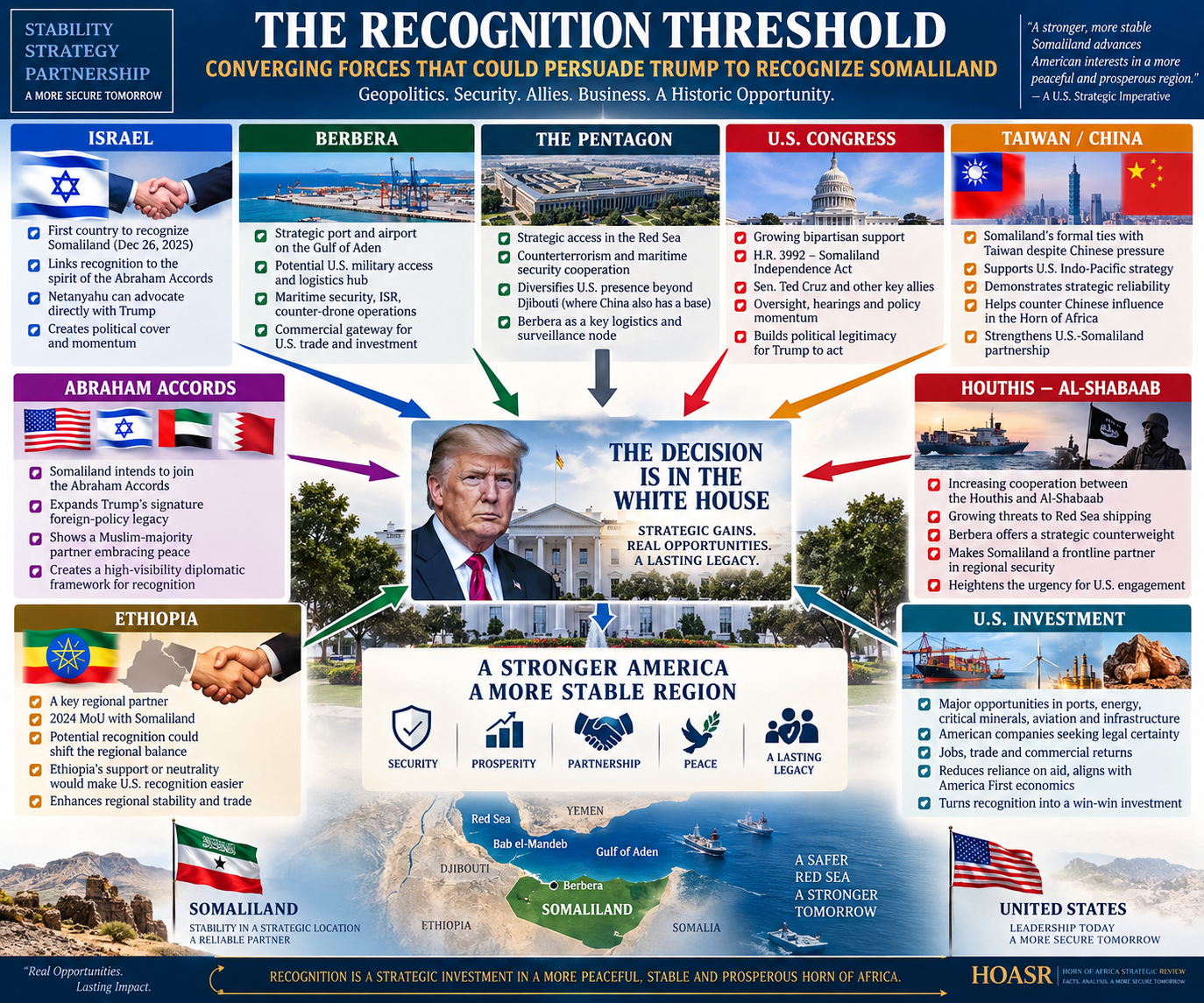
The Somaliland Recognition Threshold: Israel’s breakthrough, Berbera’s strategic value, congressional and Pentagon interest, the Abraham Accords, China competition, Red Sea security threats, Ethiopia and U.S. investment are increasingly converging on one decision point—the White House. Infographic artwork: HOASR.
What Could Finally Persuade Trump to Recognize Somaliland
Israel has broken the taboo. President Abdirahman Irro is now in Washington. From Berbera and the Abraham Accords to China, the Houthis, Congress and American investment, a rare convergence of strategic forces has brought Somaliland closer to possible U.S. recognition than at any time in its post-1991 history.
A Washington Visit at a Different Moment
President Abdirahman Mohamed Abdullahi Irro arrived in Washington on September 5 with a senior delegation for his first U.S. working visit since taking office. Somaliland’s presidency says the agenda centers on diplomatic relations, security and economic cooperation, investment and international support for recognition. Public reporting has not yet disclosed a complete itinerary or confirmed a meeting with President Donald Trump. SomalilandCurrent and Horn Diplomat have reported the delegation’s arrival and stated objectives.
The timing is exceptional. Israel’s December 2025 recognition of Somaliland removed a diplomatic barrier that had stood for more than three decades. In June 2026, the Israeli Knesset formally welcomed Irro on the first state visit by a Somaliland president and recorded his declaration that Somaliland would join the Abraham Accords. Knesset President Irro is finally confronting Washington that recognition is not a hypothetical act.
Washington has heard that case for many and is well aware of Somaliland’s historical, legal, political and geopolitical case.years. The decisive task for president Irro is to persuade the Trump administration that recognition would advance identifiable U.S. interests strongly enough to justify departing from the longstanding policy of treating Somaliland within Somalia’s internationally recognized borders.
The Trump Threshold: What Does America Gain?
For the Trump White House, the strongest case is likely to be transactional and strategic. Somaliland must be presented not as a diplomatic burden requiring American generosity, but as a partner offering access, geography, security cooperation, commercial opportunity and political alignment in a highly contested maritime theater.
Senator Ted Cruz has already supplied much of this framework. In an August 2025 letter to Trump, Cruz urged formal recognition and highlighted Somaliland’s position on the Gulf of Aden, counterterrorism role, ties with Taiwan, support for Israel and the Abraham Accords, openness to a U.S. military presence, and potential critical-minerals cooperation. Cruz letter to President Trump This is not about a senator who supports recognition. This is a significant argument translated into the language of American national security.
1. Berbera Must Become a Concrete American Proposition
Berbera is Somaliland’s most important strategic card. But geography alone does not produce recognition. The delegation’s task is to turn Berbera from a point on a map into an operational proposition: maritime surveillance, logistics, contingency access, counterterrorism cooperation, search and rescue, intelligence sharing, aviation support and redundancy for U.S. operations around the Red Sea and Gulf of Aden.
If the Pentagon looks at Berbera only as useful, recognition can remain optional. If American defense planners conclude that a structured relationship with Somaliland materially improves force protection, maritime awareness or operational flexibility, the diplomatic calculus changes. Recognition then becomes connected to a security requirement rather than a symbolic political request.
2. The Houthi–Al-Shabaab Nexus Raises Somaliland’s Strategic Value
The most important new security development may be the reported deepening relationship between Yemen’s Houthis and Al-Shabaab. A September 2026 Wall Street Journal investigation described weapons transfers, training, direct exchanges and efforts to expand maritime monitoring. The report cited U.S. military intelligence and other officials and said at least 100 Al-Shabaab fighters had traveled to Yemen for training.
This is a wake up call for Washington which historically treated Al-Shabab and the Houthis as separate geographical theaters. Yemen lies across the Gulf of Aden from Somaliland; Al-Shabaab operates in Somalia; global shipping passes through the Bab el-Mandeb corridor. If U.S. planners begin to see a single cross-Gulf security system involving drones, weapons smuggling, radar, militant training and maritime surveillance, Somaliland’s location becomes more valuable now.
A further escalation—especially credible evidence of advanced Houthi systems being transferred to Al-Shabaab or of coordinated attempts to threaten shipping—could become a recognition accelerator. It would sharpen the question of whether Washington can afford to leave a comparatively stable and strategically located Somaliland outside its formal security architecture. The New Strategic Encirclement Around Somaliland: From Aden to South Somalia
3. Israel Has Broken the Psychological Barrier
Israel’s recognition did more than create a new bilateral relationship. It demonstrated that a state could recognize Somaliland and absorb the diplomatic backlash. It also gave Hargeisa an ally with direct access to Trump and to influential American political networks.
The Washington Institute has argued that Israel’s move creates new Red Sea dynamics and could encourage other governments, including the United States, to reconsider their positions. The strategic logic is straightforward: Israel sees the Red Sea and the approaches to Bab el-Mandeb as a national security theater increasingly shaped by the Houthis and Iran.
For Somaliland, the next diplomatic step is to convert Israeli recognition into coalition-building. If Prime Minister Benjamin Netanyahu or other senior Israeli officials actively encourage Washington to follow, the political cost of recognition falls while its security rationale becomes easier to explain inside the Trump administration. Why Israel broke the Somaliland taboo.
4. The Abraham Accords Could Provide Trump the Political Vehicle
Recognition becomes more politically attractive if it can be packaged as part of a larger Trump foreign-policy achievement. Somaliland’s declared intention to join the Abraham Accords provides exactly such a vehicle. The Knesset’s June 2026 account explicitly records Irro’s commitment to join the framework.
Instead of presenting recognition as a technical reversal of Somalia policy, the White House could present it as part of an expanded peace, security and commercial architecture linking a Muslim-majority Somaliland with Israel and American partners around the Red Sea. That would give Trump something presidents value: a recognizable diplomatic event with a clear claim of authorship. Somaliland Could Be the Abraham Accords’ African Test Case
5. A Trump–Irro Meeting Could Change the Equation
No publicly available source has yet confirmed an Oval Office meeting. But if one occurs, it could become the most consequential event of the visit because presidential recognition is ultimately an executive foreign-policy decision.
Therefore, Irro’s strongest presentation should be short, concise and upto the point: Somaliland is stable; it controls strategic infrastructure; it is prepared to cooperate with the United States; it has aligned with Israel and Taiwan despite political pressure; and it seeks investment rather than permanent dependency. The Somaliland Recognition Case should support that argument, not overwhelm it.
6. Congress Is Building an Institutional Pathway
Congressional support has moved beyond informal sympathy. H.R. 3992, the Republic of Somaliland Independence Act, was introduced in the 119th Congress to recognize Somaliland as a separate independent country. Senator Cruz has separately urged Trump to act.
Such measures short of immediate recognition are helpful and can make a big difference: Separate reporting requirements, direct security cooperation, a representative office in Hargeisa, Berbera feasibility studies, differentiated travel guidance or distinct commercial treatment are progressively institutionalizing the reality on the ground that Washington already deals with Somaliland differently from Somalia.
That incremental separation is already creating a contradiction in the US policy of “One Somalia” doctrine: if the United States treats Somaliland as a separate partner across security, trade, diplomacy and investment, why preserve a formal formal policy that denies the political reality underlying those relationships?The Beginning of the End for One Somalia Policy
7. China and Taiwan Strengthen the Republican Case
Somaliland’s relationship with Taiwan is not a side issue. It is evidence that Hargeisa has accepted political costs in order to maintain a relationship opposed by Beijing. Cruz’s recognition letter specifically cited Chinese coercion against Somaliland because of its Taiwan ties. Cruz letter
For China hawks in Washington, recognition can therefore be framed as support for a government that resisted Beijing rather than accommodated it. Berbera also offers strategic diversification in a region where China already maintains a military base in Djibouti. Somaliland does not need to replace Djibouti in American planning to become useful; it needs to provide redundancy.
8. American Investment Could Turn Recognition Into an Economic Question
A month in the United States gives Irro an opportunity that short ceremonial visits do not: time to cultivate business constituencies. Ports, aviation, logistics, energy, fisheries, telecommunications, infrastructure, minerals and financial services can all be incorporated into a recognition strategy—but only where projects are commercially credible.
The strongest outcome would be signed memoranda, due-diligence processes, feasibility work or serious investment commitments. Once American companies require legal certainty, banking access and enforceable agreements in Somaliland, non-recognition itself begins to impose an economic cost.
9. Critical Minerals and Energy Must Be Evidence-Based
Somaliland has promoted its mineral potential, and U.S. officials have shown increasing interest in supply-chain security. But this is an area where exaggeration would be damaging. Geological claims must be supported by credible surveys, commercial grades, licensing rules, infrastructure plans and transparent investment protections.
The same applies to hydrocarbons. Oil and gas potential can attract attention, but prospective geology is not equivalent to a bankable commercial discovery. The delegation will gain more credibility by presenting verified opportunities and clearly identifying what potentially remains exploratory.
10. Somalia’s Weakness Can Help Somaliland—but Only Up to a Point
Mogadishu remains capable of imposing costs on any recognition decision, particularly through its counterterrorism relationship with Washington and its support among African, Arab and multilateral institutions. Somaliland should therefore avoid arguing that Somalia is irrelevant.
The stronger argument is comparative analysis: the United States can maintain operational relationships with Mogadishu and other Somali authorities while recognizing that Somaliland has developed a separate political order. A severe Somali constitutional crisis, major Al-Shabaab gains, worsening federal fragmentation or a confrontation with Washington could strengthen this comparison, but Somaliland cannot base its strategy on Somalia’s failure.
Is Mogadishu Facing a Kabul Style Collapse?
11. Ethiopia and an African Breakthrough Remain Crucial
Israel broke the international taboo. An African government could break the continental one. Ethiopia remains the most consequential candidate because of its geography, security weight and long relationship with Somaliland.
Even without immediate Ethiopian recognition, quiet acceptance of a U.S. move would reduce regional risk for Washington. Conversely, strong opposition from Addis Ababa would complicate the calculus. Somaliland’s Washington campaign therefore cannot be separated from its diplomacy with Ethiopia and other African capitals.
12. Somaliland’s Legal Narrative Must Stay Narrow and Precise
Opponents will portray recognition as encouragement for separatism across Africa. Somaliland’s response should emphasize the specificity of its history. The U.S. State Department’s own historical record states that the former British protectorate of Somaliland became independent on June 26, 1960, before joining the former Italian-administered territory in the Somali Republic on July 1. U.S. Department of State, Office of the Historian A contemporaneous State Department historical note likewise records Somaliland’s June 26 independence. Foreign Relations of the United States
This does not by itself settle the modern recognition question. It does, however, give Somaliland a distinctive legal and historical argument: Hargeisa can frame its claim as restoration of a previously independent territorial unit rather than the arbitrary creation of a new border. The African Union’s Somaliland Contradiction
13. Internal Stability Is a Recognition Requirement
Somaliland’s strongest external arguments can be weakened by internal conflict. Washington will scrutinize territorial disputes in the east, minority protections, political inclusion, security-force conduct, rule of law and the government’s ability to resolve disputes without sustained coercion.
Recognition does not require the absence of every border dispute. Many recognized states have them. But Washington will need confidence that recognition would stabilize rather than internationalize unresolved conflict. Horn and Red Sea Weekly Review
14. Democratic Continuity Still Matters
Somaliland’s electoral record is strategically useful because it distinguishes Hargeisa from much of the surrounding region. The peaceful 2024 transfer of presidential power strengthened the argument that, unlike many African states, Somaliland’s institutions can survive political handover of power to the opposition.
Trump may place greater emphasis on security and transactions than on democracy promotion, but Congress, State Department professionals, think tanks, human rights watch groups, and potential investors will still assess institutional durability. Democratic continuity therefore remains part of the coalition-building case for recognition.
15. The Campaign Must Become Bipartisan
Republican sponsorship is indispensable under a Trump administration, but recognition will be more durable if Somaliland avoids becoming a partisan project. Irro’s delegation should cultivate Democrats as well as Republicans and present Somaliland through several overlapping frames: Red Sea security, democratic self-government, China competition, commercial opportunity, counterterrorism and regional stability.
A bipartisan foundation would also reduce the risk that recognition—or the policies leading toward it—becomes vulnerable to the next change of administration.
The Events That Could Trigger a Trump Decision
Recognition decisions rarely occur because every argument is resolved. They usually require a catalytic event that allows a president to act. For Somaliland, the most plausible triggers include a successful Trump–Irro meeting; a Pentagon recommendation for structured access to Berbera; a U.S.–Somaliland security agreement; formal movement toward the Abraham Accords; active Israeli lobbying; a second recognition by an African state; a major American investment package; or a sharp deterioration in the Houthi–Al-Shabaab maritime threat.
What to Watch During the Washington Visit
Four indicators should be watched above all others. First, does Irro secure access to Trump or to high ranking senior White House national-security decision-makers? Second, do Pentagon discussions move from general engagement to specific arrangements involving Berbera, maritime security, intelligence or logistics? Third, does Congress advance legislation or administrative measures that formally distinguish Somaliland from Somalia? Fourth, does the visit produce credible commercial commitments rather than expressions of goodwill?
The Window Is Open, but the Outcome Is Not Yet Settled
Somaliland is closer to a serious U.S. recognition debate than it has been at any point in its post-1991 history. That conclusion does not mean recognition is imminent or inevitable. Washington still has substantial countervailing interests: relations with Mogadishu, counterterrorism access, African Union sensitivities, regional opposition and concern about territorial disputes.
What has changed is the convergence of forces. Israel has recognized Somaliland. The Abraham Accords offer a political vehicle. Red Sea insecurity has raised the value of Berbera. Houthi–Al-Shabaab cooperation is making the Gulf of Aden a more integrated security theater. Taiwan gives Somaliland credibility with China hawks. Congress now contains an organized recognition constituency. American investors are being courted. And Irro has arrived in Washington with enough time to work across government, Congress, think tanks, business and the diaspora.
The strategic objective should therefore be precise: make continued non-recognition appear less useful to the United States than recognition. That is the threshold Somaliland has never previously crossed. It is also the threshold this Washington visit has a genuine opportunity to test.
Related Topics
Related Posts