The Unreturned: Hungary’s Holocaust-Era Art
Introduction
For decades, Hungary’s museums denied having Holocaust-era looted art. Some claimed the works were “abandoned.” Others said no records existed. But now, with the decoding of the 1944 Hungarian microfilm archives—reels recovered and digitized by the U.S. Holocaust Memorial Museum—we know the truth.
This post reveals a verified inventory of some of the fine art—paintings, sculptures, bronzes—confiscated from Hungarian Jews in 1944 and inventoried by state officials. Every object listed here is tied to a named artist or collection and appeared in government intake reports, museum memoranda, or transport ledgers. Many of these works remain unrestituted.
While not exhaustive, this list represents the most complete published inventory to date based on Reels 143–145. It includes fully documented artwork found in translated archival records provided to the Holocaust Art Recovery Initiative as of August 2025. It offers a clear window into the quality, diversity, and scope of Hungary’s Holocaust-era cultural looting.
Looted Artwork Recorded in 1944 Archives
Reel 143: Slides 145–147 — Székesfehérvár Museum Intake
-
Abonyi T. – Német városka piac
-
Bihari Sándor – Esti aratás
-
Brocky Károly – Female Portrait (Ernst auction)
-
Cserey K. – Old Man
-
Fényes Adolf – Still Life
-
Iványi-Grünwald Béla – Balatoni táj
-
Kernstok Károly – Nude by the Water
-
Munkácsy Mihály (attrib.) – Study of Christ
-
Székely Bertalan – Turkish Rider
-
Cseh Elemér Lajos – Futó utca
-
Pállya Celesztin – Piaci vásár
-
Jacques d’Arthois – Landscape
Sculpture & bronze:
-
Rousseau (attrib.) – Astrologer
-
Bory Jenő – Hungarian Soldier
-
Otto Hoffner – Goethe
Reel 143: Slides 166–170 — Dr. Szurányi Miklós Collection (Budapest)
-
Rippl-Rónai József – Egrességynő
-
Francesco Guardi – San Giorgio Maggiore
-
Brück Lajos – Gondolier on a Canal, Portrait of Young Girl
-
Szinyei Merse Pál (attrib.) – Portrait of Márkó
-
Pieter Brueghel (copy) – Peasant Wedding Banquet
-
Zemplényi Tivadar – Woman with Lamp
-
Olgyai Viktor – Sunset in the Forest
-
Bolognetti Isidoro (attrib.) – Annunciation
-
Morassi (attrib.) – Ruins
-
Szentgyörgyi István – Kígyóbűvölő (Snake Charmer, bronze)
-
Tamarellen – Still Life with Rabbit
-
20+ additional oils by Márk Lajos, Noszky László, Sompuer, Tamarellen, and others
Reel 143: Slides 201–210 — Herzog Collection (Sirok Transport)
-
Alfred Sisley – The Riverbank
-
Gustave Courbet – The Spring
-
Mihály Munkácsy – Portrait of a Woman
-
Théodule Ribot – Still-Life
-
Pierre-Auguste Renoir – Standing Woman
-
Flemish School – Landscape with Cattle
-
Eugène Carrière – Child’s Head
-
Decorative miniatures, Gobelin-style tapestries, and 18th-c. cartographic art also listed
Reel 143: Slides 241–250 — Dr. Ervinné Doroghy Collection
-
Rippl-Rónai József – Ülő férfi
-
Fényes Adolf – Terített asztal, Lyukas sarok
-
Marastoni József – Woman in Turkish Headdress
-
Rubens (copy) – Bundás Vénusz
-
Jacques d’Arthois – Wooded Landscape
-
Flemish & Dutch School portraits
Reel 143: Slides 161–165 — Nyíregyháza Gymnasium Art Cache (Szabolcs County)
In May 1944, following the ghettoization of Jews in Nyíregyháza, the local museum director Dr. Kis Lajos oversaw the storage of over 200 confiscated paintings inside a public school gymnasium. These were removed from private Jewish homes and transported by order of the local military command. The collection was logged but not returned.
Artists named in the lists include:
-
Iványi-Grünwald Béla (5 paintings, all oil on canvas)
-
Komáromi Kacz Endre (3 works)
-
Szűle Péter (3 paintings)
-
Féáti Pilch Dezső, Zemplényi Tivadar, Olgyai Ferenc
-
Hubay Andor, Benczúr Gyula, Kézdi Kovács László, Jánbor Lajos
-
Additional entries cite “framed landscapes,” “genre scenes,” and “signed oils”
Curators assessed the works as culturally valuable but “not of national-level quality,” and therefore suited for regional museums (e.g. Nyíregyháza, Debrecen, Miskolc). None were restituted post-war.
Reel 145: Slides 351–395 — Hatvany & Herzog Master Inventories
-
El Greco – Christ Driving the Money Changers
-
Lucas Cranach the Elder – Portrait or Madonna
-
Courbet – Seascape
-
Paul Gauguin – The Black Pigs
-
Anthony van Dyck – Religious Portrait
-
Jan van Goyen – Dutch Landscape
-
David Teniers the Younger – Genre Scene
-
Rembrandt (School of) – Unspecified Painting
-
Raphael – Religious Scene
-
Rubens – Biblical Scene
-
Maurice Utrillo – Paris Street Scene
-
Camille Pissarro – Landscape
-
Claude Monet – (probable) Water Lilies
Reel 145: Slides 471–530 — Herzog/Sváb Collection Transfer Receipts
-
Mihály Munkácsy – Atelier
-
Hans Canon – Portrait of a Man
-
Alajos Stróbl – Marble Bust
-
Large-scale religious or biblical scenes (probable Munkácsy altarpieces)
-
Decorative art: Velázquez books, Persian carpets, Rococo chairs
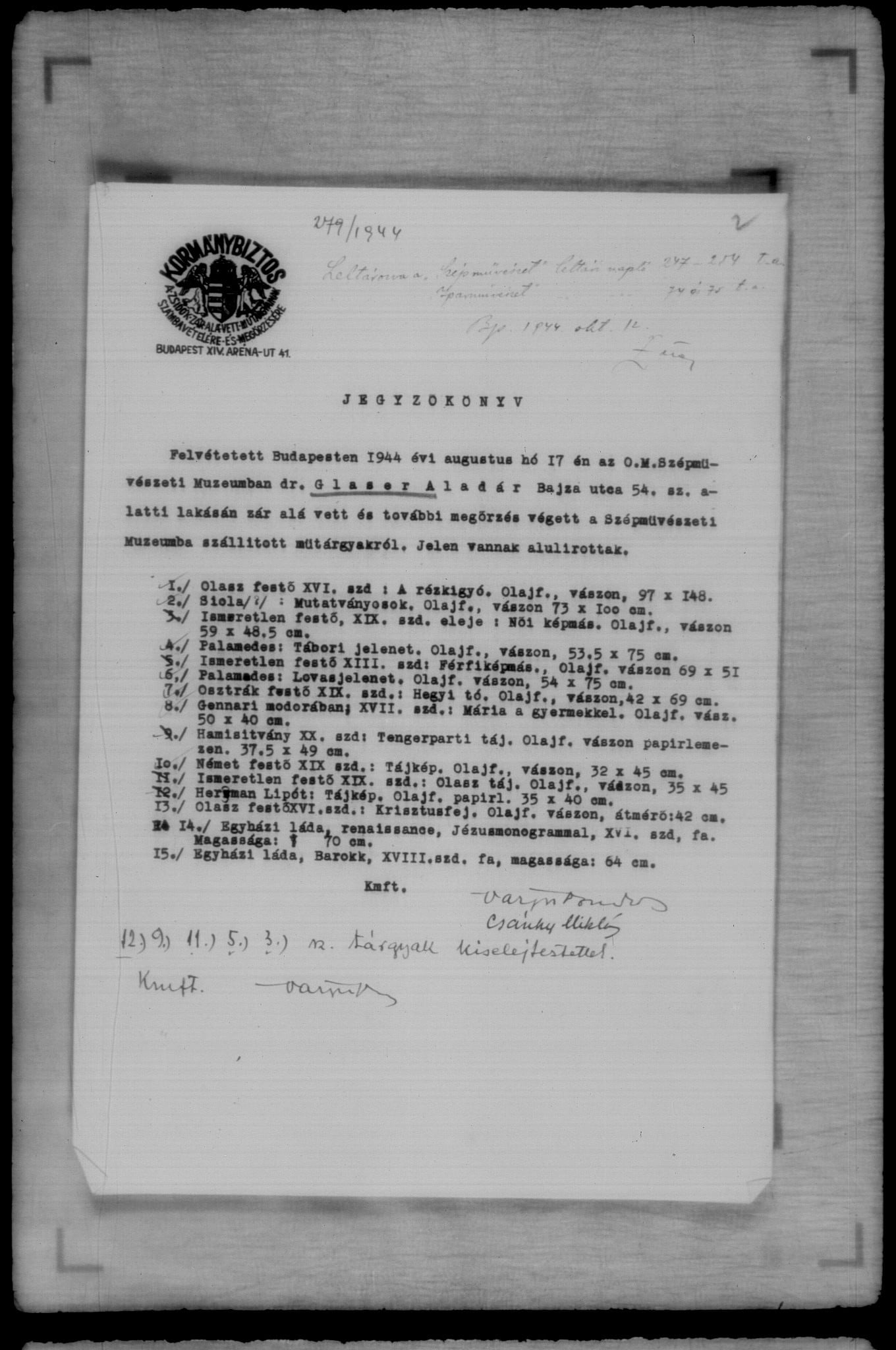
Reel 144: Slide 572 — Dr. Glaser Aladár Seizure (Bajza utca 54, Budapest)
On August 17, 1944, officials from the Hungarian Museum of Fine Arts entered the apartment of Dr. Glaser Aladár, a Jewish resident of Budapest, and removed 15 listed artworks for “safekeeping.” The seizure was documented by two top museum officials—Dr. Csánky Miklós and Varju Domokos.
The seized pieces included:
-
The Snake Woman — Italian School, 16th century, oil on canvas (97 × 148 cm)
-
Exhibition Figures — Slovakian? oil on canvas (73 × 100 cm)
-
Portrait of a Woman — Unknown, 19th century (59 × 48.5 cm)
-
Palamedes — Military Scene, and Horse Battle, both oil on canvas
-
Austrian School (19th c.) — Children in a Garden
-
German Rococo (18th c.) — Children’s Scene
-
Herman Lipót — Landscape (oil on paper, 35 × 40 cm)
-
Italian School (16th c.) — Baptism of Christ (circular painting, Ø 42 cm)
-
Two carved wood religious reliefs — Renaissance and Baroque, 14th & 18th centuries
The inventory concluded with the note that the items were “temporarily entered into the museum’s inventory,” a euphemism often used for pre-accession looted items.
Reel 145: Slides 531–560 — Baja Family Inventories (20+ named victims)
-
Károly Markó – Landscape
-
Glück Ferenc – Forest with Deer
-
Bernáth Aurél – Abstract Composition
-
Rudnay Gyula – Peasant Family
-
Barabás Miklós – Portrait of a Woman
-
Iványi-Grünwald Béla – Village Life
-
Paintings described as “by Hungarian masters” including Benczúr, Czóbel, and Vaszary
Reel 145: Slide 420 — Csontváry, Delacroix, and Stróbl
-
Tivadar Csontváry Kosztka – Landscape or Religious Scene
-
Eugène Delacroix – Romantic Interior
-
Alajos Stróbl – Sculpture (Marble Bust)
Conclusion: What These Lists Mean
This is the most complete list ever published of named Holocaust-looted art from Hungary’s wartime records.
These were not anonymous house clearances. These were systematic, documented seizures of high-value cultural property—from artists like Sisley, Gauguin, Munkácsy, Renoir, Rippl-Rónai, Brueghel, and Carrière, as well as hundreds of lesser-known but equally precious Hungarian painters.
The records show official transfers to Hungary’s major museums:
-
Museum of Fine Arts (Szépművészeti Múzeum)
-
Hungarian National Museum
-
Regional museums in Baja, Székesfehérvár, Nyíregyháza, Debrecen, and others
They also reveal that Hungary never returned most of what was taken—even after the war.
What Now?
-
For Museums: Publish holdings with wartime provenance. Cross-check this list.
-
For Heirs: Use the information in this post and others in the series to file and/or negotiate resolutions to claims.
-
For Journalists & Scholars: Spread the names of victims, perpetrators, storage locations and artwork. Reconstruct what was lost.
-
For the Public: Demand that Hungary’s museums come clean—now.
Until then, these paintings and sculptures remain unfinished crimes. Let this record stand as both evidence—and indictment.
Prepared by the Holocaust Art Recovery Initiative (HARI), August 4, 2025
Contact: HolocaustArtRecovery@yahoo.com | HolocaustArtRecovery.org