


A Moroccan Journalist
The Morocco-Israel Tripartite Bargain at Five Years
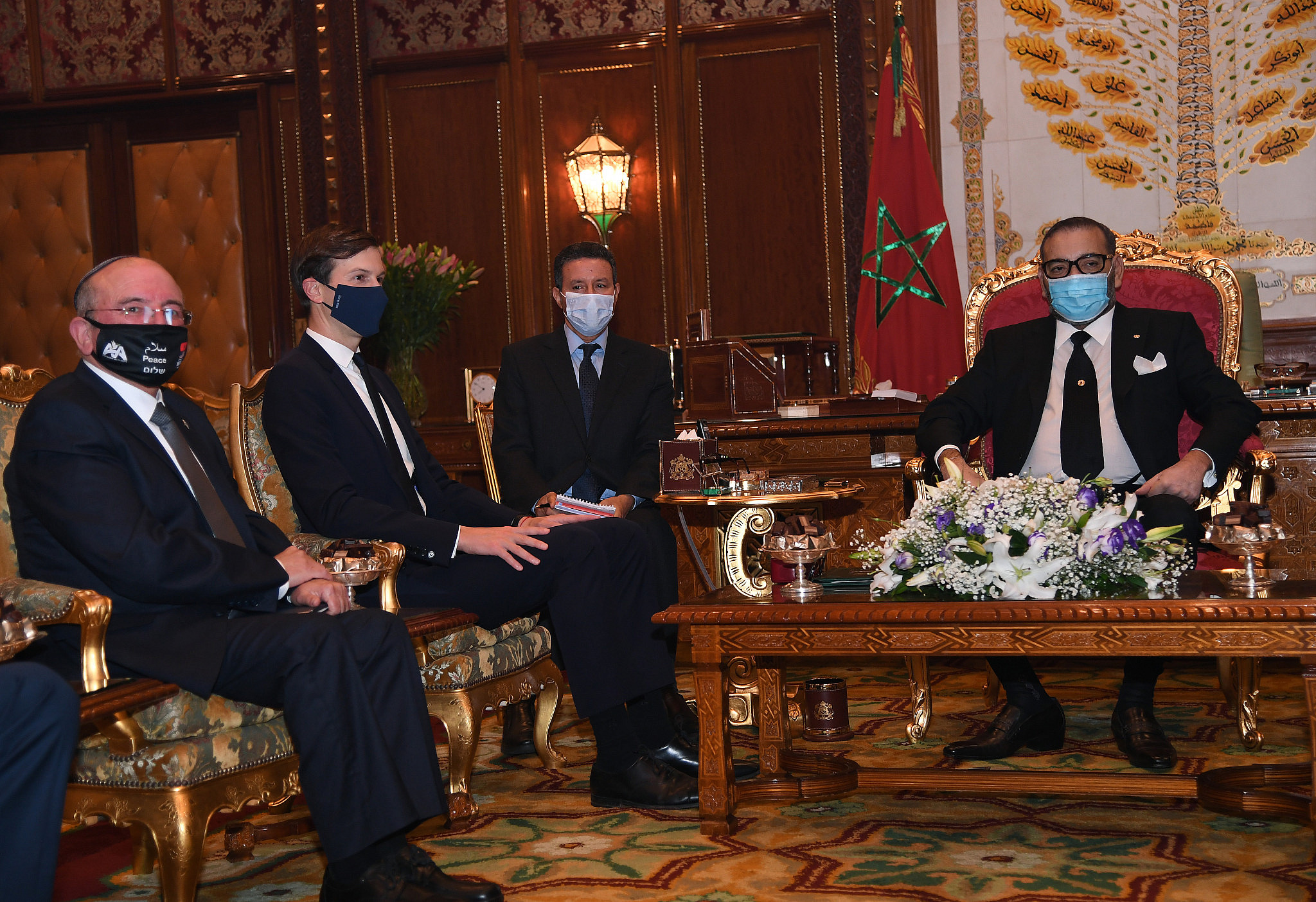
Then-Senior Advisor to the US President Jared Kushner and then-Israel’s National Security Advisor Meir Ben Shabbat led a joint US-Israeli delegation to Rabat on December 22, 2020. In the Moroccan capital, the delegation met with King Mohammed VI and other officials, and also signed various MOUs. Photo credit: David Azagury, US Embassy Jerusalem (Wikipedia)
This December 10 marks five years since the Trump administration brokered one of modern diplomacy’s most explicit quid pro quos – Morocco’s normalization with Israel in exchange for American recognition of Moroccan sovereignty over Western Sahara. The tripartite arrangement has proven structurally resilient yet normatively contested, demonstrating both the enduring power of transactional diplomacy and its inherent limitations in generating sustainable peace.
While the Rabat-Jerusalem axis has deepened institutionally – with over 30 bilateral agreements spanning defense, technology, and trade – public legitimacy has collapsed, support plummeting from 31% to just 13% following the Gaza war. The agreement’s fifth anniversary reveals a durable but cold peace, one that has fundamentally reordered North African geopolitics while leaving its core contradictions unresolved.
The architecture of transactional diplomacy
The December 2020 agreement exemplifies what international relations scholars term “transactionalism” – the inclination toward focused, deal-based, short-term interactions prioritizing immediate gains over normative consistency. Unlike classical realism, which treats states as black boxes pursuing long-term security maximization, transactionalism explicitly instrumentalizes domestic political considerations.
Morocco secured what decades of UN-mediated negotiations could not: great-power recognition of Morocco’s territorial integrity over the artificially contested Western Sahara. Israel gained another brick in its strategy of bypassing the Palestinian question through normalization with non-frontline states. The Trump administration obtained a foreign policy “win” weeks before leaving office.
The explicit linkage between disparate issues – Israeli-Arab rapprochement and a territorial dispute in North Africa – reflected what Atlantic Council analysts characterized as Trump’s signature approach: “employing the leverage of American largesse to incentivize Arab leaders.”
The proclamation’s language was deliberately unambiguous, declaring that “an independent Sahrawi State is not a realistic option” and endorsing Morocco’s autonomy plan as “the only basis” for resolution. This represented a sharp departure from three decades of studied American neutrality.
Neorealist logics and the reverse periphery doctrine
Beyond transactional mechanics, the agreement reflects deeper structural shifts in regional security architecture. Israel’s traditional “periphery doctrine” – developed by David Ben-Gurion to forge alliances with non-Arab states (Turkey, Iran, Ethiopia) to outflank hostile Arab neighbors – has undergone what the George C. Marshall European Center terms a fundamental “reversal.” Contemporary Israeli grand strategy now prioritizes normalization with Arab Gulf states and North African monarchies against common adversaries, principally Iran and its proxies.
Morocco’s participation fits this reconfigured regional security complex. Rabat severed diplomatic relations with Tehran in 2018, accusing Iran of funneling weapons to the separatist Polisario Front through Hezbollah – a claim that aligned Moroccan threat perceptions with Israeli and Gulf security concerns.
The Barak MX air defense system acquisition (approximately $500 million), the landmark 2021 defense memorandum of understanding – Israel’s first with any Arab state – and ongoing intelligence cooperation reflect this strategic convergence. Morocco now sources approximately 11% of its defense imports from Israel, including Harop loitering munitions, Hermes 900 UAVs, and electronic warfare systems.
Regional destabilization and the Maghreb security dilemma
The tripartite agreement has simultaneously intensified the most dangerous rivalry in North Africa. Algeria, which hosts the so-called “Sahrawi populations” in protracted-camp conditions and provides strategic, financial, and diplomatic backing to the Polisario’s secessionist project, interpreted the deal as a direct security threat.
Prime Minister Abdelaziz Djerad’s warning – “There is a desire to bring the Zionist entity next to our borders” – captured Algerian anxieties about encirclement. Within months, Algiers severed diplomatic relations with Rabat, closed its airspace to Moroccan aircraft, and terminated the Maghreb-Europe gas pipeline transiting Moroccan territory.
What followed has been characterized as a regional arms race of unprecedented proportions. Algeria’s defense budget surged to $21.6 billion in 2024 – nearly double the previous year – while Morocco’s rose to $12.47 billion. Both nations rank among Africa’s largest weapons importers, with Algeria pivoting toward Russian and Chinese suppliers while Morocco deepens its American and Israeli partnerships.
The International Crisis Group warns this dynamic creates “the risk of accidental escalation” in a region where the 1991 Western Sahara ceasefire was effectively ruptured by Polisario’s unilateral actions in November 2020, ushering in a phase of low-intensity hostilities.
The Maghreb’s fragmentation extends beyond the Algeria-Morocco bilateral. Tunisia’s President Kaïs Saïed warmly received the Polisario leader in 2022, triggering mutual ambassador withdrawals with Rabat. His increasingly tight alignment with President Abdelmadjid Tebboune has fueled commentary describing Tunisia as drifting into a de-facto Algerian wilaya, compromising elements of its foreign-policy sovereignty in favor of Algiers’ regional agenda
Libya maintains a 1957 law criminalizing normalization; Foreign Minister Najla Mangoush was suspended and forced to flee in 2023 after Israel leaked news of a meeting. The Arab Maghreb Union, already moribund, is now effectively defunct, with anti-normalization sentiment forming a regional axis between Algiers, Tunis, and Tripoli against Morocco’s singular embrace of Israel.
The October 7 stress test and institutional resilience
The Gaza war initiated on October 7, 2023 constituted the most severe stress test for Abraham Accords architecture. In Morocco, over 10,000 protests have occurred since the attack, with tens of thousands regularly mobilizing in Rabat and Casablanca. Royal Air Maroc cancelled direct flights to Tel Aviv; the Israeli liaison office was evacuated; tourism collapsed. Arab Barometer surveys documented support for normalization falling to 13% – and to just 9% among Moroccans who characterize Israeli operations in Gaza as genocide.
Yet institutionally, the relationship demonstrated notable resilience. None of the Abraham Accords signatories has withdrawn or suspended agreements. Behind the scenes, defense cooperation actually intensified.
BlueBird Aero Systems was reported in 2024 to be establishing a drone manufacturing capability in Morocco – a development reinforced in November this year when the Israeli company hosted a Moroccan technical team for advanced SPY-X production training, part of the ongoing technology-transfer program preparing the launch of the first locally manufactured SPY-X drones. Military-to-military coordination continued in parallel, including the participation of an IDF delegation in African Lion 2025.
Trade reached €48.9 million in the first half of 2024, a 64% increase year-over-year. Morocco vetoed proposals to sever Arab League ties with Israel at the November 2023 Riyadh summit.
This dual reality – public normative contestation alongside institutional durability – reflects what scholars term the “decoupling” phenomenon in “authoritarian” foreign policymaking.
Morocco’s foreign relations remain the domaine réservé of the monarchy, insulated from electoral accountability. King Mohammed VI has maintained a careful balance: chairing the Organization of Islamic Cooperation’s Al-Quds Committee, issuing statements condemning civilian casualties, while preserving strategic ties with Jerusalem.
Trump’s second term and the Abraham Accords renaissance
The October Gaza ceasefire – brokered through Trump’s 20-point peace plan and achieved through intensive shuttle diplomacy by Special Envoy Steve Witkoff and Jared Kushner – has fundamentally altered the normalization calculus. With hostilities paused and a phased withdrawal underway, the Trump administration has seized upon the diplomatic opening to re-energize the Abraham Accords framework with characteristic transactional vigor.
In November, Kazakhstan became the first country of Trump’s second term to formally accede to the Accords – a largely symbolic gesture given Astana’s three-decade diplomatic relationship with Israel, but one explicitly designed to demonstrate that the normalization architecture remains a “club that many countries want to join.”
The administration has openly signaled ambitions extending far beyond Central Asia: Syria’s transitional president Ahmed al-Sharaa has reportedly engaged in negotiations with Israel, but he has publicly ruled out any formal normalization for now, conditioning any movement on Israel’s withdrawal from Syrian territory occupied since the post-Assad expansion into the Golan in 2024.
Saudi Arabia remains the paramount prize. Crown Prince Mohammed bin Salman’s November White House visit yielded Trump’s approval for an eventual F-35 sale and a raft of new defense and tech commitments – but no Accords accession, as Riyadh continues to insist on irreversible steps toward Palestinian statehood.
Even Qatar – despite the traumatic September Israeli strike in Doha that killed a Qatari security guard and targeted Hamas negotiators – has, according to Axios, now entered a quiet trilateral process with the US and Israel in New York aimed at rebuilding coordination and managing the next phase of the Gaza agreement.
For Morocco specifically, this renewed momentum carries concrete implications for consolidating the tripartite bargain’s gains. White House Senior Advisor Massad Boulos publicly affirmed in October that “President Trump has affirmed Morocco’s sovereignty over the Sahara” and that Washington will fulfill its December 2020 commitment to open a consulate in Dakhla – a promise that remained dormant throughout the Biden administration.
American diplomatic personnel have already conducted site assessment visits to the Western Saharan city, laying groundwork for what would represent the first permanent US diplomatic presence in the territory. The consulate’s opening would not merely constitute symbolic ratification of Moroccan sovereignty rights; it would anchor American institutional commitment in physical infrastructure, raising the costs of any future policy reversal.
Simultaneously, this momentum could catalyze the long-anticipated upgrade of Morocco-Israel diplomatic representation from liaison offices to full embassy status – a step Rabat had conditioned on Israeli recognition of its Western Sahara sovereignty, which Netanyahu delivered in July 2023.
The transition from liaison office to embassy would represent the final formalization of normalized relations, elevating the Morocco-Israel partnership to the same diplomatic tier as the UAE and Bahrain relationships and signaling that the tripartite bargain has achieved irreversible institutionalization.
Western Sahara’s diplomatic windfall and the international recognition cascade
For Morocco, the agreement’s primary dividend remains the Western Sahara recognition cascade it triggered. Spain reversed decades of neutrality in March 2022, endorsing the autonomy plan as “the most serious, realistic and credible basis” for resolution. France followed in July 2024, with President Macron affirming that “the present and future of Western Sahara fall within the context of Moroccan sovereignty.”
Israel formalized recognition in July 2023. The United Kingdom endorsed the autonomy plan in June this year. October’s UN Security Council Resolution 2797 adopted unprecedented language centering Morocco’s autonomy proposal as the negotiating basis.
This represents a fundamental shift in Western Sahara’s international legal standing. Over 22 African nations have opened consulates in Laayoune or Dakhla – part of a broader cohort of roughly 30 countries whose missions amount to implicit recognition of Moroccan administration. Recognition of the self-proclaimed Sahrawi Arab Democratic Republic (SADR) has declined from 84 UN member states historically to approximately 46 currently.
What analysts once termed American “positive neutrality” has given way to what Carnegie’s Sarah Yerkes describes as a recognition cascade that makes “establishing an independent state far more difficult.”
Conclusion: The cold peace trajectory
Five years on, the Morocco-Israel relationship has evolved from diplomatic normalization to genuine strategic partnership – yet one constrained by fundamental legitimacy deficits.
The absence of progress on Palestinian statehood means the arrangement remains, as Middle East Institute analysts note, one that “leaves behind the crucial issue it was meant to further.” The 18-percentage-point collapse in Moroccan public support since October 7 underscores the fragility of elite-driven accords disconnected from popular sentiment.
The trajectory increasingly resembles the “cold peace” model of Egyptian-Israeli or Jordanian-Israeli relations – institutionally stable, strategically significant, yet lacking the societal buy-in required for genuine normalization.
As the next Moroccan monarch, Crown Prince Moulay Hassan, eventually assumes the throne, he will inherit a strategic asset purchased at considerable normative cost. Whether transactional diplomacy can transmute into durable peace – or whether the contradiction between state interests and public legitimacy eventually proves unsustainable – remains the central question the tripartite bargain has yet to answer.
Related Topics

