Former Jewish Prison Chaplain / Co-Founder: L’chaim
Israel’s Proposed Death Penalty Bill Desecrates Holocaust Remembrance Day

Of capital punishment, Holocaust survivor and Nobel Peace laureate Elie Wiesel said: "Death should never be the answer in a civilized society." Photo source: https://www.jewishrichmond.org/jcrc/public-statements/jcrc-statements-comments-articles/public-statement-the-passing-of-elie-wiesel No copyright.
Drawing directly on his Holocaust experience, Nobel Laureate and acclaimed author Elie Wiesel famously said near the end of his life of capital punishment that “Death should never be the answer in a civilized society.” Wiesel’s firm stance as a death penalty abolitionist serves as an anthem for the thousands of members of L’chaim! Jews Against the Death Penalty. I am a co-founder of that group, as well as a Jewish prison chaplain who has communicated with several dozen Jews and non-Jews condemned to death. Like many L’chaim members, I am also a direct descendant of Holocaust survivors. We all lament the fact that, during the very week of International Holocaust Remembrance Day on January 27, the Israeli Knesset continues to debate a monstrous proposed bill to resurrect this proverbial Angel of Death. Such a spectacle is nothing short of an abject desecration of that sacred day.
The United Nations General Assembly designated January 27—the anniversary of the liberation of Auschwitz-Birkenau—as International Holocaust Remembrance Day, a time to remember the six million Jewish victims of the Holocaust and the millions of other victims of Nazi persecution. L’chaim members are accustomed to the United States defaming this solemn day. In the past five years alone, states have marked this day by torturously gassing a human being to death in Alabama, scheduling the killing of innocent men and women in Texas, signing a bill to expand the death penalty to non-lethal crimes in Florida, and even one year carrying out two gruesome executions on that very day in Alabama and Oklahoma. L’chaim members have been in touch with each of the individuals facing death on this date in these states. That Israel now joins these deplorable ranks by violating the sanctity of this day – and of life itself – strains all credulity, stains any ethical credibility, and constitutes a detestable busha (shame). It is a veritable abomination of the highest order.
There is always a danger in invoking the death penalty in the context of Holocaust remembrance. First and foremost, one must contend with the often-cited counterexamples of the execution of Nazi defendants at Nuremberg and Eichmann, no matter the ultimate futility of invoking those instances as part of the death penalty debate. More insidious is the claim that reducing Holocaust memory to a discussion of the death penalty discredits the memories of Holocaust victims and survivors. L’chaim members know all too well that the reality is the diametric opposite. On the contrary, capital punishment in any form inherently disgraces and degrades the memories of Holocaust victims like our own kin. It is nothing short of a slap in the face of countless descendants of Shoah victims.
“But what about Nuremberg and Eichmann?”
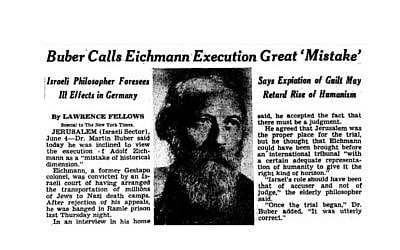
Image: Headlines of the June 5, 1962 New York Times article about Martin Buber’s objections to the execution of Nazi perpetrator Adolph Eichmann.
In the shadow of the Holocaust, many death penalty debates in Jewish circles eventually arrive at the question: “But what about Nuremberg and Eichmann?” The thousands of members of L’chaim often encounter individuals who cite these two cases as evidence that there are indeed times when the death penalty is an appropriate response to monstrous actions. Now, as National Security Minister Itamar Ben-Gvir’s death penalty bill for convicted terrorists makes its rounds in the Knesset, many conversations throughout Israel and the Jewish world conjure these potent memories. Death penalty debates for perpetrators of the October 7, 2023, massacre – the deadliest attack on the Jewish people since the Holocaust – naturally strike this nerve, triggering individual, collective, and intergenerational trauma.
The heated dialogue between death penalty bill proponents and detractors usually begins with supporters parroting the debunked myth of deterrence – that killing captured Hamas terrorists will save Israeli lives. This, of course, is patently false. Opponents of the bill respond to this lie by citing one of the manifold studies that proliferate disproving the deterrence fallacy, adding that executing convicted terrorists would only create more shaheeds (“martyrs”) among Israel’s enemies. Death penalty advocates often brush aside these facts. There are, however, those who can acknowledge this reality. Those individuals inevitably then pose the fateful question above about Nuremberg and Eichmann.
“Nuremberg” refers to the main Nuremberg Trial (International Military Tribunal), where death sentences led to the hangings of 10 high-ranking Nazis on October 16, 1946, with another scheduled (Hermann Göring) committing suicide. While the court sentenced 12 to death in total, Göring avoided execution, and the tribunal tried Martin Bormann in absentia, enabling him to escape hanging. The second popular reference is to Israel’s 1962 hanging of Nazi officer Otto Adolf Eichmann for his role as one of the primary architects of the Final Solution. Hannah Arendt covered Eichmann’s trial, during which she famously employed the term “the banality of evil” to describe Eichmann. (Of note, Israel also passed a death sentence in 1988 against former Nazi concentration camp guard John Demjanjuk, but its Supreme Court overturned it in 1993. Proponents of Israel’s death penalty bill today attempt to justify their position by equating perpetrators of the October 7, 2023, massacre with Eichmann and the Nazi mass murderers sentenced to death at Nuremberg. If we could rationalize it for the Third Reich, they argue, surely we can do so for Hamas terrorists, as well. The implication is that such “evil” demands execution, and – perhaps more on point – that there are instances when revenge through state killing is entirely appropriate.
For many L’chaim members, this argument strikes a chord. Indeed, it is the very example of the Holocaust that undergirds much of the L’chaim members’ passion for death penalty abolition. I personally know how difficult it is to transcend the overwhelming longing for violent retaliation. I grew up as an ardent supporter of the death penalty, gripped in the spell of the same vengeful bloodlust that has plagued so many of my species. I therefore strive never to judge others who harbor such feelings, especially not when horrific antisemitic acts of terror, such as the mass murder and violence of October 7th, have victimized them. Alongside my experiences as a Jewish prison chaplain, my discovery of the indisputable Nazi legacies of various execution methods helped solidify my Holocaust-informed opposition to the death penalty.
Nazi Execution Methods and Legacies
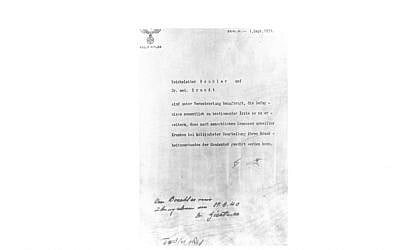
Image: Adolf Hitler’s authorization for the euthanasia program (Aktion/Operation T4) was signed in October 1939, but dated September 1, 1939. The Nazis were the first to implement lethal injection, . (National Archives and Records Administration, College Park, MD, public domain)
Many rightfully condemn the brutal, murderous actions of the October 7th terrorists to the Nazi atrocities of the Shoah. Paradoxically, upon closer examination of execution methods, it is precisely the legacy and shadow of the Holocaust that punctuates the need to oppose the death penalty. Lethal injection – the primary form of execution used in the US – is a direct Nazi legacy. The Third Reich first implemented this execution method as part of their infamous Aktion T4 protocol, using lethal injection to kill people deemed “unworthy of life.” Adolf Hitler’s personal physician, Dr. Karl Brandt, developed that protocol. It is an unconscionable Nazi legacy.
Similarly, the use of firing squads for executions inescapably evokes the widespread Nazi use of the same abomination during the Shoah to murder countless Jews and others. Finally, the existential horror that millions of Holocaust descendants experience when hearing about the gassing to death of prisoners with gas masks and gas chambers, including the notion of using Zyklon B, of Auschwitz infamy, requires no explanation. The members of Louisiana’s Jews Against Gassing Coalition know this all too well. The fact that the proposed bill in the Knesset postulates hanging, as well, changes nothing about the incalculable collective trauma that the spectre of state-sponsored killings evokes for so many Holocaust victims and descendants.
Elie Wiesel: “Death should never be the answer in a civilized society.”
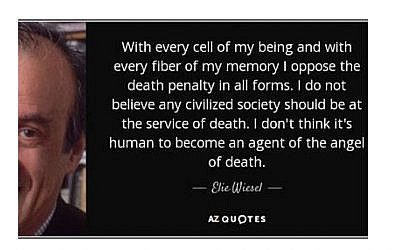
Image: Acclaimed Nobel laureate, human rights activist, Holocaust survivor, and author Dr. Elie Wiesel’s quote about capital punishment. (No copyright.)
There is a long list of celebrated Jewish death penalty abolitionists who recognized this direct connection to the Shoah. Foremost among them perhaps is Holocaust survivor and Nobel laureate Elie Wiesel (1928-2016), who viscerally grasped the danger of giving the state the power to kill its prisoners long before I was born. Wiesel would no doubt reiterate his famous, aforementioned statement about capital punishment if he were alive today and asked about Israel’s proposed death penalty bill for convicted terrorists on Holocaust Remembrance Day. That quote best encapsulated his inflamed opposition to the death penalty in all forms. It is a torch that L’chaim members carry in our hearts and souls. Wiesel’s comment is a simple phrase that should echo throughout the collective consciousness of all humanity, and in the hearts and souls of all Israelis now as their nation considers enacting this abhorrent, medieval act. Wiesel’s words should serve as a mantra for our world when anyone – including Israel – raises the barbaric scepter of a return to capital punishment.
Wiesel expounded upon the subject of the death penalty for a 1989 recording he made with other death penalty abolitionists entitled Lighting the Torch of Conscience, in which he stated the following:
“Death should be opposed, not served. I have seen too much death in my life. I have met too many people who served death in my life…
There is no reason in the world why death should be imposed by people of good will, of intelligence, of kindness – people in the name of justice – on other people. Those who sinned – those who committed crimes – can be punished in other ways, but not with death. When we impose death on others, we are doing something to ourselves…
With every cell of my being and with every fiber of my memory, I oppose the death penalty in all forms…
I belong to a tradition – a Jewish tradition – that says that when a Sanhedrin in ancient times pronounced one death sentence in its entire tenure, that Sanhedrin – that Supreme Court – was called murderous.”
It is not difficult to discern from Wiesel’s stated position how he would respond to the notion that the modern Israeli government might execute not one, but potentially hundreds of convicted terrorists.
Some critics have argued that Wiesel was on record stating, as late as 1989, that he made an exception for convicted Nazis like Adolph Eichmann. Like Wiesel, I, too, once supported the death penalty for those who murdered my family members in the Holocaust. Just as my mind shifted on this point, so, it seems, did Wiesel’s by the end of his life. A public statement that Wiesel made six years before his death reflects this apparent change of heart.
As late as Oct. 27, 2010, Wiesel spoke out against the death penalty during a lecture on capital punishment at Wesleyan University in Connecticut. Earlier that day at a press conference, he was asked about his feelings on the possible execution of the perpetrators of a horrific home invasion that had taken place in nearby Cheshire, CT, in 2007. As a Connective native myself, I shall never forget that case, which all the local news stations carried at the time. On July 23, 2007, Linda Hayes (born Steven Hayes) and Joshua Komisarjevsky invaded the residence of the Petit family in the small town of Cheshire. Though initially planning only to rob the house, Hayes and Komisarjevsky horrifically raped, attacked, and murdered Jennifer Hawke-Petit and her two daughters, 17-year-old Hayley Petit and 11-year-old Michaela Petit. They mercilessly burned young Hayley and Michaela alive. Their father, Dr. William Petit, escaped with severe injuries. The Hartford Courant cited this case as “possibly the most widely publicized crime in the state’s history.”
When asked for his opinion on the death penalty for the perpetrators, Wiesel focused his remarks on people like Dr. Petit and himself, both of whom were family members of murder victims. (Wiesel lost both parents and a sister in the Nazi death camps.) He indicated that society should punish such murderers more harshly than other prisoners and encouraged the criminal justice system to focus efforts on the survivors of violent crimes “so that families will not feel cheated by the law.” “But,” he said, “death is not the answer.” He emphasized that he might change his stance if the death penalty could bring back victims, which, of course, it could not. “I know the pain of those who survive,” Wiesel said. “Believe me, I know… Your wound is open. It will remain. You are mourning, and how can I not feel the pain of your mourning? But death is not the answer. He concluded: “Death should never be the answer in a civilized society.”
Wiesel’s words are a clarion call. They reveal that by the end of his life, he likely would have joined the pantheon of Jewish and non-Jewish human rights luminaries who fully aligned with death penalty abolition, and the massive scale of rabbinic and Jewish voices standing against Israel’s bill now.
Principles Over Vengeance: The Inspiring Example of Robert Badinter
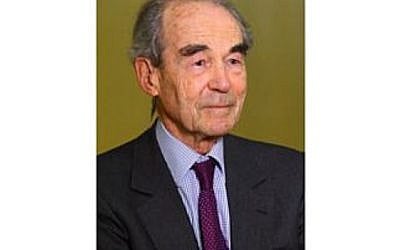 Image: French Minister of Justice Robert Badinter (1928-2024) in 2013 (Wikipedia)
Members of L’chaim and I continue to be galvanized by lofty examples of Jewish death penalty abolitionists who rose from the embers of the Holocaust, as we chant “Never Again!” to state-sponsored murder. One such eminent figure who rightfully received global attention upon his passing in 2024 was the former French Minister of Justice, Robert Badinter, of blessed memory. The Holocaust experience of Badinter’s family was punctuated by the unfathomable murder of his father, Simon Badinter, in the Sobibor concentration camp in 1943. Emboldened by this killing and the lessons of the unparalleled conflagration of the Shoah, Badinter went on in his illustrious legal and political career to successfully advocate for the ultimate abolition of the death penalty in France in 1981. A tribute celebrating his accomplishments poignantly described that when Badinter confronted Klaus Barbie, the Nazi who had arrested and sent his father to his death, he proudly “stood by his opposition to the death penalty and did not wish nor seek to have his father’s killer executed. He thereby demonstrated a rare willingness to place principle over the powerful personal desire to avenge the brutal death of a beloved parent.” Badinter’s laudable attitude was reminiscent of the late Eva Mozes Kor, founder of the Candles Holocaust Museum in Terre Haute, Indiana, and a champion of Holocaust education and the power of forgiveness.
Like Badinter, Kor, and countless family members of murder victims, I, too, have managed in my own way over time to overcome the bloodlust that had been growing like a cancer within me since before my birth. As a result, I firmly believe that others can do the same. People are capable of change, including those who have vengeance deeply rooted in their hearts, as I once did. As the Knesset decides the fate of convicted October 7th terrorists, the time is now for Israelis and Jews everywhere to unveil the trauma-laden, insidious revenge impulse that drives this death penalty bill, releasing it at last from behind its mask of false notions of deterrence. Only then will the cycle of violence and killing truly have a chance at ending. Only then can true restorative justice and reconciliation begin.
An Affront to Holocaust Memory and to the Human Right of Life
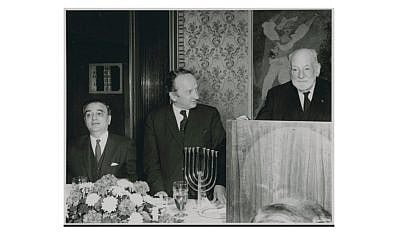 Image: Monsieur René Cassin (1887-1976), pictured on the far right, speaks at a Hanukkah gathering. Cassin was a French jurist and activist, a Sephardic Jew and a staunch supporter of Israel, who helped draft the right to life, as outlined in Article 3 of the Universal Declaration of Human Rights, adopted by the UN in 1948. No copyright. Source: https://open.substack.com/pub/davidaaronovitch/p/israelis-versus-the-jim-crow-zionists
Robert Badinter, Elie Wiesel, and other countless other Jewish abolitionists in the wake of the Shoah would stridently oppose the bill before the Knesset now to execute the perpetrators of the October 7th, 2023, massacre, or any convicted terrorist – Jewish or otherwise. They came to realize that any nation that opens Pandora’s Box by dealing with the man-made “Angel of Death” that is capital punishment has crossed the Rubicon beyond the bounds of civilized humanity. They knew that when this happens, all bets are off for what nightmares may come. They would no doubt lament how far the world still has to go in its sacred mission of global abolition.
These human rights luminaries would join fellow Holocaust-era Jew and co-drafter of the Universal Declaration of Human Rights, René Cassin, in determining that the death penalty is one of the most egregious violations of the human right to life itself. It is an assault on each of their memories that the Israeli Knesset is even considering this bill on this Holocaust Remembrance Day. As Rabbi Yitz Greenberg, Rabbi Bruce D. Forman, and countless other rabbis and others have indicated, in this liminal moment in the spiritual evolution of Israel – and indeed of all human civilization – Israeli citizens must heed Wiesel’s prophetic words. They must not neglect their responsibility to work to slam the door on the Angel of Death by calling upon their members of the Knesset to vote “no” to the proposed death penalty bill, and “yes” to civilized humanity, once and for all.
Cantor Michael J. Zoosman, MSM, BCC
Co-Founder: L’chaim! Jews Against the Death Penalty
Advisory Committee Member: Death Penalty Action
Related Topics
Related Posts