
What’s in Hungary’s National Museum Storage?
A Holocaust Art Recovery Initiative (HARI) Report on Wartime Museum Records, Unrestituted Cultural Property, and the Call for Full Transparency at Budapest’s OMRRK
Introduction
On the surface, it is one of Europe’s most advanced museum facilities — an award-winning complex designed to preserve and protect Hungary’s cultural treasures. But for those who have studied the 1944 records of state-orchestrated seizures from Jewish families, it raises a different question: what else might be in its care, and why is the public not allowed to know?
Budapest’s National Museum Conservation and Storage Centre — in Hungarian, Országos Múzeumi Restaurálási és Raktározási Központ (OMRRK) — opened in 2019 at Szabolcs utca 33–35. Built on the grounds of the former Szabolcs Street Hospital, it is part of the high-profile Liget Budapest Project. The facility covers roughly 37,000 square meters, with four underground and three above-ground levels. It was engineered to modern conservation standards: environmental zoning for different materials, climate-controlled storage vaults, conservation and restoration laboratories, photography studios, and high-security “visible storage” spaces.
Its capacity is estimated at 350,000 objects, serving as the centralized storage and conservation hub for three major institutions: the Museum of Ethnography, the Museum of Fine Arts, and the Hungarian National Gallery. It also houses the Central European Art History Research Institute (KEMKI). The centre has earned architectural and environmental awards for its design and sustainability.
These are the official facts. The question is what has not been disclosed — and why that matters in light of wartime documentation now translated and made public.
The Paper Trail from 1944
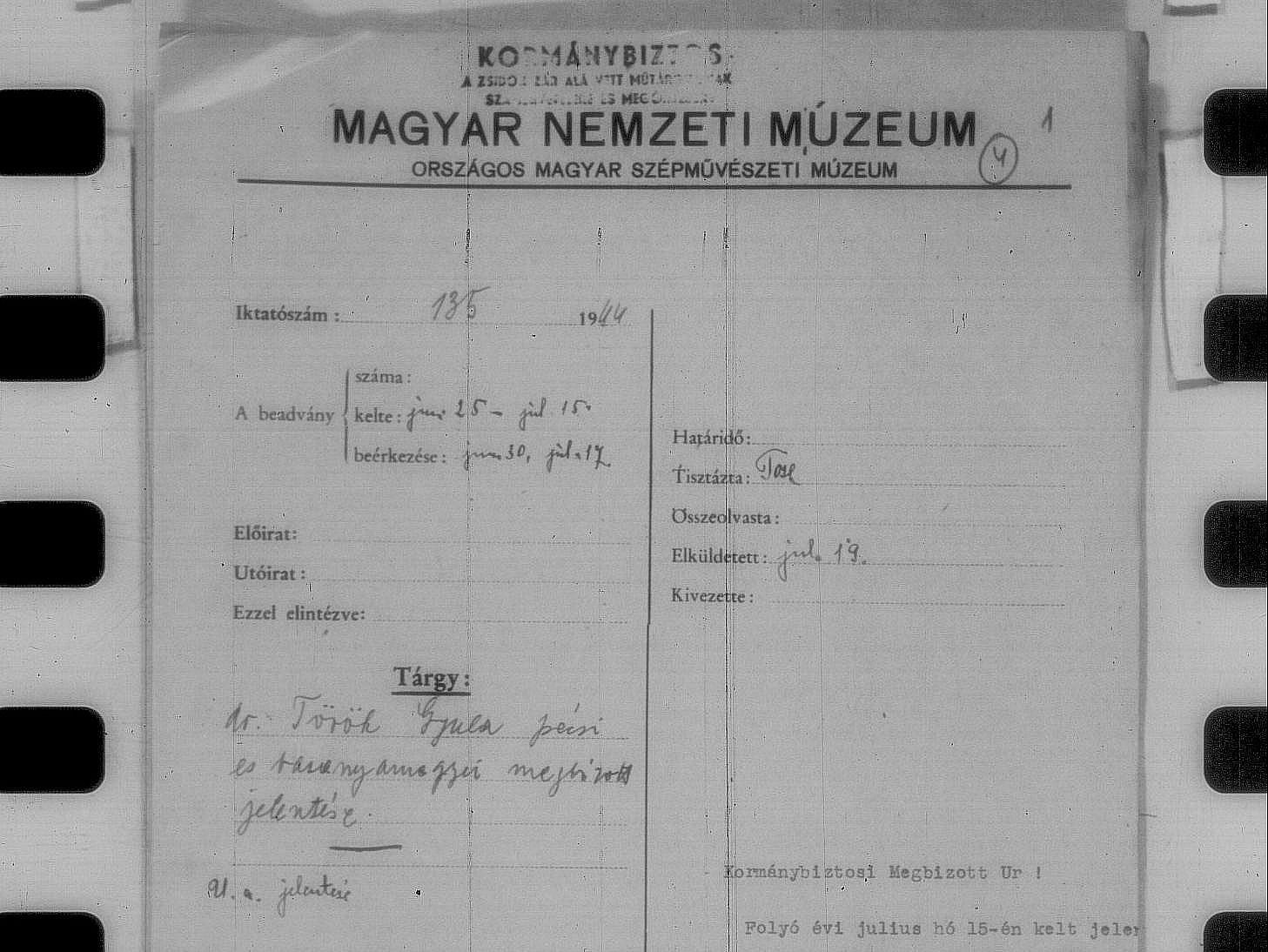
Hungarian government microfilm archives — specifically Reels 143–145 — contain detailed 1944 inventories naming Jewish owners, identifying artworks, and recording the institutions that received them. These were not random seizures; they were coordinated transfers routed through a national network of museums, galleries, UNESCO heritage sites, universities, and libraries.
Many of the institutions named in those records are part of the ecosystem OMRRK now serves. This does not prove that objects from those seizures are physically inside the Szabolcs Street facility today. But it does establish a clear historical link between OMRRK’s client museums and the wartime receiving network. That link demands transparency.
Hungary’s Commitments to Restitution and Museum Ethics
Hungary is a signatory to — or has endorsed in principle — multiple international frameworks that speak directly to the responsibilities of cultural institutions holding material with contested ownership histories:
-
Washington Conference Principles on Nazi-Confiscated Art (1998) — urging nations to identify such art, make public relevant records, and achieve “just and fair solutions” for restitution.
-
Terezin Declaration (2009) — committing to open archives, identify looted art, and resolve claims fairly and expeditiously.
-
International Council of Museums (ICOM) Code of Ethics — requiring museums to establish the full provenance of items in their care, particularly those with incomplete ownership history between 1933 and 1945, and to act on findings in a transparent, accountable manner.
OMRRK’s position as the central repository for national collections gives it — and its client institutions — an even greater obligation to meet these standards in full view of the public.
What Transparency Should Look Like
HARI calls on OMRRK and its client museums to take the following steps without delay:
-
Publish a complete, searchable wartime-provenance inventory
List every object in OMRRK storage with a 1933–1950 provenance gap or evidence of state seizure. Include object ID, description, prior owner (if known), seizure record reference, and current custodial institution. -
Identify the chain of custody
For each flagged object, disclose the intake source, departmental handling, and any reclassification as “abandoned,” “safekept,” or “state property” in post-war decades. -
Prioritize restitution
Where ownership is clearly documented, open immediate restitution discussions with heirs or their representatives. Where no heirs can be identified, place the object in a public-domain trust with permanent labeling acknowledging the victim family and the seizure record. -
Enable independent oversight
Grant access to an external panel of provenance scholars, archivists, legal experts, and survivor-community representatives, with authority to examine storage lists, movement logs, and object files. -
Report annually
Publish data on newly identified suspect items, audits completed, restitutions achieved, claims in process, and reasons for any denials.
Why Disclosure is in Hungary’s Interest
-
Legal and Ethical Alignment — Meeting the Washington Principles, Terezin Declaration, and ICOM Code of Ethics is not only a moral duty; it also reduces legal exposure by addressing issues proactively.
-
Reputation — International recognition for design and sustainability should be matched by recognition for moral leadership in restitution.
-
Scholarship — KEMKI’s mission of advancing Central European art history is strengthened, not weakened, by making provenance data public.
-
Security — Transparent inventories and photographic documentation make illicit removal harder, not easier.
-
Human Truth — The 1944 records are not abstract lists. They name people, homes, and lives. Public institutions should not hold those stories in silence.
What Is Known — and What Must Be Clarified
HARI’s published translations show the breadth of the 1944 receiving network. The public still does not know whether any of those items — or related records — are now housed at Szabolcs Street.
OMRRK has benefited from substantial national investment and European recognition. Its client institutions participate in EU-funded research projects and international museum networks. Yet none has publicly addressed how the 1944 seizure records intersect with their current holdings.
This silence leaves open essential questions:
-
Are any objects with 1933–1950 provenance gaps, identified in wartime records, in OMRRK storage?
-
Are relevant wartime object files, accession cards, or transfer ledgers stored there?
-
If so, why have they not been inventoried and published?
The public — in Hungary and internationally — has a right to know.
Conclusion
The OMRRK was built to be a state-of-the-art solution for Hungary’s public collections. It can also be a state-of-the-art solution for confronting Hungary’s unfinished past.
We call on OMRRK and its client institutions to open their ledgers, release full wartime provenance data, and act on it. The technology, the expertise, and the ethical frameworks already exist. What is required now is the will.
Let the records speak. Let the families, finally, be heard.
Endnotes
-
Liget Budapest Project, official project description of the OMRRK.
-
PestBuda.hu, coverage of the opening and specifications of the OMRRK.
-
Holocaust Art Recovery Initiative, translated extracts from Hungarian microfilm Reels 143–145, 2025.
-
Washington Conference Principles on Nazi-Confiscated Art, U.S. Department of State, 1998.
-
Terezin Declaration on Holocaust Era Assets and Related Issues, Prague Holocaust Era Assets Conference, 2009.
-
International Council of Museums (ICOM) Code of Ethics for Museums, 2017.
-
Architectural and sustainability awards announcements for the OMRRK, 2019–2021.
-
European Commission project listings for Hungarian National Museum and affiliated institutions.