
Teachers and Students Helped Seize Jewish Art
Teachers, Students, and the Machinery of Cultural Seizure in Hungary (1944)
A Holocaust Art Recovery Initiative (HARI) Report
Introduction
In the summer of 1944, as deportation trains rolled east, Hungarian classrooms stood empty. The state filled them — not with children, but with the confiscated books, paintings, and possessions of their Jewish neighbors. Secondary-school teachers — and, in several districts, their students — were officially tasked and paid to inventory, sort, and redistribute this cultural property.
This wasn’t local improvisation. It flowed from a national ministry order, executed through regional school directorates, and coordinated with museum and finance authorities. The record obliges a response not only from museums, but from education ministries, school districts, and municipal libraries.
1) What the records show (specific examples)
A nationwide order to mobilize teachers
June 12, 1944: The Ministry of Religion & Public Education authorizes state-employed secondary-school teachers on summer leave to perform the “inventory and safeguarding of Jewish cultural property,” for pay. Circular signed by Dr. Ékes Kálmán; distributed to regional superintendents and the Government Commissioner for Jewish Property. *This made educator deployment national policy.*¹
Reel 143, Slide 711 (pictured below): June 12, 1944: Ministry of Religion and Public Education directive, signed by Dr. Ékes Kálmán, orders that state-employed secondary-school teachers on summer leave be assigned to the “inventory and safeguarding of Jewish cultural property,” for pay. This nationwide order formalized educator involvement in the seizure process.
Regional plans that include “student youth”
Kassa (Košice): Chief educational inspector vitéz Ujváry Lajos drafts a multi-page plan to classify Jewish books, paintings, and household art. He proposes field teams of “high-school teachers and the student youth (tanulóifjúság)” during the summer recess, with ideological and language filters and redistribution of “acceptable” works to schools and youth libraries.²
Implementation in the field, by town
-
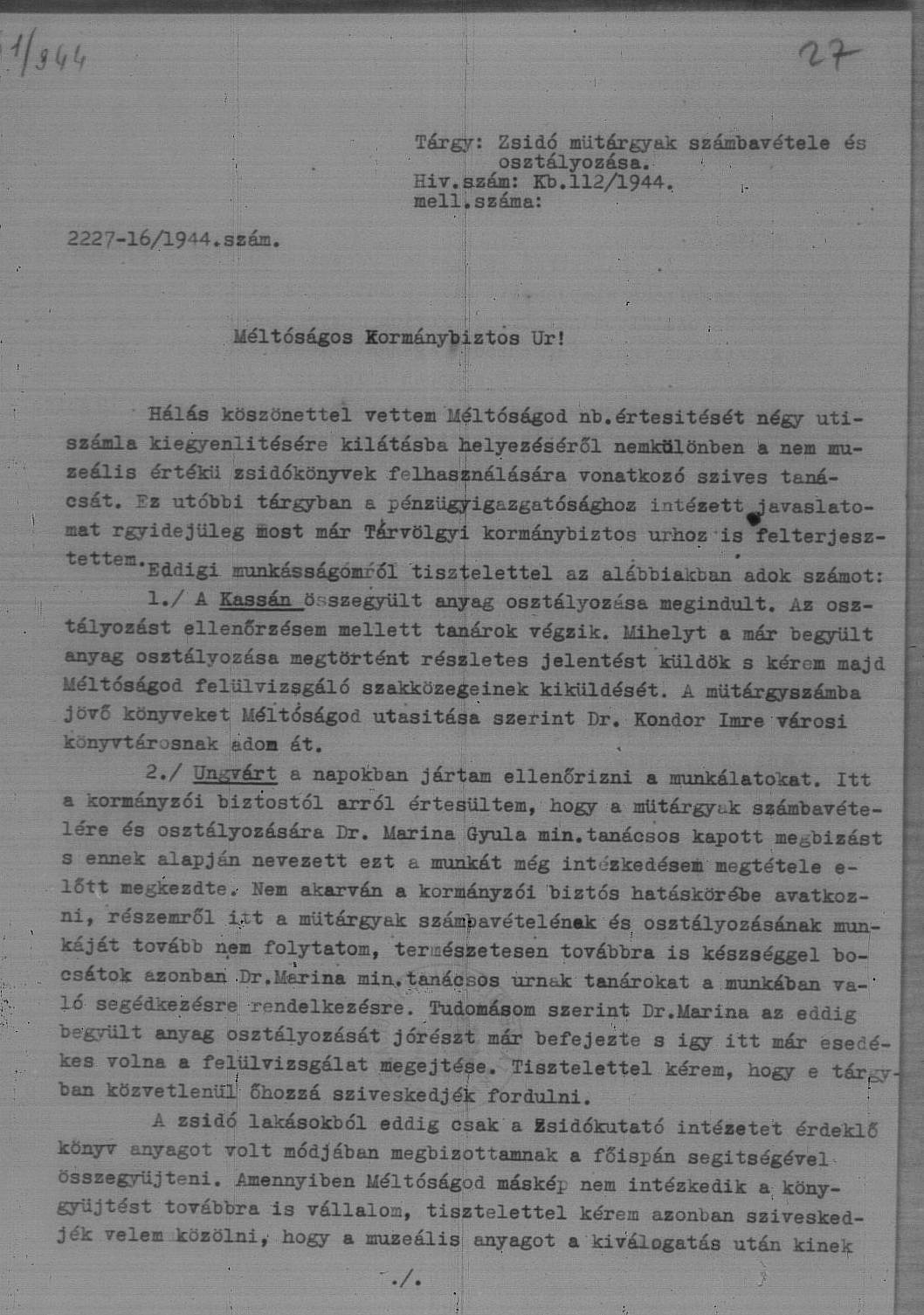
Kassa city: Teachers are already conducting classification; processed Jewish book stock is to be handed over to the city library under Dr. Kondor Imre per the commissioner’s instructions.³
-
Ungvár (Uzhhorod): Dr. Marina Gyula began classification (without formal appointment), then continued with teacher assistance; most work completed by early July; recommended for official review.⁴
-
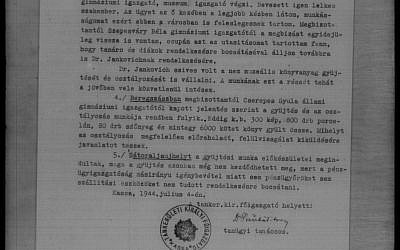
Munkács (Mukachevo): Dr. Jankovich József, gymnasium director and museum director, is managing the collection and classification of both books and art, with teachers and students made available to him.⁵
-
Beregszász (Berehove): Cserépes Gyula, state high-school principal, reports ~300 artworks, ~80 rugs, and ~6,000 books collected; classification proceeding according to instructions.⁶
-
Sátoraljaújhely: Preparations are in place, but work delayed by funding and transport shortages — evidence of scale straining logistics.⁷
Teachers as paid, traveling seizure staff
Teacher-agents receive travel reimbursements and support for classification/sorting trips (e.g., Vörös István), confirming paid, policy-backed labor rather than ad hoc volunteering.⁸
Libraries and academics in the chain
-
Sopron: Municipal librarian Rádi István files inventories of books seized from Jewish homes and seeks permission to retain selected volumes for the city library.⁹
-
Eger: The local commissioner requests the immediate dispatch of a museum expert/university professor to sort high-value cultural objects — an academic pressed into service for the regime’s cultural triage.¹⁰
A category system that fed education
Sorting rules specify subject and language groupings, excluding works by Jewish authors or marked as ideologically “undesirable,” while routing Hungarian-language textbooks to schools and “youth literature” to educational channels. *Seized Jewish learning was folded directly into the public education network.*¹¹
Museum pushback — but policy remains
The National Museum (Commissioner’s office) warns middle-school teachers should not handle museum-quality fine art, insisting trained experts do that work. But this does not rescind the ministry’s nationwide teacher-deployment order; educators remain mobilized for mass classification and redistribution of books and non-museum objects.¹²
2) Why this matters
Institutional complicity beyond museums. The education system — ministry, regional directorates, gymnasia, teachers, and students — was embedded in the seizure pipeline. The beneficiaries were public schools and libraries, not only art museums.
Education as an endpoint. The category system intentionally channeled textbooks, science, and youth literature into classrooms and youth libraries, erasing provenance and appropriating Jewish knowledge for state use.
Scale and normalization. Drafting students during the summer recess shows both the volume of material and the effort to normalize participation in cultural plunder as civic work.
A broader chain of custody. The same summer saw centralized storage requisitions in Budapest (e.g., Andrássy út 93 for Jewish cultural property under the commissioner), indicating a national funnel from provincial classification to capital storage.¹³
3) International legal and ethical context
These acts predate, but plainly offend, principles now embedded in international norms:
-
Hague Convention (1907), Art. 56: Forbids seizure/destruction of institutions dedicated to education and the arts.
-
Hague Convention for the Protection of Cultural Property (1954): Reinforces protection of cultural property and opposes institutional appropriation during conflict.
-
UNESCO 1970 Convention: Obligates states to prevent illicit appropriation and facilitate return of unlawfully acquired cultural property.
-
Washington Conference Principles (1998): Require identification, publication, and “just and fair” solutions for Nazi-era property.
-
Terezín Declaration (2009): Commits to open archives, identify looted property, and resolve claims expeditiously.
-
ICOM Code of Ethics: Requires provenance research and action for items with 1933–1945 ownership gaps.
Given the record, Hungary’s obligations extend beyond museums to education authorities and public libraries that materially benefited from this program.
4) What HARI is demanding now
-
Publish a consolidated, searchable list of all items in museums, municipal/school libraries, and education repositories with 1933–1950 provenance gaps, including chain-of-custody entries (collector → commissioner/police → local sorting → central storage).
-
Open the education archives: wartime personnel orders assigning teachers/students; reimbursement ledgers; accession/shelf lists in city and school libraries; transfer receipts to and from commissioner offices.
-
Create claim-ready files (accession cards, movement logs, condition photos, commissioner orders, post-war relabeling decisions).
-
Independent audit panel (provenance scholars, archivists, jurists, survivor-community representatives) with on-site access to museum and education-sector object files.
-
Quarterly public reports listing newly identified items, restitutions, claims pending, and denials with reasons.
5) Why it belongs in the historical record
If this dimension is not named, Holocaust-era cultural plunder is misremembered as the work of a narrow professional cadre. The documents show classrooms, libraries, teachers, and students were enlisted to turn private Jewish culture into state stock. Recording that breadth is essential for truth, education, and restitution.
Endnotes:
-
Ministry of Religion & Public Education circular, 12 June 1944, Reel 143, Slide 711.
-
Kassa (Košice) regional plan by vitéz Ujváry Lajos, Reel 143, Slides 705–710.
-
Kassa city classification under teachers; processed books to city library (Dr. Kondor Imre), Reel 143, Slides 705–710.
-
Ungvár: Dr. Marina Gyula with teacher assistance, Reel 143, Slides 705–710.
-
Munkács: Dr. Jankovich József with teachers and students, Reel 143, Slide 710.
-
Beregszász: seizure totals (~300 artworks, ~80 rugs, ~6,000 books), Reel 143, Slide 710.
-
Sátoraljaújhely: work delayed by finance/transport shortages, Reel 143, Slide 710.
-
Teacher-agent Vörös István travel reimbursement, Reel 143, Slides 705–710.
-
Sopron: Rádi István inventories and retention request, Reel 143, municipal correspondence (June–July 1944).
-
Eger: commissioner request for museum/university expert, Reel 143, regional correspondence (June–July 1944).
-
Category instructions routing textbooks/youth literature into education, Reel 143, Slides 705–710.
-
National Museum caution on teachers handling fine art, Reel 143, Slides 705–710.
-
Central storage requisition in Budapest (“Andrássy út 93”), Reel 143, early July 1944.