By Force and Under Guard: Hungary’s 1944 Art Theft
Armed Escorts, Requisitioned Convoys, Regional Hubs, and Complicit Banks: How Hungary’s Wartime Machinery Stripped Jewish Citizens of Art, Heirlooms, and Financial Assets
Introduction
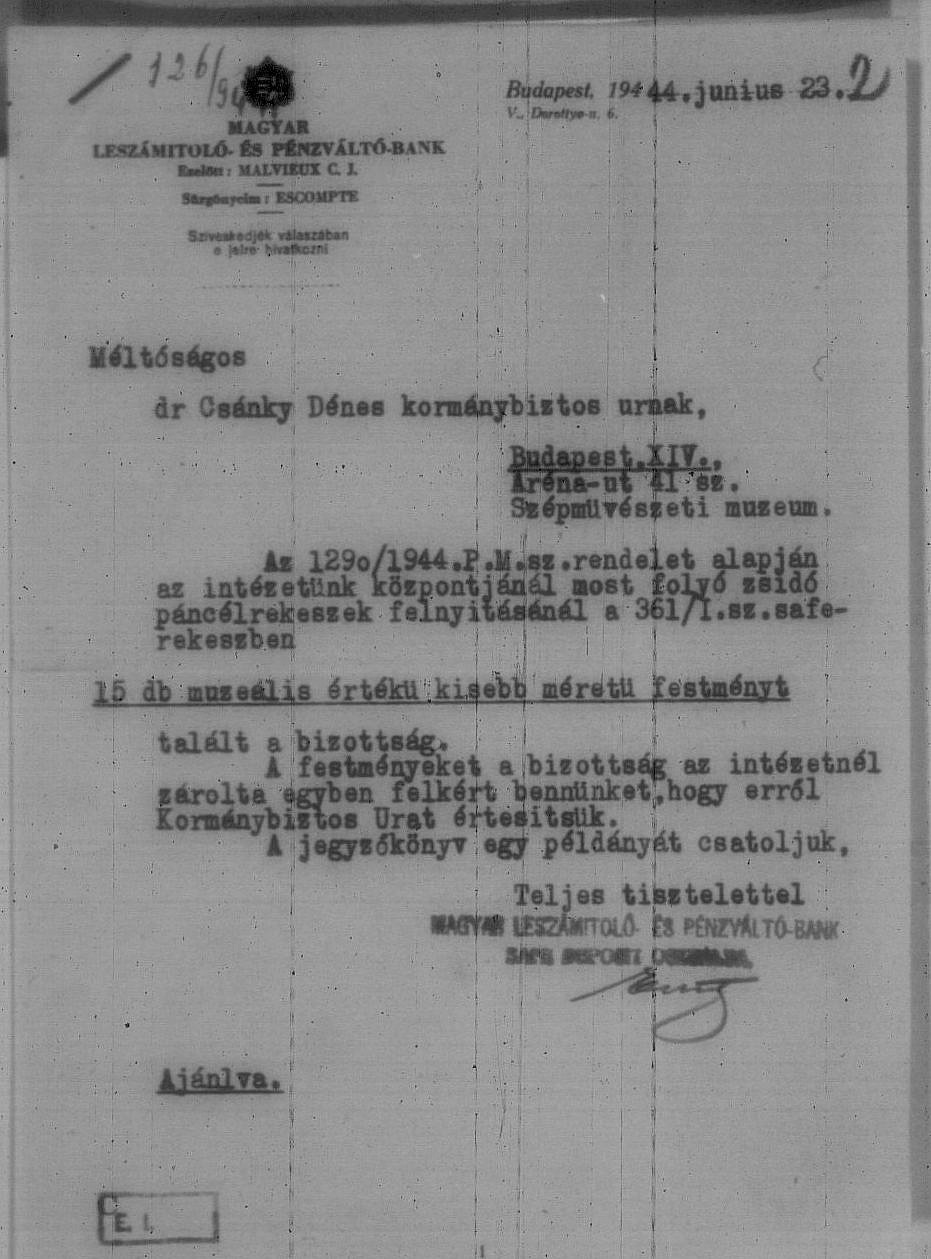
On June 23, 1944, a Hungarian bank wrote to the government’s commissioner for seized Jewish art, reporting that it had “found” fifteen museum-quality paintings in a Jewish client’s safe-deposit box. The bank placed the paintings under official custody, citing the anti-Jewish seizure decrees then in force.
That letter is one of hundreds preserved on Hungarian wartime microfilm (Reels 143–145) that expose the depth and organization of the plunder. These were not isolated thefts. They were part of a coordinated system in which museums, ministries, banks, police, and the military acted together to confiscate and redistribute Jewish cultural and financial property.
I. Armed Force and Legal Coercion
Police and gendarmerie escorts
Records repeatedly order “rendőri kíséret” (police escort) or armed gendarmerie to accompany the removal of valuables from Jewish homes, banks, and storage sites. Officers carried rifles or sidearms and had arrest authority for any interference.
Threats of prosecution
Owners—when still present—were served notices citing ministerial decrees that declared the property “under state protection.” Resistance or concealment was described as punishable by civil or criminal action, with some orders explicitly warning of jail.
Special removal crews
Under the Ministry of Religion and Public Education, specialized “art removers” were tasked with packing, crating, and moving confiscated cultural property. They worked in tandem with finance ministry appraisers and police, creating a paper trail from seizure to storage.
Guarded storerooms
Looted objects were held under armed guard at museums, municipal depots, castles, and abbeys until formally inventoried and redistributed.
Reel 143, Slides 60–80; Reel 145, Slides 380–400.
II. Transportation Logistics
Motor convoys
Municipal offices requisitioned trucks, often in groups, with separate vehicles for paintings, books, silver, and furniture. Records list license plates, drivers, and destinations.
Rail shipments
Freight cars under seal moved crated cultural property from regional hubs to Budapest or other designated repositories, often immediately after ghettoization of local Jews.
Armed guards on the move
One directive orders police protection for trucks carrying art from provincial towns to Budapest, with named officers assigned.
Cross-border transfers
Late 1944 notes hint at shipments toward Austria and Germany—possibly via rail-to-barge along the Danube—as Axis forces attempted to secure high-value loot from advancing Soviet troops.
Reel 143, Slides 80–100; Reel 145, Slides 380–420.
III. The Geography of Plunder
Győr (Győr–Moson–Pozsony)
Government commissioner Dr. Ferenc Jenei oversaw sealing Jewish homes, inventorying contents, and storing valuables in the Bishop’s Palace and Pannonhalma Abbey before routing to Budapest.
Székesfehérvár (Fejér)
Mid-June 1944 inventories recorded paintings, sculpture, porcelain, and textiles from Jewish homes, with “museum-worthy” items held locally and others reassigned.
Békéscsaba (Békés)
Commissioner Mokos József, also a museum artist, seized county-wide cultural assets, including the Kner family library, for municipal museum custody.
Baja (Bácska/Bács-Bodrog)
Address-linked seizures in summer 1944 documented paintings, porcelain, silver, and furniture from Jewish homes, signed by local officials.
Hatvan (Heves)
Decree-based confiscations listed porcelain, clocks, glassware, and gilded items under municipal/treasury oversight.
Budapest (District V: Szabadság tér 15)
Multiple Jewish residences in one building targeted; inventories routed to the Hungarian National Museum with signatures from commissioner Dr. Dénes Csánky, museum staff, security police, and finance appraisers.
Budapest (District VI: Andrássy út 93—Herzog Palace)
Seizure of the Herzog family’s palace and collection, with transfers to the Museum of Fine Arts.
Kolozsvár/Cluj (Northern Transylvania)
The Transylvanian Museum Association sought to keep seized collections locally rather than send them to Budapest, revealing internal competition over loot.
Reel 143, Slides 300–320; Reel 144, Slides 110–140; Reel 145, Slides 530–560.
IV. Institutional Complicity
Museums
The “Institutional Complicity List” names more than 20 designated recipients, including, but not limited to:
-
Balaton Museum (Keszthely) – Chinese porcelain, paintings, archaeological artifacts.
-
Déri Museum (Debrecen) – Fine art, ethnographic materials.
-
Baja City Museum – Paintings, decorative arts.
-
Szeged Museums – Paintings, furniture, Judaica.
-
Győr Municipal Museum – Paintings from private Jewish collections.
Ecclesiastical sites
Bishop’s Palace in Győr and Pannonhalma Abbey were documented storage points for seized art and valuables.
Reel 143, Slides 4–20.
V. Banks as Active Partners
Magyar Leszámítoló és Pénzváltó Bank
June 23, 1944: Reported 15 museum-quality paintings from safe-deposit box no. 361/1, placed under official custody for Dr. Dénes Csánky.
Magyar Általános Hitelbank (Hungarian General Credit Bank)
Reels record openings of Jewish safe-deposit boxes, inventories of gold coins, jewelry, silverware, securities, and personal heirlooms, and transfers to state custody.
Other named banks
Records show similar actions by the Hungarian Discount and Exchange Bank and regional savings banks, acting under commissioner orders.
Bank vaults as art storage
Some paintings were stored temporarily in bank vaults pending pickup by government-approved transport teams for museum transfer.
Staff cooperation
Bank personnel identified Jewish account holders, cross-referenced ghetto lists, and facilitated access to vaults, speeding the confiscation process.
Reel 145, Slides 400–420.
VI. Select Case Studies
Baroness Hatvany Deutsch Károlyné
Budapest, Lánchíd Street, October 17, 1944. Private library including rare art monographs, museum catalogues, classical works, Encyclopaedia Britannica (11th ed.). Transferred to the Museum of Fine Arts.
Herzog Family
Andrássy út 93, Budapest. Palace and collection seized; paintings transferred to the Museum of Fine Arts.
Fleissig József
Antiquities and numismatics case managed by the Hungarian National Museum; part at home, part on deposit at Magyar Bank.
Kornfeld Móric
Paintings, sculptures, books, and religious artifacts transferred to the Museum of Fine Arts.
Strauss Pál
Five paintings, including a Peter Paul Rubens, seized for the Museum of Fine Arts.
Conclusion
The 1944 Hungarian plunder was a national program: armed police and gendarmes enforcing decrees; trucks, trains, and sealed convoys moving property; regional hubs cataloguing loot; museums, abbeys, and banks holding it; and high officials signing every stage.
The microfilm records are not just relics — they are a to-do list for restitution. They name the officials, the institutions, the victims, and the objects. Every museum, bank, archive, and ecclesiastical body still holding these assets has unfinished business. Justice will only be complete when those ledgers are open, the provenance is public, and the property is returned or its history fully acknowledged.
Endnotes:
(Archival citations use reel ranges to capture complete sequences and serve as general markers)
-
Reel 143, Slides 60–80; Reel 145, Slides 380–400 – Armed/military escort orders.
-
Reel 143, Slides 66–80 – “Art remover” and packing crew assignments.
-
Reel 143, Slides 4–20 – Guarded storerooms and institutional custody.
-
Reel 143, Slides 80–100; Reel 145, Slides 380–400 – Truck convoys, categorized cargo.
-
Reel 144, Slides 350–360 – Railway shipment directives.
-
Reel 145, Slides 400–420 – Police-guarded convoys, bank inventories.
-
Reel 144, Slides 110–140 – Győr intake hub.
-
Reel 145, Slides 530–560 – Baja serial seizures.
-
Reel 143, Slides 300–320 – Hatvan confiscations.
-
Reel 143, Slides 570–580 – Szabadság tér 15 building-level seizures.
-
Reel 145, Slides 490–530 – Herzog Palace transfers.
Prepared by the Holocaust Art Recovery Initiative (HARI), 2025
Contact: HolocaustArtRecovery@yahoo.com | HolocaustArtRecovery.org